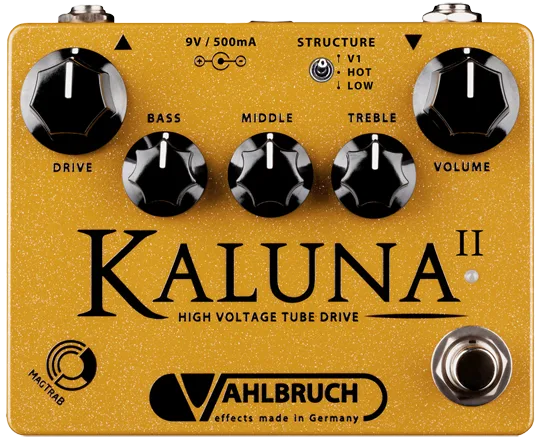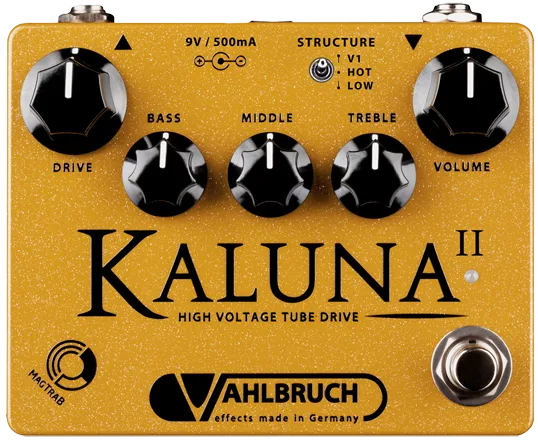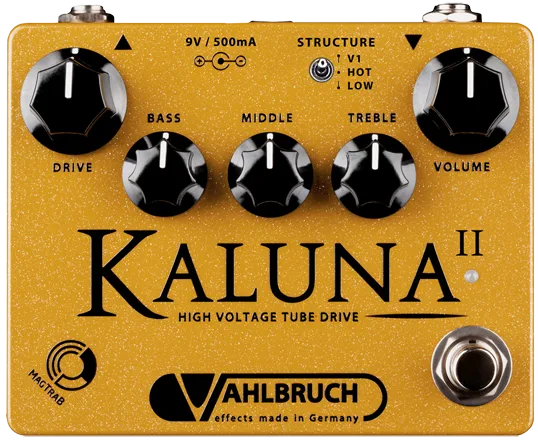


The Vahlbruch KALUNA II is a high-voltage tube drive pedal, an overdrive/distortion unit handmade in Germany by Vahlbruch FX. It is built around an ECC83/12AX7 tube that the maker describes as delivering "100% pure analog tone," and unlike many tube pedals it runs that tube at a full 250 volt operating voltage, generated inside the box from an ordinary 9V power supply1. Vahlbruch positions it as a new upgraded version of the original Kaluna with more features, the biggest being a three-way Structure switch1.
Vahlbruch describes the pedal's character as "sweet harmonic content, overdrive clarity, fast pick attack response and complex compression," comparing it to cranked tube amps, transparent with great dynamics, and covering everything from mild breakup to creamy saturation1.
The controls: Drive, Volume, three-band EQ and Structure switch
The front panel keeps things familiar. You get a drive control, a volume control, and a three-band EQ that Pete Thorn, reviewing the pedal on his YouTube channel, compared to "the controls that you would find on an amplifier"2.
| Control | What it does |
|---|---|
| Drive | Sets the amount of gain2 |
| Volume | Sets the output level2 |
| Bass, Middle, Treble | Active three-band EQ, placed after the tube, with a boost/cut range of plus or minus 12dB1 |
| Structure | Three-way switch: V1, Hot, Low1 |
The EQ is worth a closer look for players comparing circuits. It sits post-tube, meaning it shapes the signal after the tube stage has done its work, and Vahlbruch calls it "extremely responsive"1. Guitar World's reviewer, covering the Kaluna line, called it "a powerful three-band EQ, Bass, Middle and Treble, each with up to 12dB of cut and boost" offering plenty of shaping range3, and Guitar Player's review of the original Kaluna noted the same post-tube active design with 12dB of boost and cut4. That much cut and boost is amp-tone-stack territory, more than most overdrive pedals offer.
The Structure switch is the headline feature of version II. It has three positions1:
- V1: the gain structure of the first Kaluna. Thorn described it as "kind of like the gain range of the original version"2.
- Hot: a higher gain mode2.
- Low: a lower gain mode, which Thorn said "sounds awesome"2.
Guitar Pedal X's coverage spells out the same three voicings as V1 (original/stock), Hot (higher gain) and Low (lower gain)5, and Delicious Audio's write-up describes the switch the same way, letting you choose between the familiar V1 gain structure and the two new modes6.
Power: 9V, 500mA, with a 250V tube supply inside
The Kaluna II requires an external regulated 9V power supply delivering 500mA, with the polarity positive at the ring and negative at the tip1. The adapter is not supplied3. There is no battery option; the 500mA draw alone rules that out.
The interesting engineering is inside. The tube's 250 volt operating voltage is generated within the pedal from the standard 9V input1, which is what separates a high-voltage tube design from the low-voltage tube stages in many compact pedals. Guitar Pedal X's news piece describes the same arrangement, the 250 volts produced from a 9V line5.
Version II adds an overvoltage protection circuit that prevents damage to the tube if a power supply with more than 9V is accidentally connected1. Guitar Pedal X describes it as safeguarding the pedal against supplies exceeding the 9V maximum5. The protection does not change the requirement: the pedal still needs a regulated 9V, 500mA supply.
Kaluna II versus the first Kaluna
The original Kaluna launched in June 2020 as a 100% analog overdrive/distortion pedal based on a 250-volt ECC83/12AX7 double triode with an active three-band tone control and Vahlbruch's MagTraB footswitch. The core recipe is unchanged in version II: same tube, same high-voltage approach, same EQ concept.
What version II adds:
- The three-way Structure switch, giving you the original V1 gain structure plus higher and lower gain modes15.
- The overvoltage protection circuit for the tube1.
Everything else carries over. The MagTraB switching technology, in which a magnet is measured by a sensor and audio switching is done by a gold-plated relay, is still on board1, as is the power-up programming that lets you choose true bypass or on mode in four steps1. Input impedance is 1.0M Ohms and output impedance is 100 Ohms1.
What reviewers said
Pete Thorn's review video covers the pedal's practical uses, and his verdict on where it fits is worth quoting directly2:
"Great in front of a clean amplifier. Great for preamping an amplifier that's already dirty. kind of adding almost like a"
In other words, he found it works three ways: into a clean amp as the dirt source, in front of an already dirty amp as a preamp-style shaper, or as a primary dirty amp channel altogether2.
Thorn's demo walks through the control set and the three Structure modes, including his favorable take on the low gain setting2.
Where it is made and how to get one
The Kaluna II is handmade in Germany by Vahlbruch FX1. Guitar Pedal X reported it as available to order from the Vahlbruch Effects webstore and at selected international dealers5. The maker's listed prices are $372 in the USA and 339 € including VAT in the European Union, as of 20251.
Videos
Alberto Barrero
EytschPi42
Brett Kingman
Questions
Does the Vahlbruch Kaluna II have a real tube?
Yes. The Kaluna II is built around an ECC83/12AX7 double triode tube, and Vahlbruch FX describes the pedal as 100% pure analog. The tube runs at a 250 volt operating voltage that is generated inside the pedal from a standard 9V power supply, rather than the low voltages many tube pedals use.
What power supply does the Kaluna II need?
It requires an external regulated 9V power supply with 500mA of current, with the polarity positive at the ring and negative at the tip. The supply is not included. The tube's 250 volt operating voltage is generated inside the pedal from the 9V input, and an overvoltage protection circuit guards against supplies above 9V.
Is the Kaluna II true bypass?
It can be. In four steps at power-up you can program the pedal to start in true bypass mode or in on mode, so the choice is yours. Audio switching is handled by a gold-plated relay as part of Vahlbruch's MagTraB switching technology, in which a magnet is measured by a sensor.
Can the Kaluna II be used as a preamp in front of a dirty amp?
Yes. Reviewer Pete Thorn found it great in front of a clean amplifier, great for preamping an amplifier that is already dirty, and usable as a primary dirty amp channel overall. Its active three-band EQ with plus or minus 12dB of boost and cut gives it the shaping range of an amp's tone stack.
Where is the Kaluna II made?
It is handmade in Germany by Vahlbruch FX, a effects maker based in the country. The company lists the pedal as available to order from its own webstore and through selected international dealers.
Sources (6)
- Vahlbruch, Vahlbruch FX, 2025
- AWESOME REAL TUBE DRIVE AND ANALOG DELAY TONES! Vahlbruch Kahluna II and Spacetime Tap V2, YouTube (Pete Thorn channel), 2025-05-27
- Vahlbruch Kaluna Tube Overdrive, SpaceTime Tap & Quantum Compressor review, Guitar World, 2020-08-25
- Vahlbuch Kaluna High Voltage Tube Drive Review, GuitarPlayer (www.guitarplayer.com), 2021-01-14
- Guitar Pedal X, Guitar Pedal X, 2024-11-28
- Vahlbruch Kaluna II Tube Overdrive, Delicious Audio, 2024-12-24