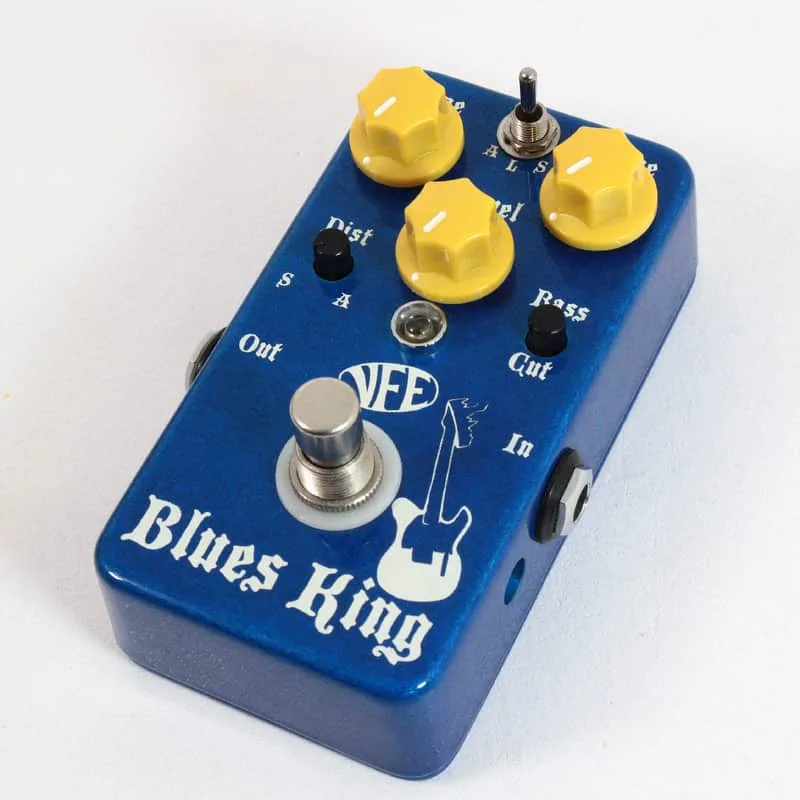


The VFE Blues King is a low-gain overdrive pedal from VFE Pedals, a small family business that built its pedals by hand in Pennsylvania1. VFE describes it as a tool for sculpting low-to-mid gain tones and pushing an amp into its sweet spot, with an EQ curve designed to avoid the tone-masking flaws of many overdrive pedals2. Delicious Audio's reviewer called it a "low-gain" distortion pedal that "actually has plenty on tap"1.
What it does to your sound
The Blues King runs two gain stages, and the DRIVE knob sets the gain of both the pre-gain and main gain stages at once, with a taper aimed at fine-tuning low-gain drive tones2. The pre-gain stage's bass response is set by the BASS knob, which is actually a bass cut: turning it clockwise cuts bass to keep the bottom end tight and punchy through the clipping stages2. A passive treble cut follows, smoothing grit from the two drive sections2.
What sets the Blues King apart from most low-gain overdrives is its adjustable clipping. The SOFT and HARD knobs use what VFE calls variable HCC circuitry to tailor the character and compression of the drive, moving between symmetrical and asymmetrical clipping and blending the characteristics of silicon and germanium diodes21.
The controls
| Control | What it does |
|---|---|
| Level (100kA) | Sets output volume; in version 3 can add an additional 9dB of boost2 |
| Drive (100kB) | Sets gain of both pre-gain and main gain stages, tapered for low-gain fine-tuning2 |
| Tone (25kB) | Simple treble cut; pulling it back smooths the top end and increases bass cut for a mid-boosted drive tone2 |
| Bass (500kA recommended) | Bass cut; clockwise cuts bass to keep the bottom end tight through the clipping stages2 |
| Soft (w20kC) | Transitions between asymmetrical clipping (counterclockwise), symmetrical clipping (clockwise) and diode lift at 12:002 |
| Hard (1MB) | Transitions between asymmetrical germanium clipping (clockwise) and symmetrical silicon clipping (counterclockwise); 12:00 removes clipping2 |
| IMP (1M internal trim) | Sets input impedance of the first gain stage; up for passive pickups, down for active2 |
The SOFT knob's positions each have a distinct character. Asymmetrical yields the most compression, distortion and even harmonics; symmetrical gives dynamic clipping; and at 12:00 the diode lift removes all clipping components, turning the stage into a clean boost2. The HARD knob moves from smooth germanium drive clockwise to biting silicon clipping counterclockwise, with 12:00 again removing the compression2. The w20kC pot for SOFT is a 20k pot with a center detent, included with the board2.
Clean boost setup
To use the pedal as a full-range clean boost, set TONE clockwise and BASS counterclockwise, with HARD and SOFT both at 12:002.
Power and the internal circuit
The Blues King starts with a simple unity-gain buffer whose input impedance is set by the internal IMPED trimpot2. Higher input impedance gives more top end sparkle when the pedal is tied directly to a guitar with passive pickups2.
The circuit uses a single-rail power supply rather than split-rail, so no charge pump is needed on the switching board2. It can run at up to 18V, and the build documentation reports a measured 9.42V DC on a One-Spot supply2. The clipping diodes are BA282 (4) or MA856, 1n914 (2) and 1n34a (3); the MA856 is hard to find, and the suggested substitute is the BA2822. In the second gain stage, R12 and R13 are two 470k resistors in parallel, approximating an odd-ball value of 235k2.
DIY notes
The PCBs are the actual boards used to build the discontinued VFE line, provided for DIY use2. The project is for DIY use only and may not be used commercially, including the sale of completed pedals or kits2.
A few points from the build documentation worth knowing:
- Use the component values listed on the image, not the values on the PCB's silk-screen; some values changed over the VFE product cycles2.
- The 500kA pot is recommended for the bass control; the PCB image shows 100kA, which the document's author believes is an error2.
- The original w1MC pot is no longer available; a 1MB pot works instead, differing only in lacking a center detent and having a different taper around center, with the same range of tones available2.
- Put a jumper in the "JUMP" component and leave the "9V" component empty2.
- Either wired or PCB-mounted jacks can be used2.
- The shopping list covers the audio board only; the v.2 Switching Board document covers the switching parts2.
The build documentation's author suggests not building the "Burn" version: high gain settings caused oscillation in his build. Peter of VFE suggests a 100kC drive pot for the Burn version, which reaches higher gain settings more quickly than a 100kB2.
What reviewers said
Delicious Audio reviewed the Blues King in 2012, noting its symmetrical and asymmetrical soft clipping and the ability to blend the distortion characteristics of silicon and germanium diodes1. The reviewer's honest caveat on all that flexibility:
"Unless you're really listening for differences between one type of distortion and another, it's hard to tell symmetrical and asymmetrical soft clipping apart"
Videos
ProGuitarShopDemos
ProGuitarShopDemos
JetCityMusic
Questions
Is the VFE Blues King discontinued?
Yes. The Blues King was part of a line of VFE pedals that has been discontinued, and VFE has stated it will close down at the end of 2026 while continuing repair service indefinitely. The PCB and build documentation remain available for DIY use.
Can the Blues King be set up as a clean boost?
Yes. Set the TONE control clockwise and the BASS control counterclockwise, with HARD and SOFT both at 12:00. At 12:00 the clipping sections are lifted, so the stage acts as a clean boost. In version 3 the Level control can add an additional 9dB of boost.
What op-amp does the VFE Blues King use?
The build documentation lists two JRC4580 op-amps, specified as 4580D or 4580DD. The pedal runs a single-rail design rather than split-rail, so no charge pump is needed on the switching board.
Can I sell pedals built from the VFE Blues King PCB?
No. The project is intended for DIY use only and may not be used in any commercial endeavor, including the sale of completed pedals or kits. Building one for yourself is fine.
What does the IMPED trimpot do on the Blues King?
The internal IMP trimpot (1M) sets the input impedance of the first gain stage. Set it all the way up for passive pickups and turn it down for active pickups. Higher input impedance gives more top end sparkle when the pedal is tied directly to a guitar with passive pickups.
Sources (2)
- Pedal Review: VFE Blues King, Delicious Audio, 2012-11-14
- Microsoft Word, madbeanpedals.com, 2019