

The Walrus Audio Emissary is a parallel dual boost pedal: two independent boost circuits run side by side inside one box, and you can blend them to taste1. One is a clean, high-headroom JFET boost with a slight emphasis on higher frequencies; the other is a midrange boost whose center frequency is switchable between 800Hz and 1kHz2. Walrus Audio, the Oklahoma-based boutique maker, pitched it as a tool to make leads stand out, make slides sing, bring fingerpicking to life, and push tube amps into natural breakup23.
The pedal is discontinued and no longer available from the maker2. It was released on 18 June 2018 at a preorder price of $1694, and Premier Guitar still listed its street price as $169 in a 2023 review5.
Two boosts in parallel: bright and mid
Most boost pedals give you one circuit and one knob. The Emissary's idea is to run two boosts at once, in parallel, so each contributes its own character and you set the balance between them21. Guitar.com's reviewer described the topology as "two boost circuits running in parallel, one JFET with the emphasis on higher frequencies, one focused on the midrange, that can be blended to taste"1.
The bright side is the clean one. Walrus Audio describes it as "a clean, high headroom JFET boost, with a slight emphasis on higher frequencies to liven up your tone"2. Gearnews noted that this high-headroom JFET design "should be a valuable tool when you need to rise above the rest of your band, perfect for your solos"6.
The mid side is a targeted boost rather than a full-range lift: it pushes a specific band, with the toggle switch selecting whether that band centers at 1kHz or 800Hz278.
The controls and the 800Hz/1kHz switch
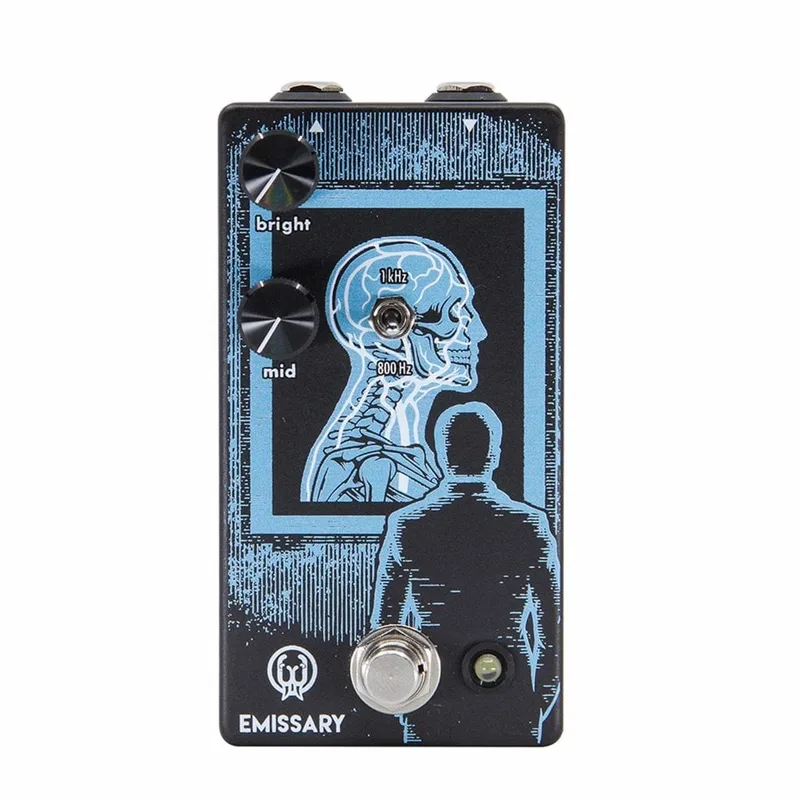
The control set is minimal: two knobs and one toggle1.
| Control | What it does |
|---|---|
| Bright knob (top) | Volume for the "bright" JFET boost circuit25 |
| Mid knob (bottom) | Volume for the "mid" boost circuit25 |
| Toggle switch | Selects the mid boost's target frequency: 1kHz or 800Hz31 |
The single footswitch handles bypass, with a momentary trick built in. When the switch is in the off position, press and hold to temporarily activate the effect; releasing the switch turns the effect off again2. Premier Guitar's reviewer explained the appeal: "The on/off stomp switch is a soft-relay, non-latching type, which offers the bonus function of momentary operation so you can add a dose of boost for a quick passage and get back out without clicking twice"5. A quick click gives you normal latching stomp-on and stomp-off behavior5.
The Emissary runs on 9V DC only, at 100mA minimum, with no battery option21. Walrus Audio recommends an isolated power supply rather than a daisy-chained solution5.
How the two boost circuits sound
What the circuits do to a rig comes from the reviewers who played them. Guitar.com's Richard Purvis found the bright boost is not a treble booster in the old sense: "this is really a full-range level-lifter with some added zing, rather than a pure treble booster"1. That makes it usable as a general volume lift for solos, with the high-frequency tilt keeping the top end lively.
The mid boost behaves differently at its two settings. At 1kHz, Purvis heard "a strongly mids-focused sound that has a likeable character of its own, especially with overdrive"1. Flipping to 800Hz pushes the emphasis lower and narrower; in his words, "now we really do get the sound of a wah pedal stuck at halfway"1. Players who want a vocal, cocked-wah style cut for leads may find that 800Hz position is the whole point of the pedal.
Premier Guitar's 2023 review put both sides to work through a Gibson 1958 Les Paul reissue, a Novo Serus J with P-90s, a tweed Deluxe-style combo, and a Friedman Small Box head with a 2x12 cab, and found the Emissary "proved superb in several applications"5. The reviewer's overall verdict:
"A surprisingly versatile yet simple boost pedal, great for both nudging your tube amp into overdrive and helping solos cut through an already sizzling lead channel."
Guitar.com's take was similar on versatility, with one caveat about flexibility: "You're not getting the flexibility of a fully parametric booster here, but it's surprising how much ground you can cover with such minimal controls"1.
Where the name and artwork come from
The name is anatomical. The Emissary is named for the emissary veins, "certain veins that pass through the skull and connect the venous sinuses inside with the veins outside"6. Guitar.com put it more bluntly: the pedal is "named for the veins that connect the inside and outside of the skull"1.
The artwork carries the theme through. Illustrator Adam Forster drew an x-ray of a patient's skull viewing the Emissary and other vital veins running through the head, printed in light blue and white ink on a Silk Satin Black die-cast enclosure29.
Where it sits among boost pedals
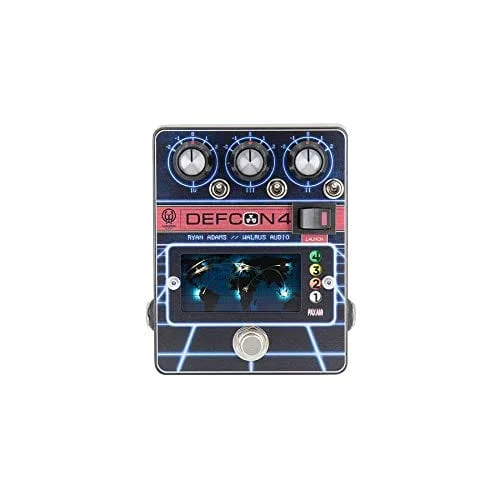
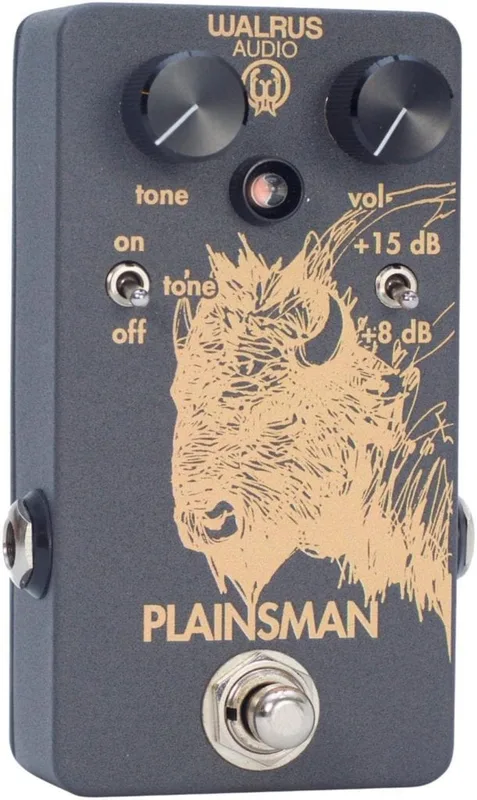
For a player comparing boosts, the Emissary's distinguishing feature is the parallel layout: instead of choosing between a clean full-range boost and a mid push, you get both at once and blend them21. The trade-off, as Guitar.com noted, is that the two fixed voicings and one frequency switch give less tone shaping than a parametric booster1. If you are weighing other Walrus Audio options in the same territory, the company also built the DEFCON4 EQ and boost pedal and the Plainsman clean boost. For more on the category generally, see boost pedals.
Since the Emissary is discontinued2, it is now a secondhand-market pedal, and its $169 launch price from June 20184 is the last official figure on record.
Videos
Premier Guitar
Premier Guitar
Premier Guitar
Questions
Is the Walrus Audio Emissary true bypass?
Yes. The Emissary is a true bypass pedal, so with the effect off your signal passes through without active circuitry in the way. The bypass switch is a soft-relay type rather than a mechanical true bypass switch, and it also offers a momentary function for quick boosts.
Can the Walrus Audio Emissary run on a battery?
No. The Emissary is powered by a 9V DC supply only, with no battery option. Walrus Audio specifies 9VDC at 100mA minimum, and the original review noted it runs on a 9V mains supply that is not included with the pedal.
Where does the name Emissary come from?
The pedal is named after the emissary veins, the veins that pass through the skull and connect the venous sinuses inside the head with the veins outside. The artwork by illustrator Adam Forster follows the theme, showing an x-ray of a patient's skull with the Emissary and other veins running through the head.
Is the Walrus Audio Emissary made in the USA?
Yes. The Emissary was made in the USA by Walrus Audio, the boutique pedal maker based in Oklahoma. It shipped in a die-cast enclosure finished in Silk Satin Black with light blue and white ink.
Does the Emissary footswitch have a momentary mode?
Yes. With the bypass switch in the off position, press and hold to temporarily activate the effect; releasing the switch turns the effect off. A quick click works as a normal stomp-on and stomp-off, so you can add a short burst of boost without clicking twice.
Is the Walrus Audio Emissary discontinued?
Yes. Walrus Audio lists the Emissary Parallel Boost as discontinued and no longer available. It was released on 18 June 2018 at a launch price of $169, so remaining units are found only on the secondhand market.
Sources (9)
- Walrus Audio Emissary Review, Guitar.com, 2018-09-24
- Emissary Parallel Boost, Walrus Audio
- Emissary Parallel Boost by Walrus Audio, RockBoard PedalPedia, 2026
- Walrus Audio introduces Emissary Parallel Boost pedal, MusicRadar, 2018-06-12
- Walrus Audio Emissary Review, Premier Guitar, 2018-08-24
- Walrus Audio Emissary Parallel Boost: 2 boost circuits in one pedal, gearnews.com, 2018-06-13
- Walrus Audio Emissary Parallel Boost, Delicious Audio, 2018-06-13
- Walrus Audio Emissary Parallel Boost, Guitar Interactive Magazine, 2018-06-12
- Walrus Audio Introduces the Emissary Parallel Boost, Premier Guitar, 2018-06-11