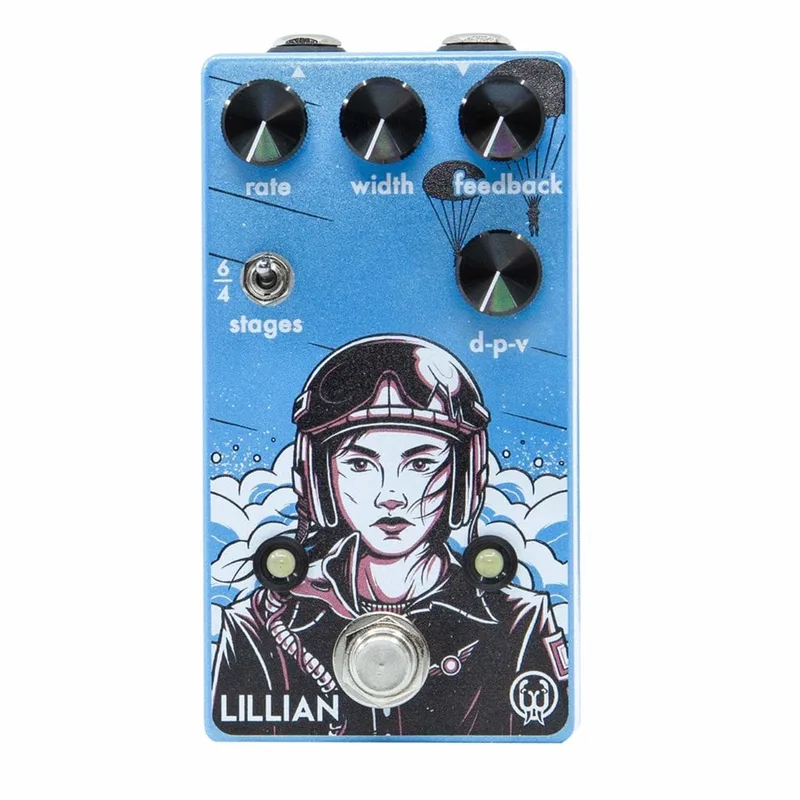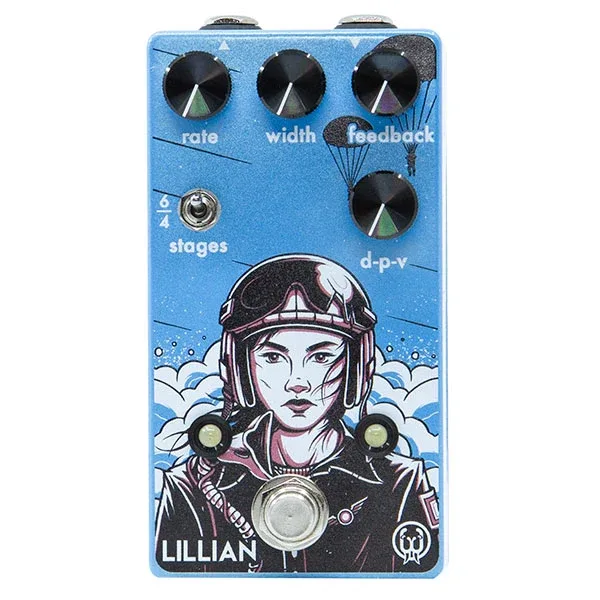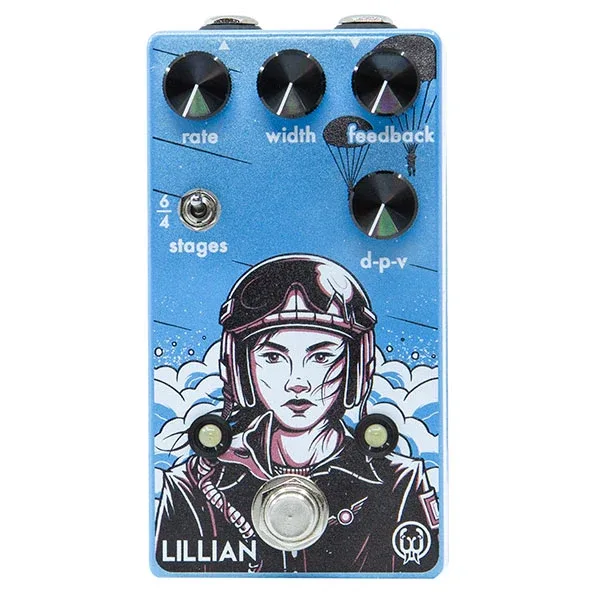


The Walrus Audio Lillian Multi-Stage Analog Phaser is a true bypass, all-analog multi-stage phaser pedal that Walrus Audio describes as "drawing inspiration from her cousin Julia," the company's chorus/vibrato pedal12. A "Stages" switch selects 4 or 6 phasing stages, which the maker says alters the overall voice of the effect, and a D-P-V blend knob mixes dry, phase shifted, and vibrato sounds in one control2.
The pedal debuted at NAMM in January 2019 and retailed at $199 at launch3. Walrus Audio has since discontinued it: the maker's product page states it is discontinued and no longer available, and a blemished variant listed on the site is sold out12.
The Lillian is discontinued and no longer available from Walrus Audio1. A blemished variant, with cosmetic-only flaws such as scratches or dents in the finish, was listed as sold out2.
What it does: 4- or 6-stage phasing with a vibrato blend
A phaser splits your signal and shifts the phase of one copy through a chain of stages, then recombines the two, producing the moving notches that give the effect its sweep. The number of stages shapes that character. On the Lillian, the "Stages" switch lets you select 4 or 6 stages, and Walrus Audio says each setting changes the overall voice of the effect245.
The maker and the press describe the two settings differently. Walrus Audio's page says the switch moves from warm and tight phasing with 4 stages to a more complex filtered sound with 62. Gearnews, reporting at launch, said the opposite pairing: "The 6-stage setting is warmer and tighter whilst the 4-stage sound is more complex phase"4.
The other half of the pedal's character is the blend knob. The D-P-V knob lets you blend between dry, phase shifted, and vibrato sounds, which Walrus Audio says gives a wide range of control over the intensity and type of effect2. At minimum you hear no effect, at noon you get equal parts dry and wet, and at maximum the output is 100% wet, which produces pitch vibrato2. That maximum setting effectively turns the pedal into a vibrato, the same trick the Julia uses with its dry, chorus, and vibrato blend2.
Controls
| Control | What it does |
|---|---|
| Rate | Sets the speed of the phase sweep2 |
| Width | Sets how wide the sweep travels2 |
| Feedback | Sets the intensity and resonance of the effect2 |
| D-P-V blend | Blends dry, phase shifted, and vibrato; minimum is no effect, noon is equal dry and wet, maximum is 100% wet pitch vibrato2 |
| Stages switch | Selects 4 or 6 phasing stages, altering the overall voice of the effect2 |
The D-P-V knob is the same concept as on Walrus' Julia Chorus/Vibrato pedal, as Pedal of the Day noted at launch5. Gearnews reported the blend points labeled d-p-v on the pedal itself4.
Power, size, and connections
The Lillian runs on 9VDC with a 30mA minimum draw2. The input, output, and power jack are all top-mounted, which Gearnews highlighted at launch and which suits tight pedalboards with side-by-side placement4. The enclosure is diecast and measures 4.77" x 2.9" x 2.3"2.
On bypass, the maker's page lists the pedal as True Bypass2, while Gearnews described it as having soft switch relay bypassing4. The two accounts disagree, and both date from the same product.
Where it came from
Walrus Audio announced the Lillian at NAMM in January 20193. Gearnews called it "a (sort of) cousin to its popular Julia pedal"4, and the maker's own description leans on the same family link, calling the Lillian a phaser "drawing inspiration from her cousin Julia"21. The borrowed feature is the blend between dry and wet signals, adapted from the Julia's dry, chorus, and vibrato blend into dry, phase shifted, and vibrato2.
The name has its own story. Pedal of the Day reported that the pedal is inspired by the story of Lillian Yonally, a female pilot who flew as a member of the W.A.S.P. program during WWII5.
What reviewers said
Pedal of the Day reviewed the Lillian in April 2019 as one of three new Walrus pedals covered during its "Walrus Week," and its verdict was positive:
"the Lillian Phaser is mesmerizing, ambitious and intense all at once, and adds a great flavor to any rig"
Pedal of the Day, April 20195
Lillian and Julia
The Julia is a chorus/vibrato pedal; the Lillian is a phaser. The difference in the effect itself is the core distinction: chorus and vibrato work with delay-based modulation, while a phaser uses phase shifting through its stage chain. What the two pedals share is the blend architecture. Walrus Audio states plainly that "the unique blend between Dry, Chorus and Vibrato has also been provided on the Lillian," reworked as Dry, Phase Shifted, and Vibrato2. A player who knows the Julia's blend knob will find the Lillian's D-P-V control familiar, with the maximum wet setting producing pitch vibrato on both pedals2.
For players shopping the phaser category today, the Lillian sits among phaser pedals as an all-analog, blend-equipped option that is now discontinued12, while Walrus Audio's later Fundamental Phaser covers the bread-and-butter end of the maker's range.
Videos
Pete Thorn
Premier Guitar
walrusaudioeffects
Questions
Is the Walrus Audio Lillian discontinued?
Yes. Walrus Audio states that the Lillian is discontinued and no longer available. A blemished variant listed on the maker's site is also sold out. The pedal debuted at NAMM in January 2019 and retailed at $199 at launch, so remaining units are found on the used market.
What does the D-P-V knob do on the Lillian?
The D-P-V knob blends between dry, phase shifted, and vibrato sounds. At its minimum you hear no effect, at noon you get equal parts dry and wet, and at maximum the signal is 100% wet, which produces pitch vibrato. Walrus Audio borrowed this blend concept from its Julia chorus/vibrato pedal.
How much current does the Walrus Lillian draw?
Walrus Audio lists the power requirement as 9VDC with a 30mA minimum draw. That is modest by modern pedal standards and easy to run from a standard isolated power supply, though the maker gives no battery option.
Is the Walrus Lillian true bypass?
Walrus Audio's product page lists the Lillian as true bypass. Gearnews, reporting on the 2019 launch, described it as having soft switch relay bypassing instead. The two sources disagree on the bypass design, so players comparing used units may want to verify with the seller.
What is the difference between the Walrus Lillian and Julia?
The Julia is a chorus/vibrato pedal, while the Lillian is a phaser. Walrus Audio describes the Lillian as drawing inspiration from its cousin Julia, and the main borrowed feature is the blend between dry and wet signals, here dry, phase shifted, and vibrato rather than dry, chorus, and vibrato.
Sources (5)
- Lillian Multi-Stage Analog Phaser, Walrus Audio
- Lillian Multi-Stage Analog Phaser, Walrus Audio
- NAMM 2019: Walrus Audio debuts the Lillian Multi-stage Analog Phaser, Guitar.com, 2019-01-26
- NAMM 2019: Walrus Audio debuts Lillian Analog Multi-Stage Phaser, gearnews.com, 2019-01-21
- Walrus Audio Lillian Multi-Stage Analog Phaser, Pedal of the Day, 2019-04-04