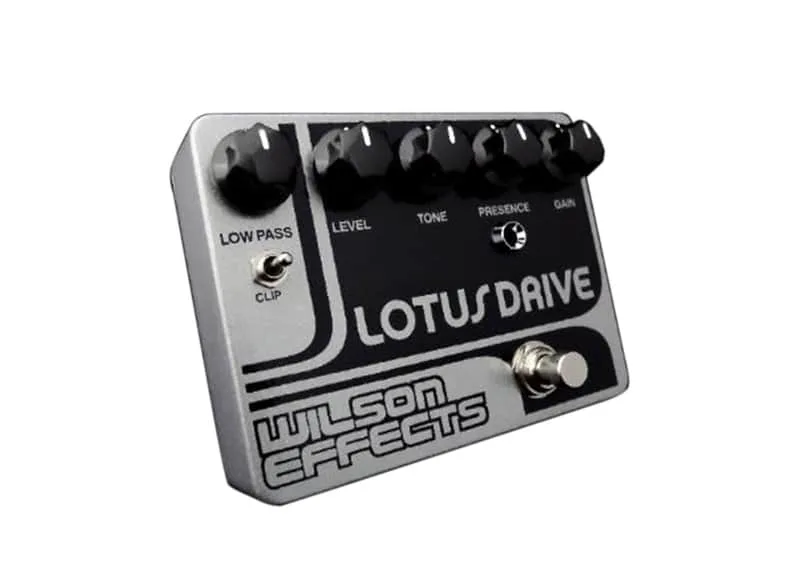


The Wilson Effects Lotus Drive is a D-style overdrive pedal: a compact stompbox voiced after the hand-built Dumble amplifiers that players chase for their smooth, touch-sensitive overdrive. Wilson Effects, a small builder working out of Guilford, Indiana, describes it as capturing "one of the most sought-after overdriven tones" and enhancing it with extra tonal flexibility, chiefly a three-position clipping switch and a post-circuit low-pass filter1.
The maker sums up its range like this:
"Crystal clear cleans to a light overdrive to searing leads when pushing an amp. All the Dumble you need in a compact package1!"
Wilson Effects product page1
What D-style means here
"D-style" points at Dumble amplifiers, the low-production amps whose overdrive channels became the reference point for a whole family of pedals. On the Lotus Drive, Wilson Effects says the gain control goes "from a clean boost with the dynamics of a D-style amp to a nice rounded overdrive tone"2. In practice that means moderate gain with touch response rather than high-gain saturation: the maker positions it as "a lighter D-style overdrive pedal" that will not alter the dynamics of the circuit2.
Delicious Audio, in a 2024 round-up of Dumble-style pedals, grouped the Lotus with the maker's other D-style offerings and noted its gain and volume controls plus a three-band EQ of Tone, Presence and Low Pass3.
The controls
The Lotus Drive carries five knobs and a switch. Here is what each does, per the maker's own descriptions12:
| Control | What it does |
|---|---|
| Gain | Ranges from clean boost to rich, dynamic overdrive |
| Volume | Standard output level control |
| Tone | Shapes the overall EQ balance of the pedal |
| Presence | Shapes the overdriven frequencies; works with the gain control in sculpting the tone |
| Low-Pass | Post-circuit filter that trims high end after the overdrive stage |
| Clipping switch | Selects standard clipping, clipping removed, or LED clipping |
The Presence control is worth a note for players used to simpler overdrives: Wilson Effects says it shapes "the overdriven part of the circuit" and tends to work in conjunction with the gain knob, so it is not a plain treble control2.
The clipping switch: standard, removed and LED
The three-position toggle changes how the overdrive stage clips the signal, which alters headroom and response4. The maker describes the three positions as1:
- Standard Clipping: classic response, the stock diode-clipped voice.
- Clipping Removed: increased headroom, opening up the circuit for a cleaner, more open feel.
- LED Clipping: a punchy, dynamic drive, which the maker calls "a personal favorite."
Because the switch sits on the clipping stage itself, it effectively gives you three overdrive voices in one pedal without touching the knobs1.
The low-pass filter
The Low-Pass knob is the other feature that separates the Lotus Drive from a basic D-style clone. It works after the overdrive circuit rather than before it, so it shapes the finished signal. Wilson Effects says it "lets you fine-tune the high-end, even with all other controls maxed out"1: you can push Tone and Presence hard for maximum gain character and then roll off the harshness afterward4. For players who find D-style circuits bright through a clean amp, that is the control aimed at the problem.
Versions: Lotus Drive V2 and Dual Lotus Drive
The Lotus Drive is available in two main forms. The current Lotus Drive V2 page lists the same $150.00 USD price and the same control set, with the added tone control and low-pass filter described as the V2's additions over the original2.
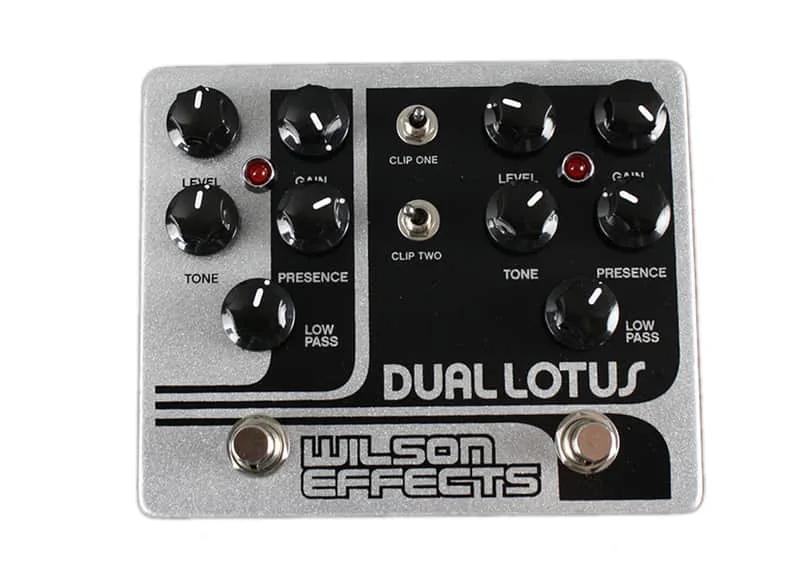
The Dual Lotus Drive puts two D-style channels in one enclosure. Wilson Effects describes it as "two channels of moderate gain, D-style overdrive stacked into one another," with Level, Grit, Tone and Presence controls on each channel, its own three-position clipping switch per channel, and its own post-circuit low-pass filter45. The channels can be used independently, set up for different sounds, or cascaded into one another for what the maker calls "rhythmic playing and searing leads"5. Delicious Audio notes that in the Dual Lotus each channel has its own input and output, which opens up routing options beyond simple stacking3. It is listed at $220.00 USD45.
| Version | Channels | List price | Notable differences |
|---|---|---|---|
| Lotus Drive / V2 | 1 | $150.00 USD12 | Clipping switch, low-pass filter, tone control |
| Dual Lotus Drive / V.2 | 2 | $220.00 USD45 | Independent or cascaded channels, per-channel clipping switch and low-pass filter, separate I/O per channel54 |
Build, warranty and buying
Wilson Effects hand-builds every unit in Guilford, Indiana, describing the Lotus Drive as "handmade in the USA, crafted with high-quality components"12. Each pedal carries a one-year warranty covering parts and labor12. Returns are accepted within 7 days of receiving the pedal, with shipping costs not refunded and return shipping the customer's responsibility2, and orders ship via USPS Priority Mail2.
The Lotus Drive runs on a 9V DC, 2.1mm center-negative supply, the industry standard used by most pedalboard power supplies12. No battery option is mentioned by the maker.
Videos
Wilson Effects
gearmanndude
JetCityMusic
Questions
What does D-style mean on the Wilson Lotus Drive?
D-style refers to overdrive circuits voiced after Dumble amplifiers, the hand-built amps known for smooth, touch-sensitive overdrive. Wilson Effects describes the Lotus Drive as capturing that sought-after tone in a compact pedal, with a gain control that goes from a clean boost with D-style amp dynamics to a rounded overdrive.
Is the Wilson Lotus Drive true bypass?
Yes. Wilson Effects builds the Lotus Drive with a true bypass circuit, which the maker says preserves your tone when the pedal is off rather than loading down your signal in bypass.
What power supply does the Wilson Lotus Drive use?
It runs on a 9V DC supply with an industry-standard 2.1mm center-negative plug, the same connector used by most modern pedals and pedalboard power supplies. No current draw figure is published by the maker.
What is the low-pass filter on the Lotus Drive for?
It is a post-circuit filter that trims high end after the overdrive stage. Wilson Effects says it lets you crank the tone and presence controls to maximize gain and then roll off unwanted highs, so you can fine-tune the top end even with everything else maxed out.
How much does the Wilson Lotus Drive cost?
The Lotus Drive and Lotus Drive V2 are listed at $150.00 USD by Wilson Effects. The Dual Lotus Drive, which puts two D-style channels in one enclosure, is listed at $220.00 USD.
Where is the Wilson Lotus Drive made?
Wilson Effects hand-builds its pedals in Guilford, Indiana, USA. The maker describes the Lotus Drive as handmade in the USA with high-quality components, and every pedal carries a one-year warranty on parts and labor.
Sources (5)
- Lotus Drive, Wilson Effects
- Lotus Drive, Wilson Effects
- Best Dumble-Style Pedals For Your Needs & Budget, Delicious Audio, 2024-09-25
- Dual Lotus Drive, Wilson Effects
- Dual Lotus Drive V.2, Wilson Effects