The WMD Geiger Counter is a digital destruction pedal that feeds your guitar into an 8-bit computer. A high gain modern preamp drives the digital stage, and WMD says the results range "from nice (tubey overdrive, lofi aliasing, hot gated leads) to total madness (impossible amounts of gain, multiple octave foldover, harsh digital data errors, and piercing sculpted noise)"1. In practice it is a bitcrusher: it reduces your signal's sample rate and bit depth and then reshapes what is left through one of 252 wave tables, each with different harmonic content1.
WMD, the maker, classifies it as a distortion/bitcrusher, and press coverage has called it a signal destroyer that anticipated the glitch pedal trend23. Total Guitar gave it a first look in March 2010, describing it as a pre-amp/distortion pedal with 8-bit computer modulation4. The pedal is still in production51.
What it does: 8-bit processing and 252 wave tables
The signal path starts with a high gain preamp, then the digital stage. Two controls do the crushing:
- Sample Rate sweeps from 260Hz to 58kHz. Lower sample rates produce lofi aliasing, where frequencies fold back on themselves2.
- Bit Depth runs from 1 to 8 bits. Full up, your signal is represented by the full 8 bits; each step down cuts the resolution in half, and at 1 bit you get what WMD calls a nasty square wave52.
After the crushing, the Wave Table stage "destroys the signal with math"5. There are 252 wave tables in all, each with different harmonic content, so the same gain and bit settings sound very different from table to table1. Mask mode logically ANDs your signal to the 8-bit number produced by the Bit Depth knob, giving another layer of mangling52.
The controls
| Control | What it does |
|---|---|
| Gain | Low settings give clean tones with no distortion; high settings brickwall the signal for sustain, and drive the wave table harder or softer16 |
| Tone | Blends muffled low-mids with chimey, clear upper mids and highs; fine tunes the harmonic content from the wave tables56 |
| Sample Rate | 260Hz to 58kHz; a red LED indicates fine mode for smaller, smoother increments at the high end2 |
| Bit Depth | 1 to 8 bits, with Mask mode25 |
| Wave Table | Knob and display select one of the 252 tables; the display reads in HEX (0 to 9 and A to F) and the selection is remembered when the pedal is off5 |
The Tone control can be disabled entirely, and the pedal always saves its settings1.
Expression and CV input
The CV Input allows control over the Sample Rate, the Bit Depth, or both simultaneously, and accepts any standard expression pedal or any 0 to 5 volt CV source12. The jack is wired with a 5.6 volt output on the ring, 0 volts on the sleeve, and the CV input on the tip2.
Use a stereo TRS cable for the CV jack. A mono cable shorts the 5.6 volt output and degrades battery life, though it will not damage the pedal2.
The Sample Rate LED doubles as a status light: green when the Key (CV) input is active, red in fine mode, yellow when both are active2.
Power and connections
Power comes from a 9V DC center negative supply, BOSS standard1. WMD's product page lists two current draw figures, 150mA and 40mA, in different spec listings, so budget for the higher figure1. Input impedance is 510k and output impedance is 1k1. New Geiger Counters use a soft touch momentary footswitch with a relay for quieter and easier actuation1.
History and versions
The Geiger Counter dates to the late aughts, when WMD released what Delicious Audio called "a seminal pedal called the Geiger Counter, some sort of signal destroyer driven by a mini-computer gone mad, which anticipated the glitch pedal trend"3. Total Guitar published a first look in March 20104.
The family has since grown:
| Version | What it is |
|---|---|
| Geiger Counter | The original, still in production, in Standard and Bass Mod versions51 |
| Geiger Counter Pro | Released in 2018 after development since 2011; 512 wavetables, 12-bit signal path, presets, MIDI, two assignable CV/expression inputs, dry/wet mix, end-of-chain low pass filter, and a RAND button for a random new setting37 |
| Geiger Counter Civilian Issue (GCCI) | A scaled down version with presets selected by a Function knob (0 to 9 and A to F); push the knob for Low Fidelity mode; handwired and true bypass62 |
| Geiger Counter Eurorack | A Eurorack module with direct input bypassing the preamp and CV control over every parameter; discontinued5 |
The Pro returned to production in a 2024 design update, in standard and limited pink versions shipping December 2024, with jacks moved slightly for ease of assembly and MIDI on Channel 1 only7. Its expression inputs take 10k to 100k linear pedals over TRS7.
What reviewers said
Delicious Audio's Gus Green reviewed the pedal in July 2024 and found it "unique and extremely interesting," adding that "the depth of control and inclusion of Control Voltage modulation is lovely"2. The same review noted the GCCI as a friendlier entry point for players intimidated by the original's vast feature set2.
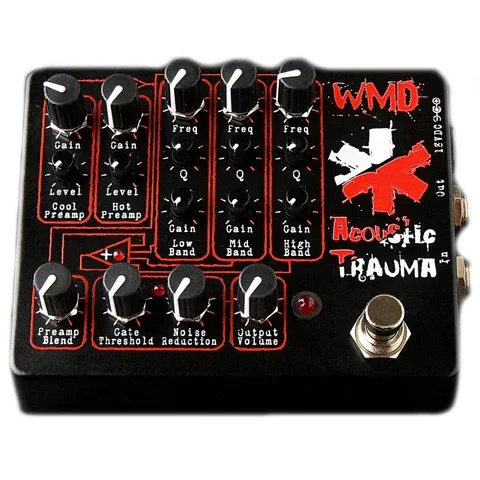
For players comparing circuits, the Geiger Counter sits apart from analog distortion, overdrive and fuzz pedals because the clipping happens in the digital domain, and the wave tables give it a range those circuits do not have. Bass players can look at the Bass Mod version alongside other bass pedals, and the CV input pairs with any expression pedal. WMD's other dirt pedal, the Acoustic Trauma, takes a different approach, and the Eurorack version brought the same engine to modular racks before it was discontinued.
Videos
ProGuitarShopDemos
gearmanndude
Dennis Kayzer
Questions
Is the WMD Geiger Counter true bypass?
Yes. The Geiger Counter uses relay true bypass with a soft touch momentary footswitch, which WMD says makes actuation quieter and easier. The pedal also always saves your settings, so it powers back up where you left it. The Civilian Issue version is handwired and true bypass as well.
Can the Geiger Counter be used on bass?
Yes. WMD sells the Geiger Counter in two versions: Standard, voiced for mid clarity, and Bass Mod, voiced for low-end clarity. The Bass Mod is the one aimed at bass players, since the standard version's wave table processing can thin out the low end.
What expression pedal works with the WMD Geiger Counter?
Any standard expression pedal, or any 0 to 5 volt CV source. The CV input lets you control the Sample Rate, the Bit Depth, or both at once. The jack puts 5.6 volts on the ring for expression pedals, so use a stereo TRS cable; a mono cable shorts that output and drains the battery faster.
What is the difference between the Geiger Counter and the Geiger Counter Pro?
The Pro, released in 2018 after development since 2011, has 512 wavetables in total (256 of them new), wavetable morphing, a 12-bit signal path, presets, full MIDI control, two assignable CV/expression inputs, a dry/wet mix and an end-of-chain low pass filter. The original stays simpler with its 252 wave tables and single CV input.
Does the WMD Geiger Counter run on a battery?
The pedal is powered by 9V DC center negative (BOSS standard) from a power supply. WMD's product page lists two current draw figures, 150mA and 40mA, in different spec listings, so plan for the higher figure on a pedalboard power supply.
Sources (7)
- Geiger Counter, WMD (wmdevices.com)
- WMD Geiger Counter Distortion/Bitcrusher, Delicious Audio, 2024-07-12
- WMD Geiger Counter Pro, Delicious Audio, 2019-11-25
- WMD Geiger Counter pedal: First look, MusicRadar (Total Guitar), 2010-03-09
- Geiger Counter Eurorack, WMD
- Geiger Counter Civilian Issue (GCCI), wmdevices.com
- Geiger Counter Pro, WMD (wmdevices.com), 2024