
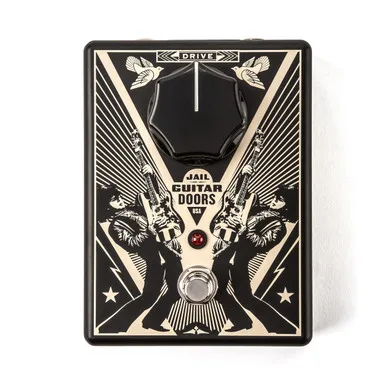

Wayne Kramer was the guitarist of the MC5, the Detroit band whose early 1970s recordings Jim Dunlop describes as capturing "the raw, gritty tones that Wayne Kramer used to upend rock 'n' roll"1. He died in February 20242. Premier Guitar describes him as a punk rock icon known for his activism, especially in justice reform, writing that "his life story embodies the defiant, DIY ethos of punk, directly inspiring generations of bands and musicians who followed"2.
Credits and gear
Kramer co-founded Jail Guitar Doors USA, a nonprofit organization, with his wife Margaret and Billy Bragg3. The charity uses instruments as tools for inmate rehabilitation4. Kramer himself spent four years in federal prison in the late '70s5.
The gear most directly tied to Kramer is the MXR Jail Guitar Doors Drive, an overdrive pedal named after his charity. Guitar World reports it "aims to capture all of the high-voltage energy of Wayne Kramer's sound"4. Kramer designed the pedal before his death, together with Jim Dunlop, Dunlop's CEO, and Daredevil Pedals owner Johnny Wator, and it features artwork from artist and activist Shepard Fairey2. Its tone fuels the title track of the MC5's final album, 2024's Heavy Lifting5.
The Jail Guitar Doors Drive was developed from Kramer's tones on MC5's early 1970s recordings, per the pedal's manual6.
News
Sources (6)
- JGD2.pdf, Jim Dunlop, 2025
- MXR Unveils Jail Guitar Doors Drive Pedal, Premier Guitar, 2025-06-04
- MXR® JAIL GUITAR DOORS DRIVE, Jim Dunlop (jimdunlop.com)
- MXR bottles Wayne Kramer's tone into the Jail Guitar Doors Drive, Guitar World, 2025-06-03
- “Not just Wayne's sound but his attitude, and the grit and rawness of the MC5.” Tom Morello tests the new MXR Jail Guitar Doors overdrive designed with the late MC5 guitarist Wayne Kramer, GuitarPlayer (www.guitarplayer.com), 2025-06-03
- JGD1.pdf, Jim Dunlop, 2025
