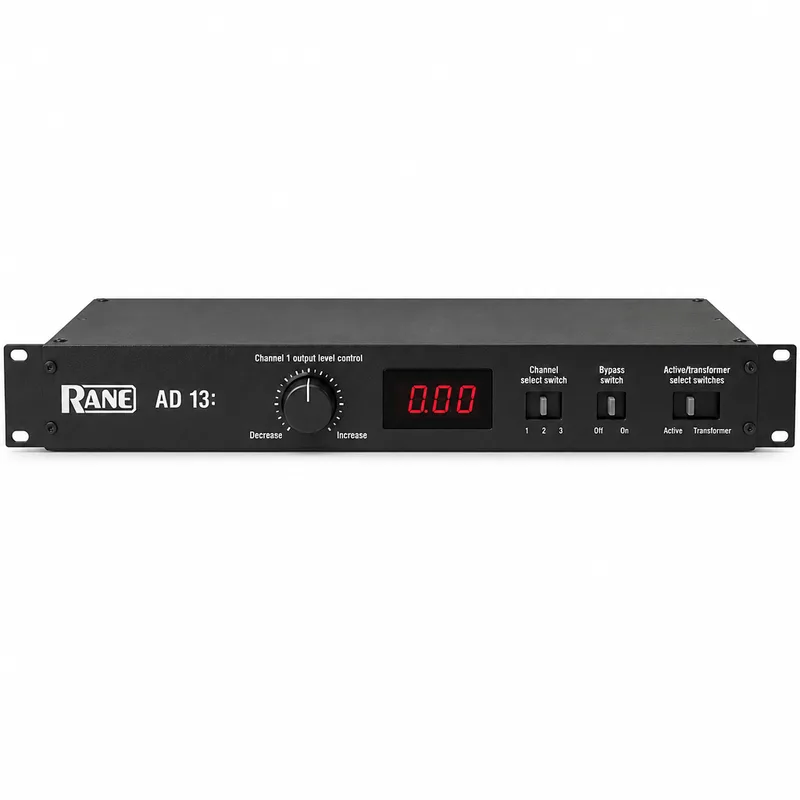
The Rane AD 13 is a rack-mount digital delay with three outputs, each of which can carry its own delay setting. It is a professional audio piece rather than a delay pedal: it lives in a rack, connects with balanced line-level wiring, and its delay range of 0 to 655ms in 20 microsecond or 1 millisecond steps suits it to installed sound work such as loudspeaker time alignment, where distances are translated into delay times. Rane describes the front panel display as showing "the amount of delay currently applied to any of the three outputs"1.
The unit is digital throughout, with a converter running at a 50kHz sample rate and a CPU operating at a 16,000,000 cycle speed1. Delay settings are held in non-volatile memory, so they survive being powered off1.
What it does
The AD 13 takes one balanced input and delivers it to three outputs, each with an independently set delay. Pressing the channel select switch advances the output channel pointer by one increment and stores the previously selected channel's delay setting in non-volatile memory, so each output keeps its own value1. Stored audio is available for recall at any 20 microsecond real time interval from 0 to 654 milliseconds after it has been stored1.
A bypass switch toggles all of the outputs between active and bypass mode at once1. The readout is a 3 digit LED with an autoranging decimal point, with an accuracy of ±5%1.
The controls
The front panel is built around a small set of controls:
| Control | What it does |
|---|---|
| Channel 1 output level control | Rotary control varying channel 1's output level from off at full counterclockwise, to unity at the center detent, to +20 dB at full clockwise1 |
| Increase button | Increases the amount of delay on the selected channel1 |
| Decrease button | Decreases the amount of delay on the selected channel1 |
| Channel select switch | Advances the output channel pointer by one increment and stores the previous channel's delay setting in non-volatile memory1 |
| Bypass switch | Toggles all outputs between active and bypass mode1 |
| Active/transformer select switches | Pressing one in places that output stage into transformer balanced mode; released, it is active balanced1 |
The increment size is 20µs or 1ms throughout the entire delay range1.
Inputs, outputs and levels
The AD 13 has a single 3-pin differential active balanced input, with pin 2 hot, pin 3 return and pin 1 signal ground, plus a barrier strip input1. The three outputs appear on both a barrier strip and 3-pin connectors, wired as differential active balanced with pin 2 positive, pin 3 negative and pin 1 signal ground1. Each output stage can be switched to transformer balanced operation instead1.
| Specification | Value |
|---|---|
| Maximum input level | +22dBu1 |
| Maximum output level | +26dBu1 |
| Input gain range | Off to +6dB1 |
| Output gain range | Off to +20dB1 |
| Input impedance | 10k ohms1 |
| Output impedance | 600 ohms balanced; 300 ohms unbalanced1 |
These are line-level figures, well above what a guitar pickup delivers directly, which is part of why the AD 13 belongs in a rack with a proper line-level feed rather than at the front of a signal chain1.
Converters and audio specifications
The AD 13 uses four converters, one A/D and three D/A, all linear pulse code modulation (PCM) types, using Philips CD data converters, running at a 50kHz oversampling conversion rate1. Filtering is handled by four 9th-order elliptic filters, one on the input and three on the outputs, with linear group delay listed among the filter features1.
| Specification | Value |
|---|---|
| Frequency response | 20-20 kHz, ±1 dB1 |
| THD + noise | less than 0.1%, 20-20kHz @ +4dBu, unity gain1 |
| Intermodulation distortion (SMPTE) | less than 0.1% @ +4dBu1 |
| Signal-to-noise ratio | 84dB minimum below +4dBu, 20kHz noise bandwidth, unity gain1 |
| Dynamic range | 90dB min, 20kHz bandwidth, any delay setting1 |
| Residual propagation delay | 190µs1 |
| Overload LED threshold | 4dB below clipping1 |
The unit is certified compliant with FCC docket 20780 Part 151 for Class A computing devices and also satisfies VDE0871 for Class A computing devices1.
Where it sits in Rane's delay line
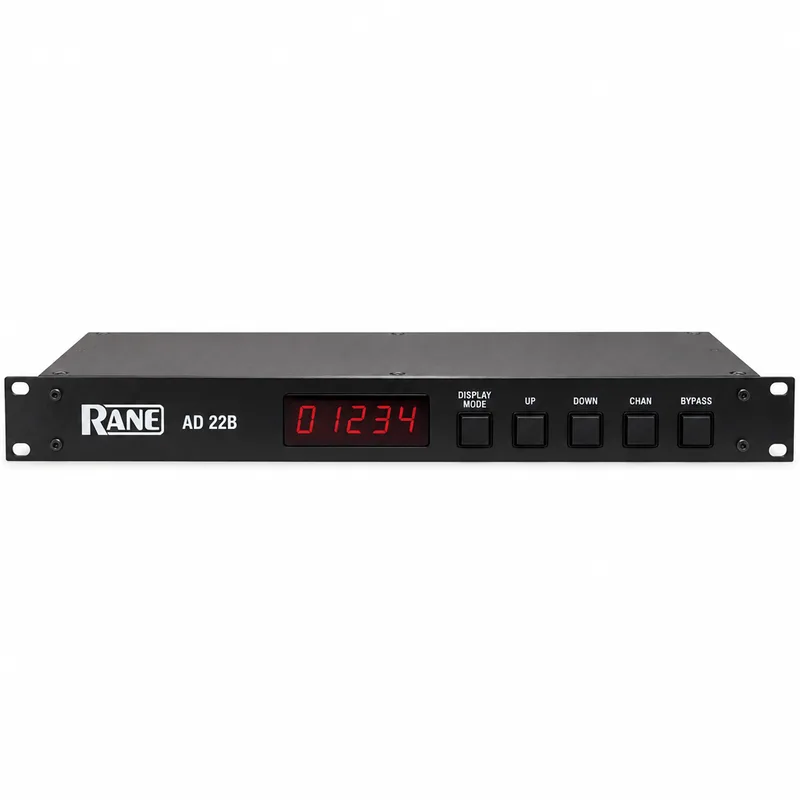
Rane's later AD 22 family covers similar ground in different packages. The AD 22B is documented as an Audio Delay housed in a single rack space, operating as two independent channels, with electronically balanced XLR inputs and outputs wired pin 2 hot per AES standards4. Internally configured as a mono device, it provides twice the single-channel delay range, 655.34 milliseconds5, a figure that matches the AD 13's 655ms ceiling. The AD 22B's Store button saves the current delay configuration into both channels' current memory, A or B, and its temperature setting changes only the displayed distance values, not the actual delay times5.
The AD 13 is a legacy product, documented through Rane's archived manuals. Its warranty, two years covering parts and labor from the date of retail purchase or from the date of manufacture without proof of purchase, is stated in the original manual1.
Questions
What is the maximum delay time on the Rane AD 13?
The AD 13's time delay range is 0 to 655ms, adjustable in increments of 20 microseconds or 1 millisecond throughout the entire range. Stored audio can be recalled at any 20 microsecond real time interval from 0 to 654 milliseconds after it has been stored.
Does the Rane AD 13 remember its delay settings when powered off?
Yes. The channel select switch stores the previously selected channel's delay setting in the AD 13's non-volatile memory, so settings survive a power cycle. Each of the three outputs keeps its own delay value.
Is the Rane AD 13 a guitar effect or a speaker delay?
It is a rack-mount digital audio delay with three outputs, built for installed and professional audio use rather than as a stompbox. Rane's AD 22 family of the same era is documented as an Audio Delay for similar duty, and the AD 13's balanced line levels and barrier strip connections point the same way.
Does the Rane AD 13 have balanced outputs?
Yes. All three outputs are differential active balanced, available on both a barrier strip and 3-pin connectors, with pin 2 positive, pin 3 negative and pin 1 signal ground. Each output can also be switched to a transformer balanced mode.
How much rack space does the Rane AD 13 take?
One rack space: 1.75 inches high by 19 inches wide, with 8.5 inches of rack depth. The chassis and front panel are all steel, and the unit weighs 8 pounds net.
Sources (5)
- AD 13 Manual, Rane Corporation, 2025
- AD 22d Manual, Rane Corporation, 2025
- ad22man, Rane Corporation, 2025
- AD 22B Manual, Rane Corporation, 2025
- ad22dat, Rane Corporation, 1998-11