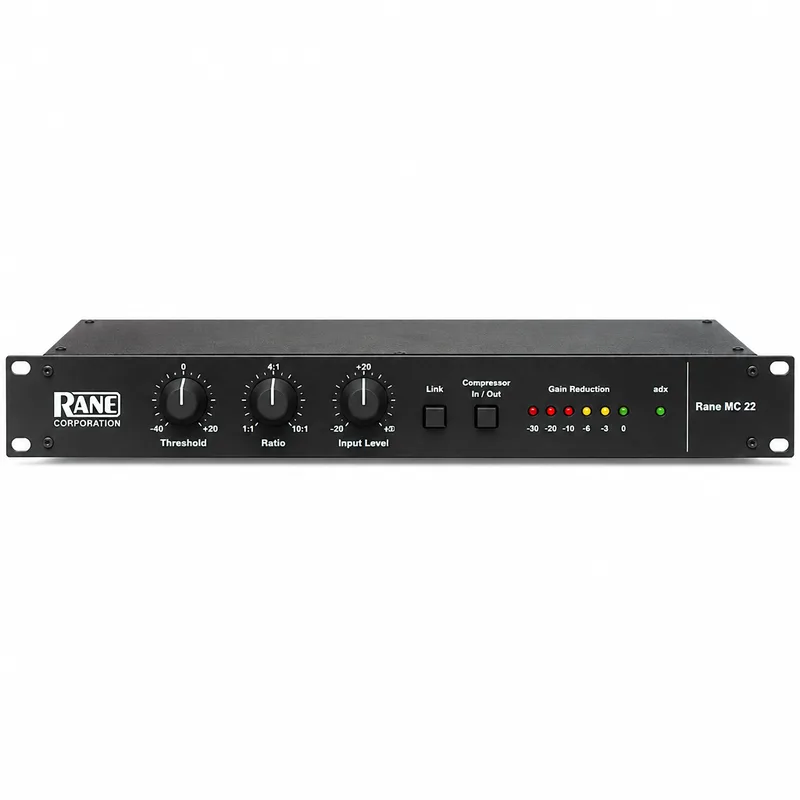
The Rane MC 22 is a two-channel stereo compressor in a single rack space, built by Rane Corporation as part of its Mojo Series. Each channel has its own compressor in/out switch, level control and gain reduction circuitry, and the two channels can run independently or be linked for stereo work. Rane's data sheet lists its applications as two-channel compressor/limiter duty, guitar and bass compression, sound system compression, driver protection, recording, and long distance line driving1.
Unlike most compressor pedals, the MC 22 has no attack or release knobs. Rane preset the attack at 30 ms per 10 dB step and designed the release to follow the program material, which the company says gives the compression a high level of transparency to the listener2. What the player adjusts is where compression starts (Threshold), how hard it squeezes (Ratio), and the overall level going in (Input Level).
What it does to your sound
The MC 22 compresses by reducing gain once the input signal rises past a Threshold you set, from +20 to -40 dBu. The Ratio control, from 1:1 to 10:1, sets how much the output changes for a given input change above that point. At 1:1 the ratio control has no effect; at 10:1, a 10 dB input increase above Threshold produces only a 1 dB output increase21. That top setting effectively makes the unit a limiter, which is what driver protection and sound system work call for.
A row of gain reduction LEDs shows the amount of average signal reduction in dB, which the manual points to as the aid for setting Threshold and Ratio2.
The unit also carries an automatic downward expander, which Rane calls adx. It works like a compressor running in reverse: when the input level drops below -55 dBu, the expander engages at a 2:1 ratio and makes the quiet parts quieter, acting like a gentle gate to keep the system quiet between notes or phrases. An adx LED lights whenever this noise reduction is active2.
Controls and how it works
Each channel offers the same small control set:
| Control | What it does |
|---|---|
| THRESHOLD | Sets the input level point at which the compressor becomes active2 |
| RATIO | Sets the ratio of input change to output change above Threshold, 1:1 to 10:12 |
| INPUT LEVEL | Controls overall level; unity gain is reached at "0"2 |
| GAIN REDUCTION LEDs | Show average signal reduction in dB, aiding Threshold and Ratio setup2 |
| adx LED | Illuminates whenever noise reduction is active2 |
| Compressor in/out | Bypass switch for each channel1 |
| LINK | Stereo-links both channels2 |
The attack and release are not on the panel. Rane made it easier, in the manual's words, "by pre-setting an attack time of 30 ms/ 10 dB step"2. The data sheet specifies the attack as 30 ms typical for a 10 dB step to settle within 2 dB, and adds that all attack and release characteristics are a function of the current program material, providing a high level of transparency to the listener1.
The Link switch and stereo use
The LINK switch is the MC 22's stereo feature. With it on, both compressors activate by the source material applied to either channel, and both channels attenuate by exactly the same amount when either compressor works, maintaining correct stereo imaging. Rane recommends this for stereo program material. With the switch off, the two channels operate independently, so one rack unit can serve two separate mono sources1.
Connections and power
Each channel accepts a balanced XLR or a balanced/unbalanced 1/4" TRS input, but only one at a time. On the output side, each channel offers a balanced XLR and an unbalanced 1/4" TS jack, and both may be used simultaneously to drive two devices2.
The MC 22 runs from its own internal power supply connected to 120 VAC, or 230 VAC where applicable, so there is no wall wart and no battery option. The 120 VAC model carries UL 6500 listing and the 230 VAC model carries CE-EMC and CE-Safety certification1.
Specifications
| Specification | Value |
|---|---|
| Compressor threshold range | +20 to -40 dBu ±2 dBu1 |
| Compressor ratio | 1:1 to 10:11 |
| Attack time | 30 ms typ., for a 10 dB step to settle within 2 dB1 |
| adx threshold | -55 dBu ±2 dBu1 |
| adx ratio | 2:11 |
| Gain | 0 dB ±0.1 dB1 |
| Input gain range | ±15 dB ±1.5 dB1 |
| Input impedance | 20k ohms, common mode each leg to ground1 |
| Maximum input level | +20 dBu1 |
| Maximum output level | +20 dBu into a 2k ohm load1 |
| Frequency response | 20 Hz to 20 kHz, +0/-.5 dB into loads above 2k ohms1 |
| THD+Noise | 0.01% typ. at 1 kHz at +4 dBu1 |
| Signal-to-noise ratio | 90 dBr typ., unity gain, re +4 dBu, 20 kHz bandwidth1 |
| Common mode rejection | 40 dB min.1 |
| Construction | All cold-rolled steel1 |
| Dimensions | 1.75"H x 19"W x 5.3"D (1U)1 |
| Weight | 5 lb (2.3 kg)1 |
The data sheet notes that 0 dBu equals 0.775 Vrms1.
Where it came from
The MC 22 is a legacy product; Rane's documentation for it now lives in the company's legacy archive. It is a line-level rack processor, not a stompbox, so it connects through XLR and 1/4" line jacks and mains power rather than a pedalboard's supply.
Questions
Can the Rane MC 22 be used for guitar or bass?
Yes. Rane's data sheet lists Guitar & Bass Compression among the MC 22's applications, alongside sound system compression, driver protection, recording and long distance line driving. It is a line-level rack unit rather than a stompbox, so it sits in a rack and connects through balanced XLR or quarter-inch TRS inputs rather than a pedalboard's power and instrument jacks.
Does the Rane MC 22 have adjustable attack and release?
No. Rane preset the attack time at 30 ms per 10 dB step, and the release follows the program material. The manual explains that the attack and release characteristics are a function of the current program material, which Rane says provides a high level of transparency to the listener. The player-adjustable controls are Threshold, Ratio and Input Level.
What does the Link switch do on the Rane MC 22?
With Link on, both compressors activate together whenever either channel's signal exceeds the set Threshold, and both channels attenuate by exactly the same amount. This preserves stereo imaging on stereo program material. With Link off, the two channels work independently, which suits using them on two separate mono sources.
What chip does the Rane MC 22 use?
Each channel uses half of an SSM 2120 compressor IC, one chip shared across the two channels, according to the schematic Rane issued in February 1998. The SSM 2120 is the gain control element around which the compressor's threshold detection and gain reduction circuitry is built.