| Type | guitar plug-in fuzz/distortion1 |
| Maker | Jordan Electronics1 |
| Debut | 1966 NAMM Show; on the market in 1967124 |
| Launch price | $29.991 |
| Status | out of production since the early seventies1 |
| Form | 1¾ by 2¼ inch molded plastic box that plugs into the guitar's output jack2 |
| Circuit | two transistors (NPN at Q1, PNP at Q2) with diode clipping15 |
The Jordan Boss Tone is a guitar plug-in fuzz/distortion: a small black plastic box that plugs directly into your guitar's output jack, with no patch cables and no pedalboard. Jordan Electronics showed it at the 1966 NAMM Show, and it reached the market in 1967 as the first commercially successful U.S. based plug-in effect12. Inside is a simple two-transistor fuzz circuit that JHS Pedals, in its history of Jordan Electronics, says "sounds really cool across the board"1.
It was cheap and everywhere. The Boss Tone was $29.99 when it first came out1, and Guitar World reports it "was probably used by four out of five garage bands in the late '60s"3. Its best known appearance is the guitar riff of Norman Greenbaum's hit single Spirit In The Sky2. Production ran until the early seventies1, and the circuit has since been copied by Dan Armstrong, Vox, Electro Harmonix and others1.
How the circuit works
The Boss Tone is a two-transistor fuzz circuit1. The two transistors are arranged as an NPN at Q1 and a PNP at Q25, a complementary pair that gives the circuit its gain. The distortion character comes from diode clipping: a stock unit uses a symmetrical diode clipping arrangement6, meaning both halves of the waveform are clipped equally, which produces the buzzy, harmonically dense fuzz the unit is known for.
The parts count is tiny, which is part of why so many builders have copied it. The madbeanpedals documentation for its FuzzyBritches build lists the full bill of materials for the circuit15:
| Part | Value |
|---|---|
| Q1 | NPN transistor |
| Q2 | PNP transistor |
| D1, D3 | 1n914 |
| D2, D4 | jumpered |
| D5 | 1n5817 |
| R1 | 150k |
| R2, R3 | 560k |
| R4, R5 | 18k |
| R6 | 4k7 |
| C1, C2, C4 | 22n |
| C3 | 47pF |
| C5 | 100uF |
| C6 | 100n |
| VOL pot | 100kA |
| ATTCK pot | 100kB |
Two details stand out for anyone building or modifying one. First, the clipping diodes in positions D2 and D4 are simply jumpered rather than populated, so the clipping comes from the remaining diode pair5. Second, the transistors are not fussy: madbeanpedals notes that "it seems there were a variety of transistors used" in original units, and its PCB is laid out in a multipin format so transistors with different pinouts are easy to use, with the center row of three pads on Q1 and Q2 connected to base5.
For comparison, later distortion designs took a different route. The Boss DS-1, for example, pre-amplifies the signal with a transistor booster and then produces all its distortion with a variable op-amp gain circuit whose diodes short the output to ground, producing hard clipping of the input waveform. The Boss Tone, by contrast, uses a simple two-transistor fuzz circuit with a symmetrical diode clipping arrangement in a stock unit781.
Controls: Attack, Volume and the on/off switch
The Boss Tone has two knobs and a switch. Guitar World describes them plainly32:
"The Boss Tone's controls are Volume and Attack, with the former operating like a master volume and the latter working like a gain control."
| Control | What it does |
|---|---|
| Volume | operates like a master volume3 |
| Attack | works like a gain control3 |
| On/off switch | toggled by hand to activate the effect2 |
That hand-toggled switch is the practical downside of the plug-in format. Because the box sits on the guitar's output jack, there is no footswitch: you reach down and flip it by hand to turn the effect on or off2. Players who want the sound in a floor pedal form have to look at the replicas and derivatives covered below.
Alhambra, Pasadena and Nashville versions
There are five official versions of the Boss Tone/Model 1000, including a modern reproduction1. The three main vintage variants were built in different places, and Guitar World found they sound noticeably different from one another3:
| Version | Character |
|---|---|
| Alhambra (early) | "a buzzy, trebly paper-shred tone that can cut through a mix like samurai sword through wet napkin"3 |
| Pasadena | more aggressive scooped mids and bigger bass3 |
| Nashville | sounds the most balanced and "modern"3 |
The Nashville chapter of the story has its own twist: in the mid '70s the Boss Tone was licensed to Sho-Bud, renamed the Sho-Sound Boss Tone and distributed by Gretsch3. Jordan also made a companion piece, the Boss Boost treble/bass booster3.
One quirk worth knowing if you encounter a later unit: JHS reports that "the V3 unit squeals like a dying hog when you take your hands off the guitar strings"1. That is a grounding artifact of the plug-in format rather than a fault, but it is part of the experience of the later version.
Beyond the fuzz settings, the circuit is more versatile than its two knobs suggest. Guitar World describes its range as "full buzzsaw square-wave fuzz effects with super sweet sustain," adding that the Boss Tone can also dial in distortion, gritty overdrive, and octave up or down textures depending on settings and playing3.
Who played it, and what songs used it
The documented marquee user is Norman Greenbaum, who famously used it in the guitar riff of his hit single Spirit In The Sky2. Beyond that, exact credits are scarce, but the unit's ubiquity was its own kind of documentation: Guitar World's estimate that it was "probably used by four out of five garage bands in the late '60s"3 says most of what needs saying about how common it was.
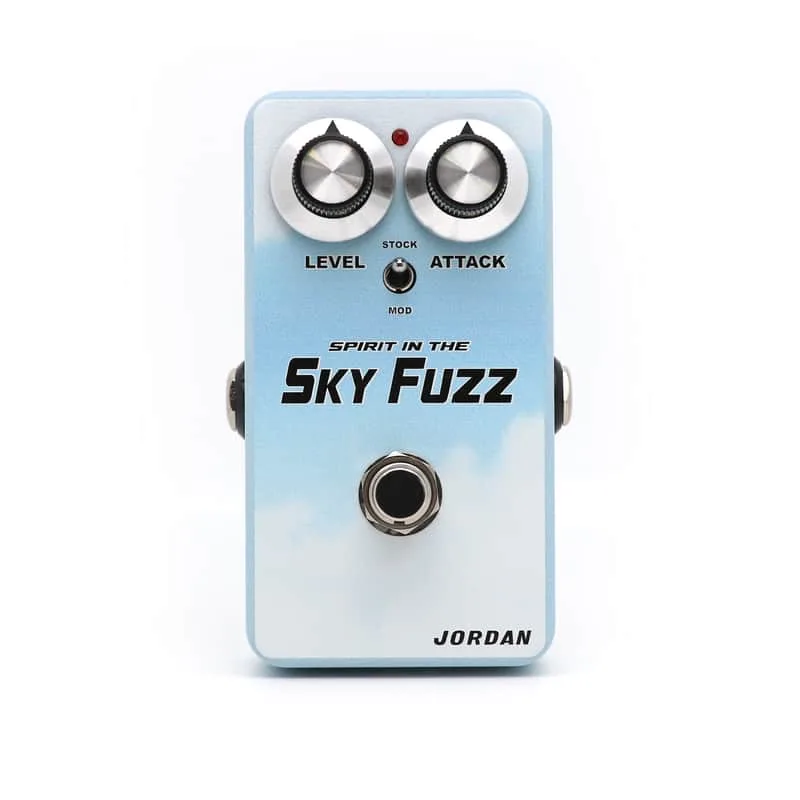
The Jordan name itself has been revived. Guitar Pedal X reported in April 2025 that the brand is fully revived with contemporary builds, including a Buzz Tone based on the 1967 original at $100 and a Spirit in the Sky Fuzz, described as a Boss Tone mod, at $1209. The same article notes the recent Anashead Spirit Fuzz as another Boss Tone style variant9.
Pedals based on the Boss Tone
Because the original is a half-century-old plug-in with a hand switch, most players today meet this circuit through replicas and derivatives. The copies started early: JHS reports that "tons of companies copied this device (Dan Armstrong, Vox, Electro Harmonix, etc.)"1. Modern options include:
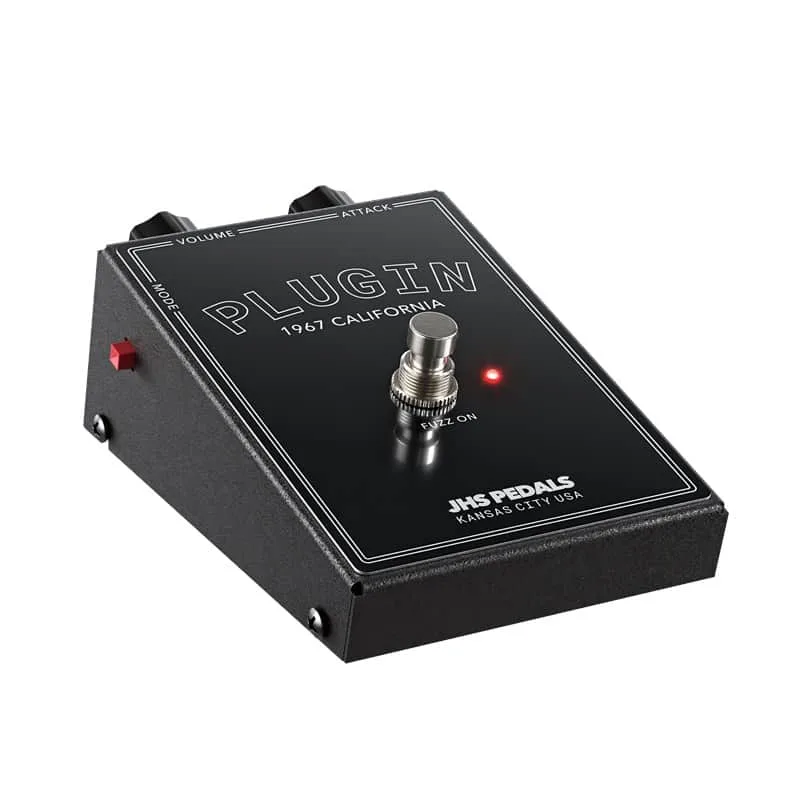
- JHS Plugin Fuzz: a replica of the Jordan Boss Tone built as a fuzz pedal2. JHS had earlier released a limited edition plug-in recreation called the Buzz Tone, which Delicious Audio describes as "obviously nearly impossible to find"2.
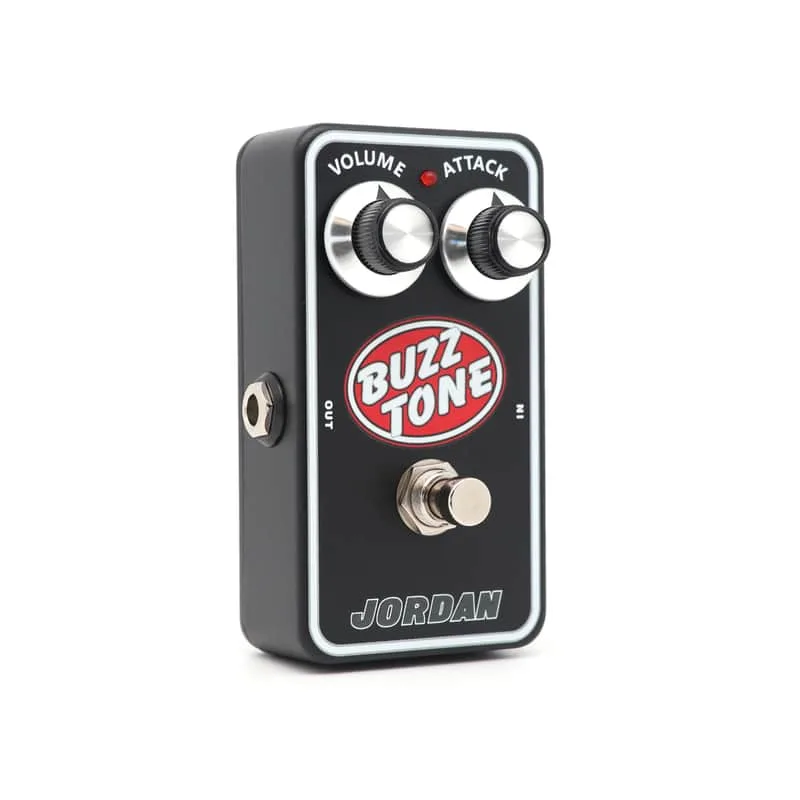
- Jordan Buzz Tone (reissue): a current build incorporating the exact circuit path as found in the original vintage Jordan units, based on the later PNP-NPN version built in Pasadena and Nashville10.
- BLAMMO! Electronics P2P Buzz Tone: a hand-wired version of the Jordan Boss Tone. BLAMMO changes the clipping slightly, describing it as "a slight but noticeable change from the symmetrical diode clipping arrangement of a stock unit," moving to asymmetrical clipping6.
- KMA Machines Fuzzly Bear 2: KMA's take on the Bosstone circuit, built as a conventional pedal. KMA notes that "the original Bosstone wasn't even a pedal, it was a device you plugged directly into your guitar, which brought a host of" practical problems its pedal version addresses11.
- PedalPCB Executive Fuzz: a PCB project that compares to the Jordan Boss Tone12.
- **D*A*M Tone Distorter:** a pedal carrying the same control set as the original, Level and Attack13.
DIY kits and layouts
The Boss Tone is a popular DIY project precisely because the circuit is so small. Options range from complete kits to bare PCBs14:
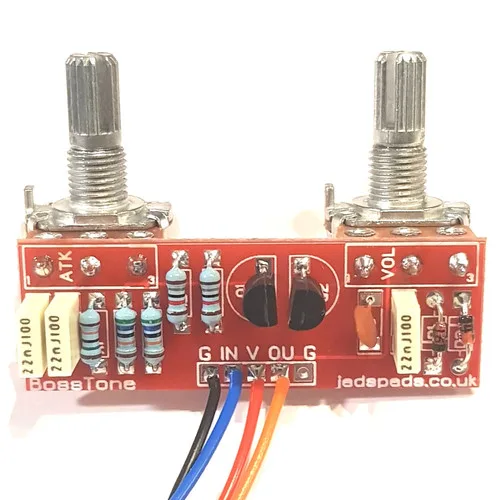
- Jed's Ped's Boss Tone kit: a kit that "compares to the Jordan BossTone and more recently the EHX Satisfaction Fuzz"14. The PCB & Components option includes the PCB, onboard components and any pots and toggle switches14.
- madbeanpedals FuzzyBritches: a documented build based on the Jordan Boss Tone, with a full bill of materials and build notes5. This version requires three jumpers: the Sag control is not used and is jumpered, and two of the clipping diodes are jumpered5.
- PedalPCB Executive Fuzz: a PCB-only option for builders who source their own parts12.
For transistor choice, madbeanpedals' recommendation is practical: "I recommend using any NPN in Q1 with an HFE in the 300-600 range and probably stick with the 2n3906 for Q2," noting that it has seen quite a few builds using a 2n2222a for Q15. The multipin transistor footprint means experimenters can swap types without cutting traces5.
Pedals on this page
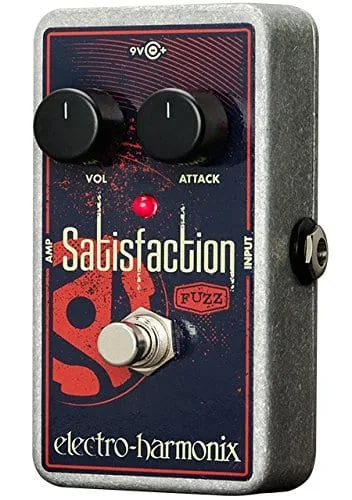
Questions
What songs used the Jordan Boss Tone?
Norman Greenbaum used it in the guitar riff of his hit single Spirit In The Sky. Guitar World reports the original was probably used by four out of five garage bands in the late '60s, so it likely appears on many recordings from that era that were never documented. Randy California of Spirit is also associated with the earliest Boss Tone models.
Was Spirit in the Sky recorded with a Boss Tone?
Yes. Delicious Audio reports that Norman Greenbaum famously used the Jordan Boss Tone in the guitar riff of his hit single Spirit In The Sky. The Jordan brand has since released a Spirit in the Sky Fuzz, a Boss Tone mod variant, priced at $120 as of April 2025.
What transistors are in a Jordan Boss Tone?
The circuit uses two transistors: an NPN at Q1 and a PNP at Q2. A variety of transistors were used in original units. For builds, madbeanpedals recommends any NPN at Q1 with an HFE in the 300 to 600 range and a 2n3906 at Q2; many builds have used a 2n2222a at Q1.
How much did the Jordan Boss Tone cost new?
The Boss Tone was $29.99 when it first came out, according to JHS Pedals' history of Jordan Electronics. It debuted at the 1966 NAMM Show and reached the market in 1967, staying in production until the early seventies.
Does the Boss Tone plug straight into the guitar?
Yes. It is a small 1¾ by 2¼ inch molded plastic box that plugs directly into the guitar's output jack, with no cables or pedalboard needed. The tradeoff is that its on/off switch had to be toggled by hand to activate the effect.
Is the Jordan Boss Tone the same as the JHS Plugin?
No, but they are closely related. The JHS Plugin Fuzz is a replica of the Jordan Boss Tone circuit built as a modern pedal. JHS had earlier released a limited edition plug-in recreation called the Buzz Tone, which Delicious Audio describes as nearly impossible to find today.
Sources (14)
- THE LEGACY OF JORDAN ELECTRONICS, JHS Pedals
- JHS Plugin Fuzz (Legends Of Fuzz Boss Tone Replica), Delicious Audio, 2023-02-27
- The Jordan Boss Tone fuzz is the original guitar plug-in, Guitar World, 2025-04-08
- Guitar Pedal X, Guitar Pedal X, 2025-02-26
- FuzzyBritches.pdf, madbeanpedals.com, 2021
- P2P Buzz Tone, BLAMMO! Electronics
- Boss DS-1 Distortion Analysis, GuitarPCB, GuitarPCB
- TONEHOME - the World of Vintage Guitar Effects Pedals - DS-1 Distortion, TONEHOME
- Guitar Pedal X, Guitar Pedal X, 2025-04-17
- Buzz Tone by Jordan, RockBoard PedalPedia, 2026
- FUZZLY BEAR 2, KMA Machines
- Tellurian Drive, PedalPCB
- 1965, stompboxes.co.uk, 2025
- Boss Tone, Jed's Ped's