The Pultec EQP-1A is a studio equalizer, not a guitar pedal, but its circuit has crossed over into the pedal world more than once. It is a passive EQ: the curves themselves are shaped by passive components, and a valve amplifier follows the EQ network to make up the lost level. Writing about the 1950s passive Pultec EQs, Origin Effects' John Dines described what made them last123:
"Still sought after today, the passive Pultec ® EQ s of the 1950s can be heard on thousands of hit records thanks to their highly musical, versatile EQ curves and the ability to overdrive their push-pull output stage."4
That combination, musical passive curves plus an output stage you can drive, is the reason the circuit keeps being borrowed for equalization pedals decades later.
Where the Pultec came from: from the EQP-1 to the EQP-1A
The family begins with the EQP-1, dated 1956, and the EQP-1A is a further updated version of it, dated 196126. The two dates come from the same account of the unit's history, so both are given here as the timeline of the design: the original passive EQ in the mid-1950s, and the revised version a few years later that became the one later engineers kept seeking out.
What carried the design forward was not a change in philosophy but the character of the curves. As Dines put it in a later piece on the Pultec Studio EQ:
"Their passive circuitry gives the EQ curves a very musical character and their push-pull valve output stages can be pushed into subtle overdrive."7
He also noted that "These EQs are still sought after today but are quite unlike a typical, modern studio EQ"7. That difference from a modern EQ is exactly why pedal makers keep returning to the design: a modern graphic or parametric EQ aims for flat, predictable response, while the Pultec's passive network shapes the sound in a way engineers have long described as musical.
The other half of the Pultec's reputation, the sound of the unit itself rather than its curves, comes from the output stage. Because the passive network loses level, the amplifier after it has to work to restore it, and a push-pull valve stage worked hard does not stay perfectly clean. That is why the phrase "overdrive their push-pull output stage" appears in the same breath as the EQ curves in Origin's description4: for engineers of the era, the coloration of the output stage was part of the tool, not a defect in it.
A passive EQ with a valve makeup amplifier
The circuit works in two stages. First, a passive EQ network shapes the frequency response. Passive EQ inevitably loses signal level, so a makeup amplifier follows it to bring the level back up. In the Pultec that amplifier is a push-pull valve output stage, and it is not perfectly clean: it can be pushed into subtle overdrive7. For a player, that means the unit is really two sounds in one, the EQ curve itself and the coloration of the output stage when it is worked harder.
This is the same broad idea behind many preamp pedals: a shaping network followed by an amplifier that adds its own character. What sets the Pultec apart is that the EQ section is passive, which is what the people who build Pultec-inspired gear point to as the source of its character7.
The passive approach also explains why the design is "quite unlike a typical, modern studio EQ"7. A modern EQ is usually active: its boost and cut stages amplify or cut directly, so the curves are symmetrical and the unit leaves the signal otherwise untouched. A passive network instead works by selectively absorbing energy from the signal, and the shape of the resulting curve depends on the components doing the absorbing. That is why the builders below go to the trouble of specifying particular inductors rather than approximating the curves with active filters.
What the EQP-1A added
The documented difference between the EQP-1 and the EQP-1A is one of revision rather than reinvention: the EQP-1A is a further updated version of the 1956 EQP-1, dated 196126. The qualities the design is remembered for, the musical passive curves and the drivable push-pull output stage, belong to the family as a whole48.
For a player shopping the pedal adaptations, the practical point is this: a pedal described as based on the EQP-1A and one described as based on the Pultec passive EQ generally draw on the same circuit ideas. The differences that matter are at the component level and in how much of the original unit each pedal keeps, not in which suffix the maker cites.
The Pultec circuit in a guitar pedal
The Pultec circuit has been adapted for pedalboards in several forms, and the adaptations differ in how faithful they are to the original13.
Broughton Audio Mastering Equalizer. Broughton Audio describes the Mastering Equalizer as "a tribute to the vintage Pultec PEQ-1A"9. Its approach is component-level: "This pedal employs a Cinemag tapped inductor using the original Pultec specs to perfectly capture the frequency response of the PEQ-1A"9. An inductor is the part of the original passive network that gives the low-end curves their shape, so building one to the original specs is the closest a pedal can get to the vintage unit's response.
Broughton Audio Lowtec. The Lowtec is "a pared down version of the Mastering EQ, capturing the passive bass and treble EQ of the famous Pultec passive equalizer in a smaller format"10. It keeps the passive bass and treble sections and drops the rest, which suits a pedalboard where a player wants the Pultec flavor without a full studio-style unit.
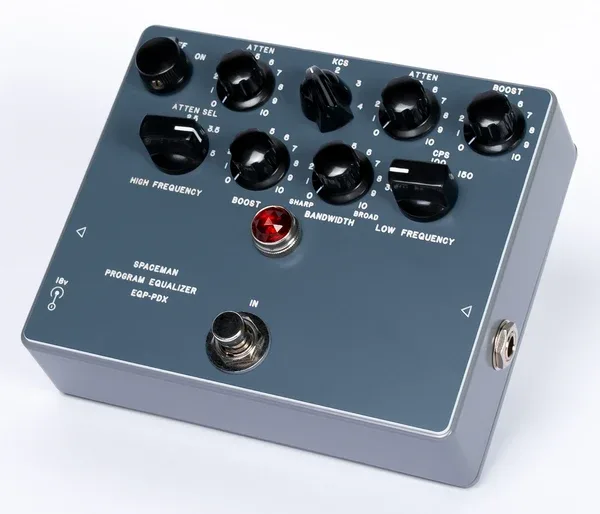
Spaceman EQP-PDX. Spaceman Effects built the EQP-PDX from "the last of the fully analog, handmade and hand-wired original Equinox circuits," with "a modest form factor, instrument level focused design"11. The instrument-level point matters: a studio EQ expects line-level signals, so a pedal version has to be voiced for the lower level a guitar puts out.
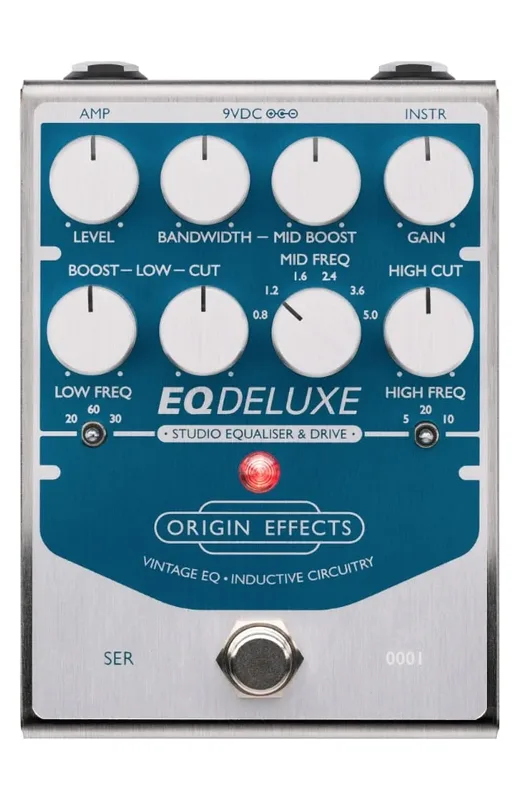
Origin Effects EQDeluxe. Origin also went the other way, toward the full unit rather than a slice of it. The EQDeluxe is described as a full-fat take on the Pultec EQP-1A program equalizer, with enhanced frequencies for guitar and bass6. Delicious Audio's coverage of the EQDeluxe places it in the same lineage5. Where the M-EQ DRIVER borrows one section of the circuit, the EQDeluxe aims at the whole program equalizer, re-voiced for the two instruments players actually plug into it.
| Pedal | Maker | Approach to the Pultec circuit |
|---|---|---|
| Mastering Equalizer | Broughton Audio | Tribute to the PEQ-1A, Cinemag tapped inductor to original Pultec specs9 |
| Lowtec | Broughton Audio | Pared-down passive bass and treble EQ in a smaller format10 |
| EQP-PDX | Spaceman Effects | Instrument-level design built from the last analog Equinox circuits11 |
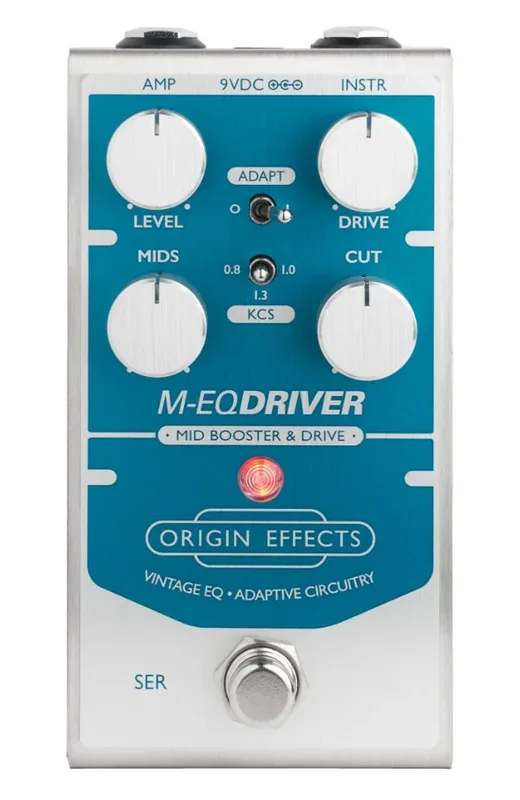
| M-EQ DRIVER | Origin Effects | Repurposes the EQP-1A's high-frequency EQ circuit2 |
| EQDeluxe | Origin Effects | Full take on the EQP-1A program equalizer, with enhanced frequencies for guitar and bass6 |
For a player choosing between them, the difference is mostly scope. The Mastering Equalizer and the EQDeluxe aim at the full original frequency response, the Mastering Equalizer through a spec-matched inductor and the EQDeluxe through frequencies re-voiced for guitar and bass. The Lowtec keeps only the passive bass and treble sections. The EQP-PDX revoices the idea for guitar level. The M-EQ DRIVER takes just the high-frequency part of the circuit and builds an overdrive pedal around it, which is why the press covered it in those terms2.
Why the circuit keeps coming back
Every one of these pedals exists because of the two properties Dines named: the musical character of the passive curves and the drivable push-pull output stage4. A modern active EQ can match any of the Pultec's curves on paper, but it cannot match the way the passive network and the valve stage interact, and that interaction is what the adaptations are buying.
The spread of approaches also says something about how circuits move from studio to pedalboard. Nobody adapts the Pultec by photocopying it: each maker decides which part of the design carries the sound they want, whether that is the inductor, the passive bass and treble shelves, the whole program equalizer, or a single high-frequency section, and then re-voices the result for the instrument level and the enclosure a player will actually use. That is the same route most classic studio and amp circuits have taken on their way onto pedalboards, and the Pultec is simply one of the designs that keeps being worth the trip.
Pedals on this page
Questions
Is the Pultec EQP-1A a passive EQ?
Yes. The EQ curves themselves come from passive circuitry, which is what gives them the character players and engineers describe as very musical. The valves in the unit are a push-pull makeup amplifier that restores the level the passive EQ network loses, and that output stage can itself be pushed into subtle overdrive.
What pedal uses the Pultec EQ circuit?
Several. Broughton Audio's Mastering Equalizer is a tribute to the vintage PEQ-1A and uses a Cinemag tapped inductor built to the original Pultec specs, with the Lowtec as a pared-down passive bass and treble version. Spaceman's EQP-PDX adapts the circuit for instrument level, and Origin Effects' M-EQ DRIVER and EQDeluxe each take the circuit in different directions for guitar and bass.
What is the difference between the EQP-1 and the EQP-1A?
The EQP-1 is the original unit, dated 1956. The EQP-1A is a further updated version of it, dated 1961. The qualities the design is remembered for, the musical passive curves and the drivable push-pull output stage, belong to the family as a whole rather than to one version.
Sources (11)
- New Pedal: Spaceman Effects Equinox | Delicious Audio, Delicious Audio, 2022-08-23
- M-EQ DRIVER, Origin Effects, 2026-08-18
- 2023 UPDATE! Best EQ Pedals For Guitar: Graphic & Parametric | Delicious Audio, Delicious Audio, 2023-12-13
- Press Release -, Origin Effects, 2022-11-22
- New Pedal: Origin Effects EQ Deluxe, Delicious Audio, 2026-07-28
- Guitar Pedal X, Guitar Pedal X, 2026-08-03
- M-EQ DRIVER vs HALCYON GREEN OVERDRIVE, Origin Effects, 2023-01-13
- Origin Effects M-EQ Driver, Delicious Audio, 2025-06-09
- Mastering Equalizer, Broughton Audio
- Lowtec | Broughton Audio, Broughton Audio
- Equinox: Analog Studio EQ, Spaceman Effects