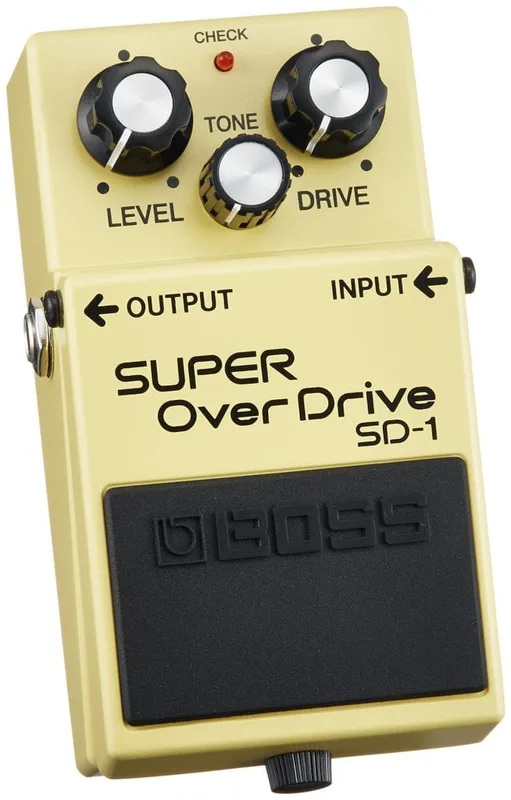
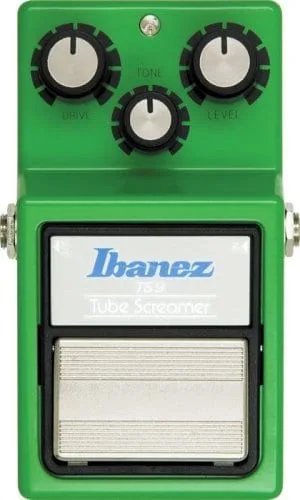
The Boss SD-1 Super Overdrive and the Ibanez TS9 Tube Screamer are two of the most widely used overdrive pedals ever built, and they are closer cousins than their different looks suggest. The SD-1 has been produced from 1981 to the present12, while the original TS9 ran from 1982 to 19843. Both are still easy to buy: the TS9 was reissued in 1993 and has been in more or less continual production since4, and ToneHome rates current TS9 availability as good, with original examples extremely collectible3.
The reason they get compared constantly is the circuit. Aion FX, which documents both designs, puts it plainly: the circuits are very similar, but parts selection gives them a very different sound, and with a handful of component swaps an SD-1 can be turned into a Tube Screamer and vice versa5. The differences that matter to a player come down to three things: how each pedal clips the signal, which op-amp chips and output sections they use, and how they have been reissued and modded over four decades.
The SD-1 and TS9 at a glance
| Boss SD-1 Super Overdrive | Ibanez TS9 Tube Screamer | |
|---|---|---|
| Maker | Boss1 | Ibanez3 |
| Type | Overdrive pedal1 | Overdrive pedal16 |
| Original release | 19811 | 19823 |
| Original production | 1981 to present1 | 1982 to 19843; discontinued 1985 per Aion FX4 |
| Current status | In production1 | Reissued 1993, in continual production since4; availability good3 |
| Clipping | Asymmetric67 | Symmetrical7 |
| Bypass | Buffered6 | Buffered2 |
| Price | Around $69 (Guitar World review)6 | Not stated in US dollars by the sources cited here |
Both pedals sit in the same slot on a pedalboard: a low-to-medium gain overdrive that most players run into the front of a tube amp. Guitar World's reviewer notes the SD-1's Level knob gives loads of output, so it can serve as a clean boost or really slam the front of a tube amp6. On That Pedal Show, the hosts found the TS9 has a little bit more headroom than the TS10 they compared it against2.
Asymmetric versus symmetric clipping
This is the core circuit difference between the two pedals, and it is what a player hears first2.
The Tube Screamer clips symmetrically. As Dan Steinhardt and Mick Taylor explained on That Pedal Show28:
"the ts9 the tube screamer is what we call symmetrical clipping it's got a diode in the positive and negative"7
Symmetrical clipping means the positive and negative halves of the waveform are clipped equally, which produces a smoother, more even overdrive. The SD-1 takes the other approach. Analog Man notes that the OD-1 and SD-1 use asymmetrical clipping, on which Boss holds a patent9. Asymmetric clipping clips one half of the waveform harder than the other, adding even-order harmonic content. Guitar World's reviewer describes the result as asymmetric soft clipping that gives the SD-1 an amp-like overdrive that feels more organic than some other budget overdrives6.
The SD-1's clipping style is inherited, not invented for the pedal. ToneHome documents that the SD-1 contains the same asymmetric overdrive circuit as the Boss OD-1, which responds very well to the player's attack, plus an additional tone control the OD-1 lacked1. The OD-1 itself was produced from 1977 to 198510. Boss's own current description of the SD-1 makes the same point: it expands on the OD-1 design with enhanced voicing and a tone control111213. Analog Man adds that the SD-1 took over from the OD-1 in the mid 80s, though players still wanted the pure OD-1 sound9.
Beyond the clipping diodes, the two circuits differ in smaller parts. On That Pedal Show the hosts noted different input capacitors between the TS9 and SD-1, and that people talk about the different clipping diodes7.
Chips, parts and the TS9 output section
The TS9's relationship to the TS808 is mostly a story of the output section. The Tokai Registry review, republished by Maxon, states the TS-9 is almost the same as the TS-808 internally, with the main change in the output section, which made the Tube Screamer a bit brighter and less smooth1415. Aion FX gives the component detail: the 100R and 10k resistors on the output buffer transistor were changed to 470R and 100k respectively, and the op-amp was changed4. A 2001 ToneQuest Report interview with Analog Mike summarized it as the TS9 using the same printed circuit board as the TS808 with a few components changed, most notably the chip16.
Which chip an original TS9 has depends on when it was built. ToneHome's serial-number breakdown3:
| TS9 production run | Op-amp IC |
|---|---|
| Early black label, serial 1xxxxxx | JRC2043DD3 |
| Later black label, serial 2xxxxx | JRC4558D3 |
| Silver label, serial 3xxxxx and 4xxxxx | JRC4558D or TA75558P3 |
Aion FX identifies the TA75558P as the op-amp of the original TS-94, and the Tokai Registry review notes the 1993 reissue uses the Toshiba TA75558 chip and is basically identical to the last original TS-9s in sound, circuitry and appearance144. The same review is blunt about chip quality in the later originals: some sound bad, especially the JRC2043DD chips143. On That Pedal Show, examining a 1982 black label example, the hosts found straight green capacitors and the 4558D chip inside, noting some examples had it and some did not2.
Versions, reissues and mods
Both pedals have long modification histories, partly because the circuits are so close to each other5.
SD-1 mods. JHS sells its Trans Am mod of the SD-1, which JHS describes as "a good sounding overdrive that is designed in the shadow of the mighty Ibanez Tubescreamer," with "gobs more available gain" than the stock pedal17. A separate SD-1 Supercharged Mod Service also exists as a modification service for the Boss SD-1 Super Overdrive pedal18. The SD-1's reach extends beyond mods: many boutique and vintage reissue overdrives have been based closely or roughly on the SD-1 itself, or on its Ibanez rival, the Tube Screamer19.
TS9 mods. Premier Guitar published a set of five DIY mods covering both pedals, written by Brian Wampler of Wampler Pedals. They include a true-bypass conversion for the TS9, which involves drilling a 1/2-inch hole in the middle of the case where it says "TS9" under the Ibanez logo8; swapping the stock silicon diodes for two LEDs running in parallel, which yields more headroom and volume with a warmer response; or two sets of series-wired diodes in parallel for more volume and headroom with slightly less clipping8. A feedback-tweak mod for either the SD-1 or TS9 uses .1, .22 and .47 microfarad film capacitors with 1k and 10k resistors8, and a final mod addresses what Wampler calls the "nasally mids that have long plagued the Tube Screamer and Super Overdrive"8.
Factory-modded versions. Susumu Tamura, the Tube Screamer's designer, has created the TS9 Tamura-Mod, built on the Ibanez TS-9 with the same Magic IC used in his TS808-TM mod, Vishay 1N914 diodes with a clipping signature distinct from both the stock TS9 and the TS808-TM mods, and a midrange peak shifted slightly higher to accentuate pick attack and improve articulation1520. Godlyke's listing describes the same midrange shift, plus a variant with a +6dB level boost; both the standard Tamura-Mod TS9 listings were sold out at the time of writing21. The TS9DX Turbo Tube Screamer is a hot-rodded TS-9 with the exact same circuit as the original plus three additional modes, Plus, Hot and Turbo, with the Plus mode grittier than the original TS922.
What reviewers and players said
Guitar World's review of the SD-1 praised its build and value:
"Everything here feels like it's made to last for literal decades, and honestly, most SD-1s probably do."6
The same review noted the launch price of $66 and a current price around $69, and found it hard to think of another pedal so cheap and reliable that so many famous players continue to use6. Documented SD-1 users include Baz Warne of The Stranglers, who used it for solos and to emulate the band's trademark scratchy guitar sound23.
For the TS9, the Tokai Registry review names The Edge of U2 as using a TS9 for most of his overdrive tones14. On That Pedal Show's 2026 comparison of vintage Tube Screamers, Mick's 1982 black label example was his pick of the bunch, with a clarity that pays dividends when things are loud2. In a 2024 episode, Mick found the Tube Screamer better suited than a Tube Driver for slightly fewer mids and without a vocal push in the mids higher up the neck20.
Questions
Is the Boss SD-1 a Tube Screamer clone?
Not a clone, but a close relative. The SD-1 was released in 1981 as Boss's response to the Ibanez Tube Screamer, and the two circuits are very similar in topology. The differences are in parts selection: the SD-1 clips asymmetrically like the Boss OD-1 it developed from, while the Tube Screamer clips symmetrically, and the two pedals sound different as a result.
Is the Ibanez TS9 true bypass?
No. The TS9 uses buffered bypass switching, and the hosts of That Pedal Show note that old Tube Screamers not being true bypass is a reason to keep them in a loop switcher. Premier Guitar published a true-bypass mod that involves drilling a 1/2-inch hole in the case for a switching control, so players who want true bypass generally add it themselves or use a switcher.
Can you mod an SD-1 to sound like a Tube Screamer?
Yes. Because the circuits are so similar, Aion FX notes that an SD-1 can be modified into a Tube Screamer and vice versa with a handful of component swaps. Common SD-1 mods include removing capacitor C6 to open up the sound, and raising the input capacitor C3 from .047uF to .1uF for more bass. Mod services from JHS and Griffin Effects take the pedal in other directions instead.
What is the difference between a TS9 and a TS808?
The TS9 uses the same printed circuit board as the TS808 with a few components changed, most notably the chip. The main change is in the output section: the 100R and 10k resistors on the output buffer transistor were changed to 470R and 100k, which made the TS9 brighter and less smooth than the TS808. The original TS9 used the TA75558P op-amp.
Which chip is in an original TS9?
It varies by production run. Early black label issues with serial numbers starting 1 used the JRC2043DD, later black label issues used the JRC4558D, and silver label issues used either the JRC4558D or the TA75558P. Aion FX identifies the TA75558P as the op-amp of the original TS-9, and the Tokai Registry review notes some later originals with random chips sounded bad, especially the JRC2043DD.
Is the Boss SD-1 still in production?
Yes. The SD-1 has been in production from 1981 to the present, making it Boss's most enduring overdrive pedal. The original TS9 run lasted only from 1982 to 1984 or 1985, but the pedal was reissued in 1993 and has been in more or less continual production since then.
Sources (23)
- TONEHOME, TONEHOME
- Mystery Tube Screamer vs Original Ibanez TS 9 & TS10 Wow, That Pedal Show (YouTube), 2026-07-30
- TONEHOME, TONEHOME
- Stratus Classic Overdrive / Ibanez® Tube Screamer, Aion FX, 2018-09-22
- Stratus Deluxe Overdrive / BOSS® SD-1W Waza Craft, Aion FX, 2025-03-28
- Boss SD-1 Super Overdrive review, Guitar World, 2026-08-17
- Boss Super Overdrive Or Ibanez Tube Screamer? In Your Band, That Pedal Show (YouTube), 2021-12-03
- 5 DIY Mods to Perfect Your Ibanez TS9 and Boss SD-1, Premier Guitar, 2012-09-06
- Boss OD-, Analog Man (analogman.com), 2026
- TONEHOME, TONEHOME
- BOSS - PX-1 | Plugout FX, BOSS (www.boss.info)
- BOSS - PX-1 | Plugout FX, BOSS (boss.info)
- BOSS - PX-1 | Plugout FX, BOSS (boss.info)
- Maxon OD808 Review, maxonfx.com (Godlyke, Inc.)
- Ibanez TS9 Tamura-Mod, maxonfx.com (Godlyke, Inc.)
- http:, ToneQuest Report (republished on analogman.com), 2001-11
- BOSS SD-1 TRANS AM MOD, JHS Pedals
- Boss SD-1 Super Overdrive Supercharged Modification Service, griffineffects.com
- For those about to rock: we salute the Boss SD-1 Super OverDrive which has wowed lead guitarists for over 40 years with its jagged, granular tone, GuitarPlayer (www.guitarplayer.com), 2023-11-25
- Ibanez Tube Screamer Or BK Butler Tube Driver? Plus Mythos Envy Pro & Hagerman 12AX7 Overdriver, That Pedal Show (YouTube), 2024-11-08
- Ibanez TS9 Tamura-Mod, Godlyke Distributing, Inc.
- Ibanez TS9DX Turbo Tube Screamer, Analog Man (aNaLoG.MaN), 2015
- Behind the Board: James Sharpe with Sam Smith, Gary Numan, and The Stranglers, BOSS (articles.boss.info), 2026-09-25