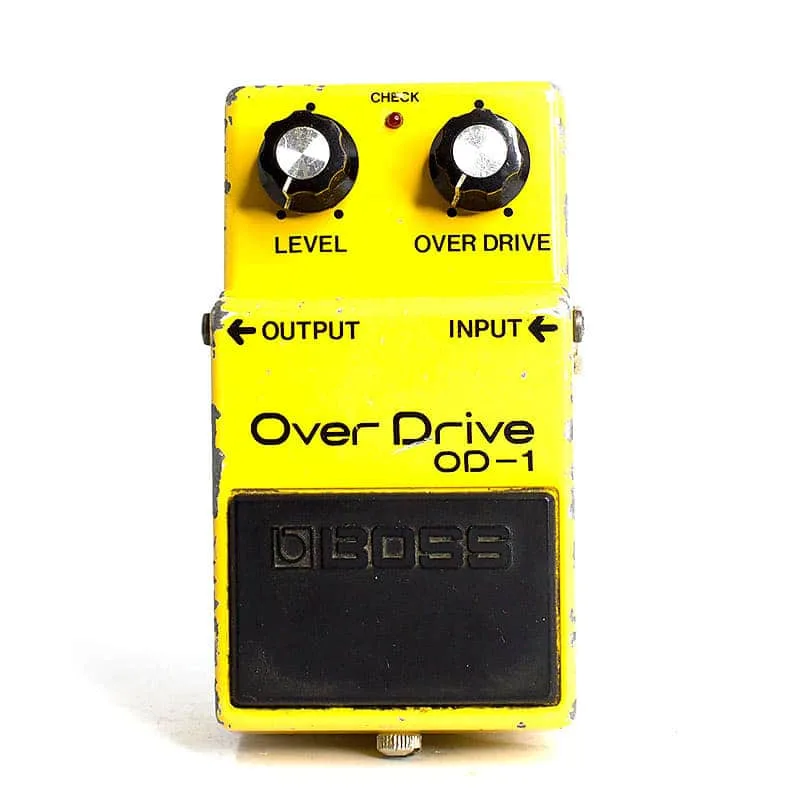


The Boss OD-1 Over Drive is an analog overdrive stompbox released by Boss in 1977, one of the three pedals that debuted the company's compact pedal format alongside the PH-1 Phaser and SP-1 Spectrum1. It is the pedal that created the "overdrive" category in the stompbox industry2, and Analog Man calls it about the first overdrive pedal made and the first of the "tube screamer type" overdrive pedals3. Production ran for eight years, with the pedal discontinued in 19854.
For a player, the OD-1 delivers a tube-like overdriven guitar sound from a small stompbox4. Boss describes it as designed with an asymmetrical clipping circuit that reproduces the pleasing sound of a driven tube amp5, and the company's own history says that with just two controls it became one of the first pedals to truly emulate the sound of an overdriven amp6. A low-impedance input let players explore shades of warm, touch-sensitive overdrive using the guitar's volume control7.
The pedal that started the overdrive category
Before the OD-1, "overdrive" was not a stompbox category. Premier Guitar notes the pedal created the now-ubiquitous "overdrive" category in the industry2, and MusicRadar describes it as the trailblazing OD-1 that heralded the start of what became a huge overdrive pedal market11. Boss itself states plainly that the OD-1 invented the now ubiquitous "overdrive" category in stompbox effects5.
The pedal arrived a year before the better-known Boss DS-1 distortion, which followed in 19781. Alongside the Ibanez Tube Screamer, the OD-1 set the standard for tube-like overdriven guitar sound out of a small stompbox4. The pedal was subject to various changes throughout its eight years of production4, covered below in the versions section.
Two controls: Level and Overdrive
The OD-1 is a deliberately simple pedal. Its face carries two knobs, labeled Over Drive and Level. Guitar World notes the manual described the Over Drive control as producing "soft distortion"12. There is no tone control, a point that has followed the pedal ever since.
| Control | What it does |
|---|---|
| Over Drive | Sets the amount of drive; the manual called it "soft distortion"12 |
| Level | Sets the output volume12 |
Guitar.com's reviewer observed that even by later standards it was still a fairly simple overdrive with just two controls13. The touch sensitivity comes from the input stage rather than the knobs: the low-impedance input allowed players to clean up and shade the overdrive with the guitar's volume control7. TONEHOME describes the result as a sound still close to the original signal even though distortion has been added4.
Asymmetrical clipping and the circuit
The heart of the OD-1 is its clipping stage. Analog Man explains that the OD-1 (and the later SD-1) use asymmetrical clipping, which Boss has a patent on, to give some thick overdrive with an edge3. Premier Guitar's history confirms Boss already had a patent on solid-state asymmetrical clipping10. Boss's own article on the SD-1 explains what this means technically: the asymmetrical clipping circuit prevented the distortion of the positive and negative waveform swings equally6.
Clipping diodes in the original circuit were vintage Japanese diodes, the Boss BAYP-84A14. The General Guitar Gadgets replica project, which reproduces the circuit, specifies 1N914 diodes in the D1, D2, D2b and D5 positions, with the D3 and D4 positions left empty, which is how the asymmetry is built15. The original also included a FET switching circuit and used the 2SC1815 transistor15.
Versions: quad op amp to dual op amp
The biggest change across the production run is the op amp. The versions break down like this34:
| Version | Op amp | Notes |
|---|---|---|
| Original | RC3403D quad op amp, 14 pins | Oldest versions have a metal thumbscrew and ink-stamped serial number in the battery compartment3 |
| Some early 1978 units | NEC uPC4741C quad op amp | Used instead of the RC3403D3 |
| Later versions | Dual op amp, 8 pins, usually a 4558, often the JRC4558D | Some 1980 units with the small chip also have the metal thumbscrew and ink-stamped serial3 |
Analog Man is blunt about the difference: the sound of the later unit with the smaller chip was NOT the same as the original version3. He also found the main circuit difference in newer pedals was the capacitors, with several smaller value capacitors used, sucking away low end and making a thin tone3. On the vintage market this matters to price: TONEHOME reports it is a matter of $100 to $200 whether a long dash and clear switch OD-1 sports an RC3403 or any other chip4. The 14-leg op amp has a following of its own; Guitar Pedal X notes builders seeking the exact equivalent specs of the original 14-leg Raytheon op amps, which share the same core designation number14.
The OD-1 and the Tube Screamer
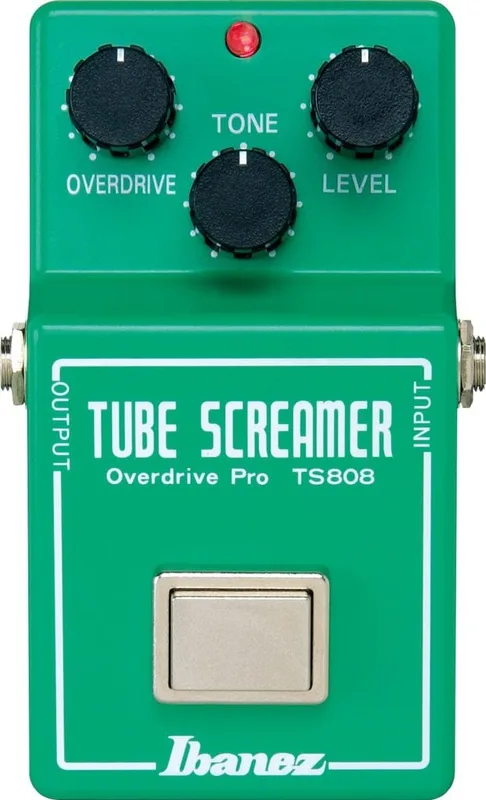
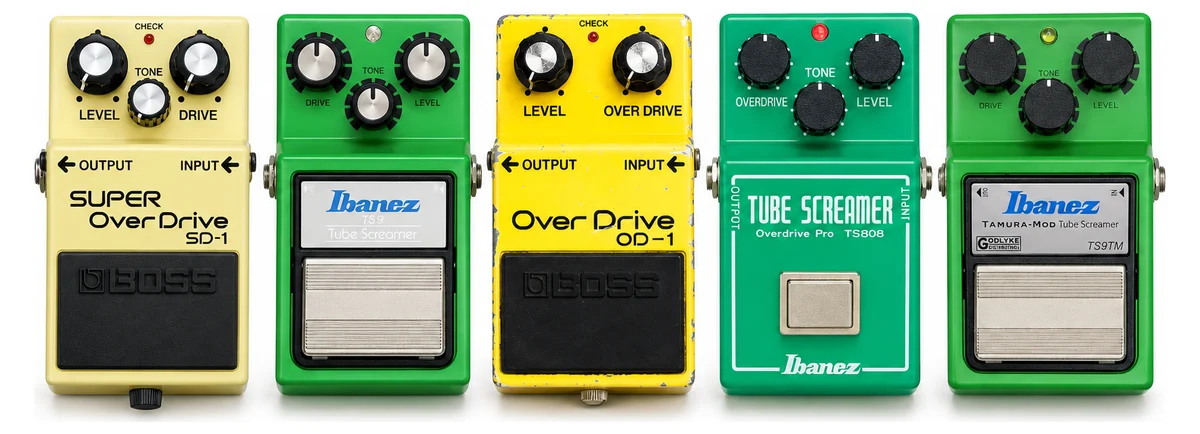
The OD-1 predates the Ibanez Tube Screamer by two years, and the two circuits are entwined. The Tube Screamer was conceived as a competitor to the Boss OD-1 and the MXR Distortion+16, and Guitar.com reports the original 808 was rumoured to be based on Boss's OD-1, only with the clipping section altered for symmetrical clipping17. JHS Pedals lists the OD-1 (1977) as the first entry in its Tube Screamer family tree, ahead of the TS-808 (1979) and TS-9 (1982)18. Guitar.com also notes the first Tube Screamer originally served as competition to Boss's OD-119.
The practical difference for a player is the clipping character: the OD-1 clips the waveform asymmetrically, the Tube Screamer symmetrically. Guitar Pedal X's reviewer, comparing the OD-1 against the SD-1 and TS808 in Boss's PX-1, found the OD-1 clips slightly harder and rawer than both20.
The OD-1 and the SD-1
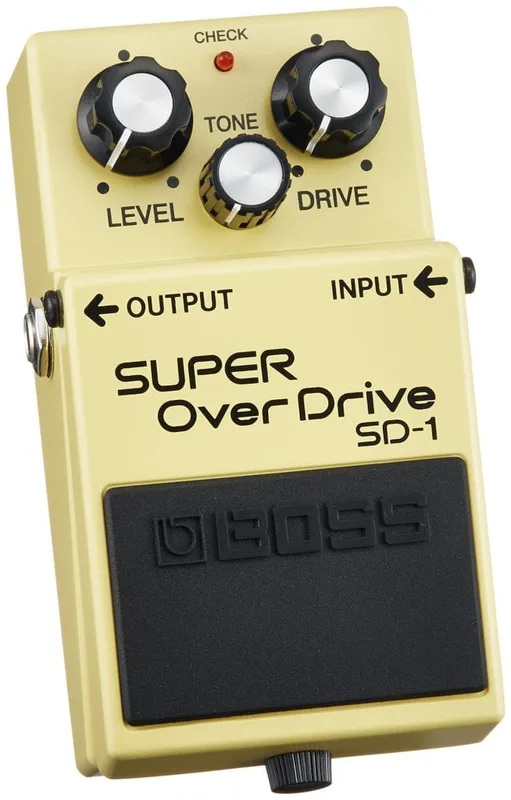
The Boss SD-1 Super Over Drive, released in 19816, is the OD-1's direct descendant. TONEHOME describes the SD-1 as containing the same asymmetric overdrive circuit as the OD-1, which responds very well to the player's attack, plus an additional tone control21. Boss frames it the same way: expanding on the OD-1 design with enhanced voicing and a tone control5. Guitar.com's jargon buster notes people often lump the SD-1 and its forebear the OD-1 together, and they are very similar pedals and circuits, but the OD-1 lacks the SD-1's tone control22.
Reissues and later appearances
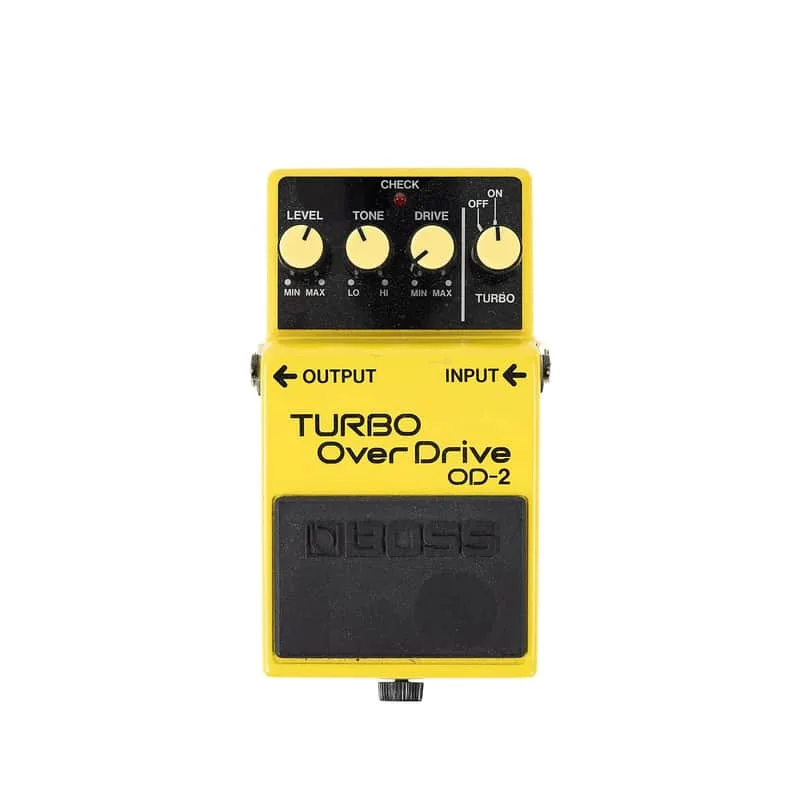
The original OD-1 was discontinued in July 19856, supplanted by the OD-2 Turbo Over Drive12. Original prices on the secondhand market went sky high a few years before 202223. The pedal has since resurfaced in several forms:
- 2017 40th Anniversary Box Set: a one-time-only reissue of the original three Boss compact pedal models, produced exactly as the originals were, with wiring and circuit adjustment performed by hand on a special production line in Japan24.
- PX-1 Plugout FX (2025): the OD-1 is onboard effect 1 on Boss's first compact digital multi-FX pedal20.
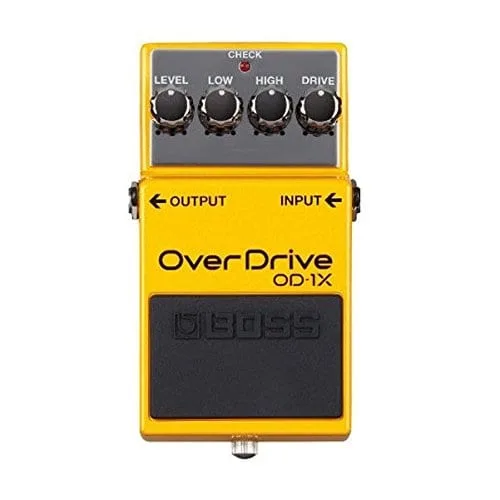
- OD-1X: a modern Boss overdrive pedal with four controls, level, low, high and drive25, which Boss says uses its MDP engine to dish up refined overdrive sounds that smoothly integrate with nearly any amp platform, from light edge-of-breakup to mid-boosted gain for singing leads26. MusicRadar notes it is unlike the analog original8.
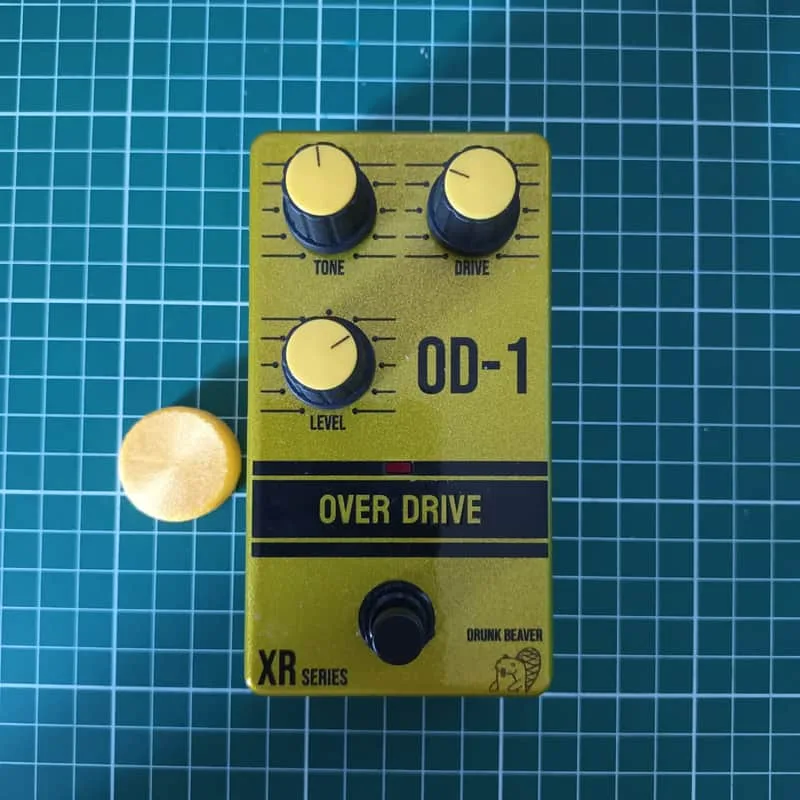
The circuit also lives on in third-party pedals, from the General Guitar Gadgets replica project15 to the Drunk Beaver OD-1, a 14-leg op amp take on the design152728, and the 1989 Exar OD-1, a Polish copy of the Boss original28.
Videos
Boss Pedal Workbench
Wampler Pedals
TheToneShack
Questions
How can you tell an early RC3403 Boss OD-1?
Open the battery compartment. The oldest versions have a metal thumbscrew and an ink-stamped serial number inside, and the original circuit uses an RC3403D quad op amp chip with 14 pins. Some early 1978 units instead used an NEC uPC4741C quad op amp. Later versions moved to a common 8-pin dual op amp, usually a 4558, often the JRC4558D.
What is the difference between the Boss OD-1 and SD-1?
The SD-1 Super Over Drive, released in 1981, contains the same asymmetric overdrive circuit as the OD-1 but adds a tone control. Boss describes the SD-1 as expanding on the OD-1 design with enhanced voicing and a tone control. Otherwise the two are very similar pedals and circuits, and both use asymmetrical clipping.
Does the Boss OD-1 have a tone control?
No. The OD-1 has only two controls, Level and Overdrive. The manual described the Over Drive knob as producing soft distortion. The lack of a tone control was carried into later comparisons, with one reviewer writing that the OD-1 has always really needed a Tone control.
Can an early OD-1 run on a 9V adapter?
Early OD-1 units were made for ACA 12V adapters rather than the standard PSA 9V supply. Analog Man reports that an early ACA unit can be modded for PSA 9V adapters, and offers that modification at no extra charge. Later Boss compact pedals moved to the 9V standard.
Is the Boss OD-1 a Tube Screamer?
No, but they are related. The OD-1 arrived in 1977, two years before the first Tube Screamer, and the original 808 is rumoured to be based on the OD-1 with the clipping section altered for symmetrical clipping. The Tube Screamer was conceived as a competitor to the OD-1 and the MXR Distortion+.
When was the Boss OD-1 discontinued?
The OD-1 came out in 1977 and was discontinued in 1985, with Boss's own history giving July 1985 as the end date. Guitar World reports it was supplanted by the OD-2 Turbo Over Drive. A one-time-only reissue appeared in the 2017 40th Anniversary Box Set.
Sources (28)
- Boss's Best-Selling Pedal Gets Waza Crafted With the DS-1W Distortion, GuitarPlayer (www.guitarplayer.com), 2022-10-06
- Boss Reissues MT-2 Metal Zone & SD-1 Super OverDrive, www.premierguitar.com, 2021-05-20
- Boss OD-, Analog Man (analogman.com), 2026
- TONEHOME, TONEHOME
- BOSS - PX-1 | Plugout FX, BOSS (boss.info)
- 40 Years of the BOSS SD-1 Super Overdrive, BOSS (articles.boss.info), 2021-03-17
- The PX-1 Plugout FX: Timeless BOSS Pedals Reborn, BOSS (articles.boss.info), 2025-06-06
- Boss OD-1X Overdrive review, MusicRadar, 2014-06-05
- BOSS Effects Pedals for Keyboardists, BOSS (articles.boss.info), 2025-07-17
- Green Giant: History of the Tube Screamer, Premier Guitar (www.premierguitar.com), 2011-10-18
- Boss announces anniversary versions of the SD-1 Super Overdrive and MT-2 Metal Zone pedals, MusicRadar, 2021-05-20
- Boss overdrive pedals: the evolution of its essential stompboxes, Guitar World, 2021-09-28
- Boss SD-1 review, Guitar.com, 2025-04-29
- Guitar Pedal X, Guitar Pedal X, 2024-03-03
- Boss™ OD-1™ Clone: Overdrive Schematic & Layout, generalguitargadgets.com, 2018-05-08
- Why do guitarists love the Ibanez Tube Screamer? The story of the classic overdrive pedal, Guitar World, 2020-05-07
- It's Tube Screamer season, guitar.com, 2022-08-22
- BONSAI - JHS Pedals, JHS Pedals
- The Tube Screamer's original inventor teams up with TWA for the next evolution of his iconic drive pedal, Guitar.com, 2025-11-18
- Guitar Pedal X, Guitar Pedal X, 2025-08-28
- TONEHOME, TONEHOME
- Jargonbuster: Overdrive, Guitar.com, 2021-11-08
- ODI Info (Legacy Product), Pettyjohn Electronics, 2022-01-03
- New and Cool: Boss Compact Pedal 40th Anniversary Box Set, Guitar World, 2017-12-04
- Boss DS-1X Distortion and OD-1X Overdrive Pedals, Guitar World, 2014-05-21
- BOSS - OD-1X | OverDrive, BOSS (boss.info)
- OD-1 by Drunk Beaver, RockBoard PedalPedia, 2026
- The JHS Bonsai crams nine Tube Screamers into one pedal, Guitar.com, 2018-02-03