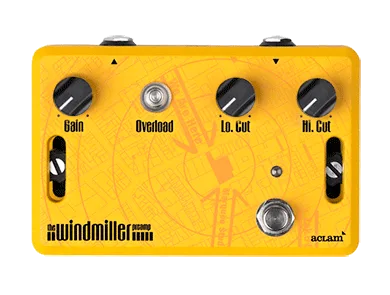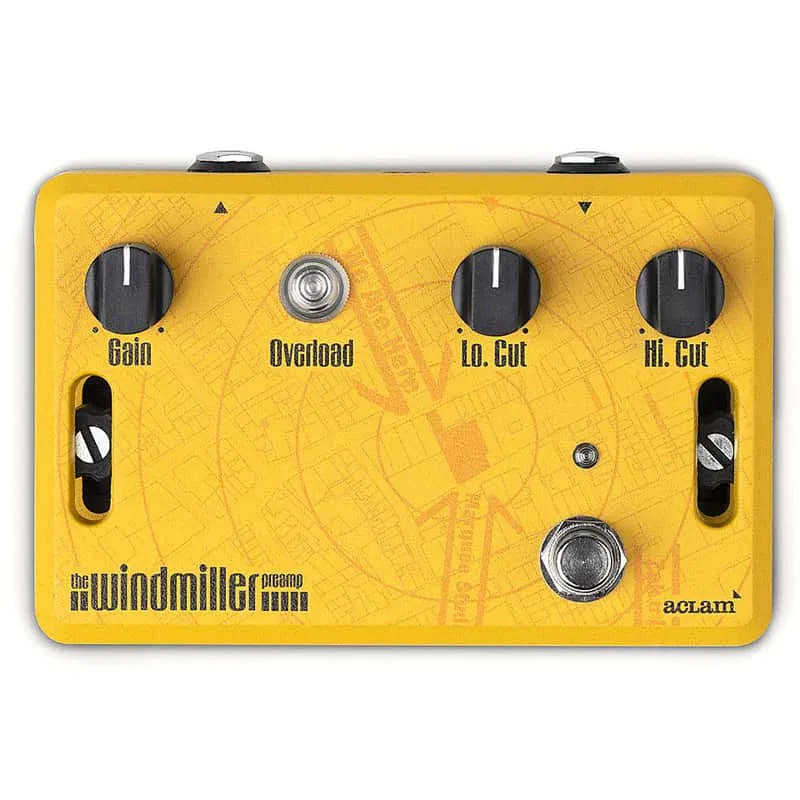


The Windmiller Preamp is a preamp and boost pedal from Aclam Guitars, the Barcelona-based maker with a habit of digging up obscure but crucial vintage gear and rebuilding it in pedal form. Aclam describes it as a tool for getting a vintage gritty tone, both clean and overdriven, usable to push your amp or overdrive pedals, or to run as an always-on preamp with a light touch of gain1.
A gritty vintage boost and preamp
Aclam positions the Windmiller as a versatile pedal: an always-on preamp with a distinct color, a booster for solo parts, or a saturation tool2. The behavior depends on where you put it in the chain. When the pedal receives the signal directly from the guitar's output jack, it "sees" the high-impedance signal and adds color, driving the amp into saturation. Fed from a buffered pedal instead, it becomes a transparent preamp, essentially a louder version of the bypassed signal2.
Guitar World's reviewer, Trevor Curwen, found that with the Gain knob at minimum there is a small level boost and an instant tonal shift when you kick it in, and that turning the Gain up gives a lively, dynamic drive that cleans up naturally with your guitar's volume control3. Aclam's manual adds that at the fully counterclockwise position the pedal gives around 3dB over the bypassed signal, depending on the Lo-Cut and Hi-Cut settings, and that at full Gain it acts as a "clean" preamp with a little asymmetrical clipping4.
"The team has recreated the preamp's essential sonic qualities while taking time to eliminate the hiss that the original was known for."
That last point matters for anyone who has heard an original Grampian: the 60s unit was known for hiss, and Aclam's recreation keeps the sonic character while removing the noise3.
The controls: Gain, Lo-Cut and Hi-Cut
The front panel is simple: three knobs and a bypass footswitch3.
| Control | What it does |
|---|---|
| Gain | Sets the amount of signal boost and drive. At minimum, around 3dB over bypassed signal; at full, a "clean" preamp with a little asymmetrical clipping4. Cleans up naturally with guitar volume3. |
| Lo-Cut | Rolls off bass content, letting you decide how tight the resultant tone is34. Pedal of the Day notes it helps the mid frequencies pop a bit more5. |
| Hi-Cut | Rolls off treble, letting you add sparkle to muddy humbuckers or tame brighter single coils34. |
The two tone controls are the practical difference between this and a straight boost. Pedal of the Day's reviewer found the Hi-Cut lets you brighten up darker pickups or remove the highs to tame the brightest of pickups, while the Lo-Cut trims bass so the mids stand out5.
There is also an overload indicator lamp, carried over from the original Grampian 636. In the pedal version it serves as a signal-in indicator: the higher the gain and the harder you play, the brighter it glows, so it reacts to your attack67.
The Grampian 636 preamp behind it
Aclam's recreation is based on the preamp of an original Grampian Reverberation Unit Type 636, serial number 1138, from the 60s16. During early development the pedal went by the name "Grampian Overdrive" before becoming the Windmiller, a nod to Townshend's windmill strumming8. Its designer is Marc Sospedra of Aclam8.
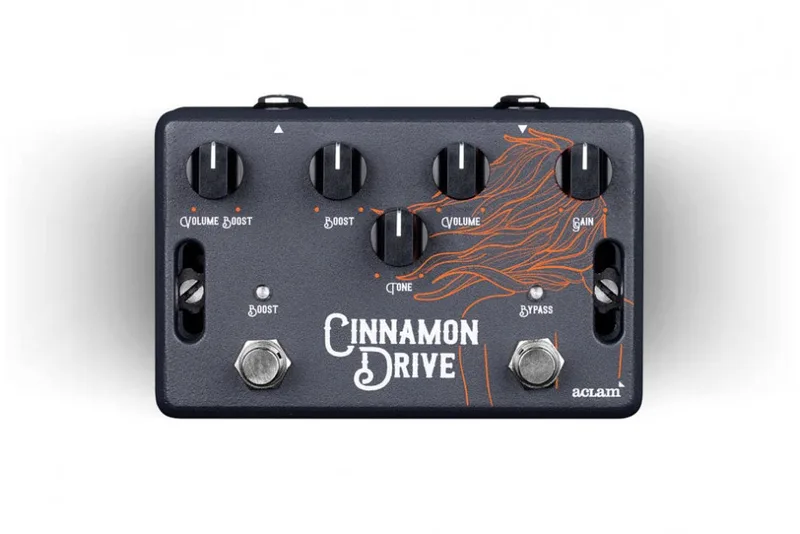
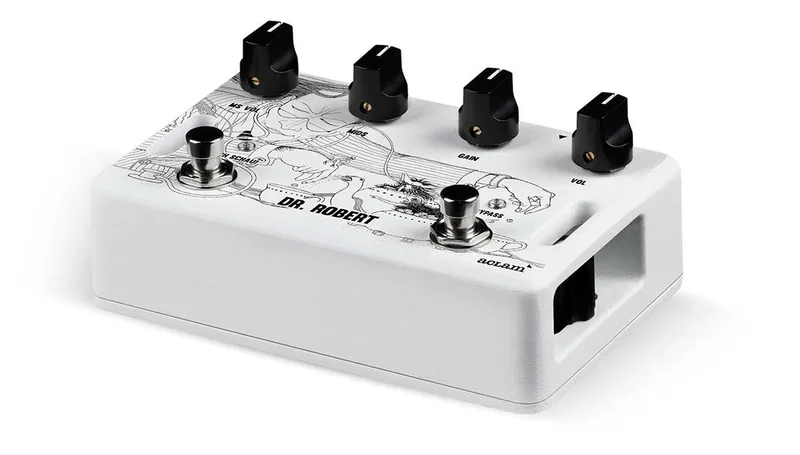
The Windmiller is part of a series of Aclam pedals that replicate classic guitar tones, alongside the Cinnamon Drive and the Dr Robert9. Where those pedals chase other players' sounds, the Windmiller is the one aimed squarely at the Townshend rig.
Power, connections and placement
The pedal runs on a 9V DC adaptor that is not supplied, drawing 100mA, with one input jack and one output jack38.
The Windmiller must not be powered above 9VDC. Aclam warns that a 12V or 18V power supply will damage the circuit and immediately void the warranty. The pedal has an internal DC/DC converter, so it does not need the extra voltage6.
Because the tone coloring depends on the impedance it sees, placement is a real decision. First in the chain, straight after the guitar, you get the Townshend-style color and amp saturation. After a buffer, you get a clean, transparent boost48. The manual says the circuit is tailored for guitar, bass and keys alike: "Guitar, bass, keys... you are the limit!"6, so bass players and keyboard players can use it too, with the same placement logic deciding how much color it adds.
What reviewers said
Guitar World's Trevor Curwen reviewed the Windmiller and concluded that it could command a place in many disparate rigs as a characterful boost and tone conditioner to enhance the signal, with particular interest for Who obsessives3. Gearnews reported on the pedal at NAMM 2021 as the latest in Aclam's series of tone-replication pedals, noting its Gain, Hi-Cut and Lo-Cut controls for dialing in that Townshend tone within your own rig9. Pedal of the Day covered it at release in April 2021 as a recreation of the Grampian 636 preamp Townshend used as a boost51.
Videos
Premier Guitar
Aclam Guitars
Aclam Guitars
Questions
Is the Aclam Windmiller true bypass?
Yes. Aclam specifies relay true bypass for the Windmiller Preamp, and Guitar World's review confirms true bypass as a feature. The pedal also carries Aclam's pedalboard fixing system for mounting it securely to a board.
Does the Windmiller work on bass or keys?
Yes. Aclam's manual says the circuit is tailored for guitar, bass and keys alike. Because the pedal colors tone when it sees a high-impedance signal directly from an instrument and behaves as a transparent booster when fed a low-impedance buffered signal, it can serve either role depending on where it sits in the chain.
What does the overload lamp on the Windmiller do?
It works as a signal-in indicator. The lamp glows brighter the higher the gain and the harder you play, reacting to your attack, and it mirrors the indicator lamp found on the original Grampian 636 unit. It does not serve any other function in the pedal version.
Does the Windmiller come with a power supply?
No. It runs on a 9V DC adaptor that is not supplied, drawing 100mA. Aclam warns that powering it with 12V or 18V will damage the circuit and immediately void the warranty, so only a 9V supply should be used.
Is the Windmiller the preamp Pete Townshend used?
No, it is a recreation. Pete Townshend used a Grampian Type 636 spring reverb unit's preamp with his amps to get his famous clean and fuzz tones, and Aclam built the Windmiller as a faithful recreation of the preamp from an original Grampian 636, serial number 1138, from the 60s.
Sources (9)
- The Windmiller Preamp, Aclam Guitars
- The Windmiller Preamp Effect Pedal, Aclam Guitars
- Aclam Guitars The Windmiller Preamp review, Guitar World, 2022-03-14
- AAFF-The WIndmiller Preamp.indd, Aclam Guitars (Llevinac S.L.), 2023
- Aclam The Windmiller Preamp, Pedal of the Day, 2021-04-02
- AAFF-The WIndmiller Preamp_ALL.indd, Aclam Guitars (Llevinac S.L.), 2020
- Aclam Windmiller Preamp (Grampian's Type 636 Reverb Emulation), Delicious Audio, 2021-10-08
- The Windmiller Preamp: A few words & tips from its designer, Aclam Guitars, 2021-09-14
- NAMM 2021: Aclam's Windmiller Preamp pedal recreates Pete Townshend tones, gearnews.com, 2021-01-21