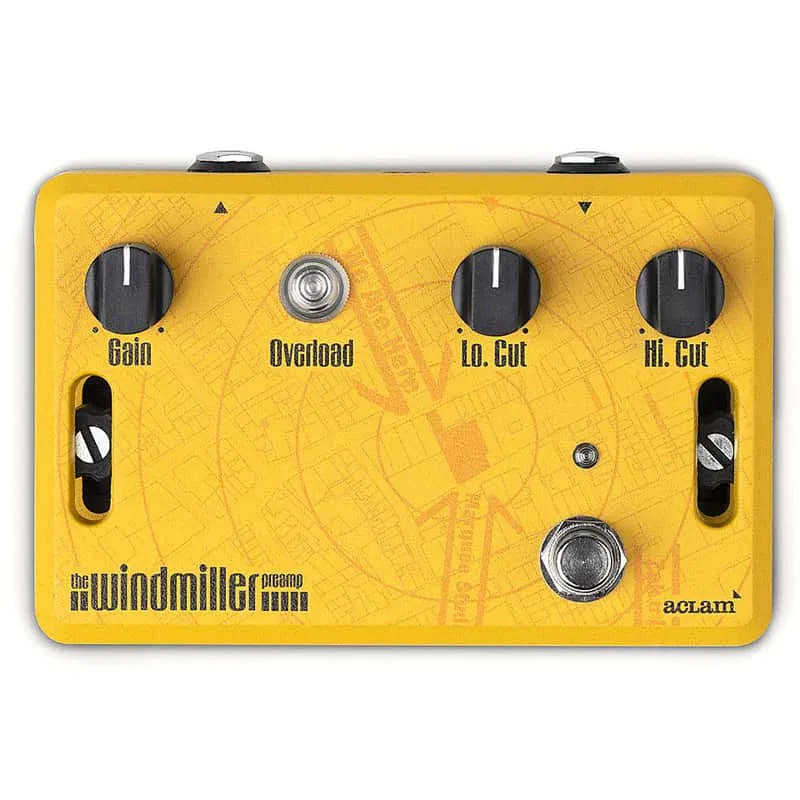
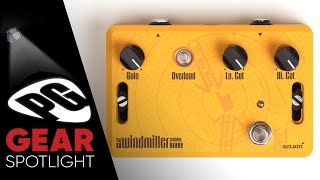


The Windmiller Preamp is a preamp pedal from Aclam, a Spanish maker, that puts the preamp section of a vintage spring reverb unit into a stompbox. The original is the Grampian Type 636, and Guitar World's Trevor Curwen describes it as "the weapon of choice was the preamp in a spring reverb unit, the Grampian Type 636" in the context of Pete Townshend's late 1960s rig1. Aclam based its circuit on a specific unit, a Grampian Reverberation Unit Type 636 serial number 11382.
The pedal behaves differently depending on where it sits in your chain. Fed straight from the guitar's high impedance output, it colors the tone and can push an amp into saturation. Fed from a buffered pedal, it acts as a transparent preamp, a louder version of the bypassed signal2. Aclam positions it as a versatile tool: an always on preamp, a booster for solo parts, or a saturation tool2.
A Grampian 636 preamp in a pedal
The story starts with The Who. Aclam traces the pedal's origin to the Grampian Type 636, the preamp in a spring reverb unit that the company calls Pete Townshend's "secret weapon" for driving an amp even further2. Gearnews reported on the pedal at its 2021 announcement as a preamp built around that same Grampian 636 circuit6.
Aclam's designer Marc Sospedra wrote about the project's aim:
"the goal I had in mind was to imagine the Grampian preamp Pete Townshend had in his dreams and try to make it real"
The circuit's character comes partly from a low input impedance, which Aclam notes is common on guitar effects of that era, like the Fuzz Face and Range Master and other 1960s units2. That is why the pedal reacts so differently to a guitar plugged straight in versus a buffered signal: the low input impedance loads the pickups the way those vintage units did.
The Windmiller is part of a series of Aclam pedals that replicate classic guitar tones, alongside the Cinnamon Drive and the Dr Robert6.
The controls
The knob layout matches the vintage Grampian, though the control functions are not the same7. There are three knobs plus the overload lamp.
| Control | What it does |
|---|---|
| Gain | Sets the amount of signal boost. Fully counterclockwise gives around 3 dB over the bypassed signal, depending on the tone knob settings. At full Gain the circuit shows a little asymmetrical clipping, so Aclam calls it a "clean" preamp5 |
| Lo. Cut | Reduces bass content. Fully counterclockwise reproduces the entire bass frequency spectrum like the vintage Grampian 636; turning it clockwise drops low frequencies. Aclam describes it as a fine tune control for deciding how tight the tone is25 |
| Hi. Cut | Removes highs as the knob turns clockwise. Fully counterclockwise is the brightest position; fully clockwise tames even the brightest pickup. Aclam says it can add sparkle to muddy humbuckers or tame brighter single coils25 |
| Overload light | An indicator lamp like the one on the original Grampian 636, sensitive to your playing and responsive to your attack. In the pedal it serves as a signal indicator, glowing brighter with higher gain and harder playing85 |
| Bypass switch | Engages the unit and lights the LED above it5 |
Guitar World's reviewer found the tone controls practical, calling them "a reason to buy" the pedal on their own1.
Power: 9V DC only
The Windmiller runs on a 9V DC center negative supply with a standard Boss type 2.1mm connector, drawing about 38 mA, and Aclam recommends a supply rated at 100 mA minimum25. There is no battery option; the manual specifies a power supply only5.
Do not power the Windmiller above 9V DC. The manual warns that a 12V or 18V supply will damage the circuit and immediately void the warranty5.
The pedal uses a custom light aluminum enclosure designed to fit Aclam's Smart Track pedalboards, with side thumb screws that lock it in place, though it works with other pedalboard options too5. It also carries Aclam's pedalboard fixing system, which Guitar World lists among its features1. The two-year warranty from the purchase date follows current Spanish legislation and is not transferable5.
History and versions
In its early stages of development the pedal went by the name "Grampian Overdrive"7. Aclam based the finished circuit on the preamp of a specific Grampian Reverberation Unit Type 636, serial number 113862, and sells the pedal under reference AP00303.
During the early stages of development the pedal was called the "Grampian Overdrive" before the Windmiller name settled in7. The regular version carries reference code AP00303.
Aclam also sells a Scratch & Dent version, reference AP0030-B. These are fully functional pedals tested to the same standards as regular products, but they may have minor cosmetic imperfections such as small scratches, smudges on the screenprint, or powder coating defects, and in some cases they are demo units used for reviews. They carry the same warranty, ship next day, and come with 30-day free returns9.
What reviewers said
Guitar World reviewed the pedal and summarized its practical strengths:
"Practical tone controls."
The review lists true bypass and the pedalboard fixing system among the features, notes its Spanish origin, and specifies the same power requirements: a 9V DC adaptor, not supplied, at 100 mA1. Delicious Audio described the pedal as a compact stompbox carrying the tonal character of the vintage Grampian preamp, and highlighted the overload lamp as sensitive to playing dynamics8.
Videos
Premier Guitar
Aclam Guitars
Aclam Guitars
Questions
Is the Aclam Windmiller Preamp the Pete Townshend Grampian sound?
It is Aclam's recreation of the preamp in the Grampian Type 636 spring reverb unit, the piece of gear Pete Townshend used with his amps to get his famous clean and fuzz tones. Aclam based the circuit on a specific unit, a Grampian Reverberation Unit Type 636 serial number 1138, so the pedal follows the same circuit rather than sampling his actual rig.
Is the Aclam Windmiller true bypass?
Yes. Aclam specifies relay true bypass, so when the pedal is disengaged the signal passes through without the circuit in the way. The bypass footswitch engages the unit and lights an LED above it. Guitar World's review also lists true bypass among the pedal's features.
What does the overload light on the Windmiller do?
It is an indicator lamp like the one on the original Grampian 636, and it reacts to your playing and attack. In the pedal version it works as a signal indicator: the higher the gain and the harder you play, the brighter it glows. It does not change the sound, it just shows what the circuit is seeing.
Does the Windmiller Preamp take a battery?
No. The manual specifies a 9V DC negative tip power supply only, with a standard Boss type 2.1mm connector, and no battery option is mentioned. It draws about 38 mA, and Aclam recommends a supply rated at 100 mA minimum. Powering it at 12V or 18V will damage the circuit and void the warranty.
What is the Windmiller Preamp Scratch & Dent version?
It is a sale version of the same pedal, reference AP0030-B, that Aclam sells with minor cosmetic imperfections such as small scratches, smudges on the screenprint, or powder coating defects, and in some cases demo units used for reviews. Aclam says these pedals are fully functional, tested to the same standards, and carry the same warranty as regular products.
Sources (9)
- Aclam Guitars The Windmiller Preamp review, Guitar World, 2022-03-14
- The Windmiller Preamp Effect Pedal, Aclam Guitars
- The Windmiller Preamp, Aclam Guitars
- Cinnamon Drive, Aclam Guitars
- AAFF-The WIndmiller Preamp.indd, Aclam Guitars (Llevinac S.L.), 2023
- NAMM 2021: Aclam's Windmiller Preamp pedal recreates Pete Townshend tones, gearnews.com, 2021-01-21
- The Windmiller Preamp: A few words & tips from its designer, Aclam Guitars, 2021-09-14
- Aclam Windmiller Preamp (Grampian's Type 636 Reverb Emulation), Delicious Audio, 2021-10-08
- Scratch & Dent The Windmiller Effect Pedal, Aclam Guitars