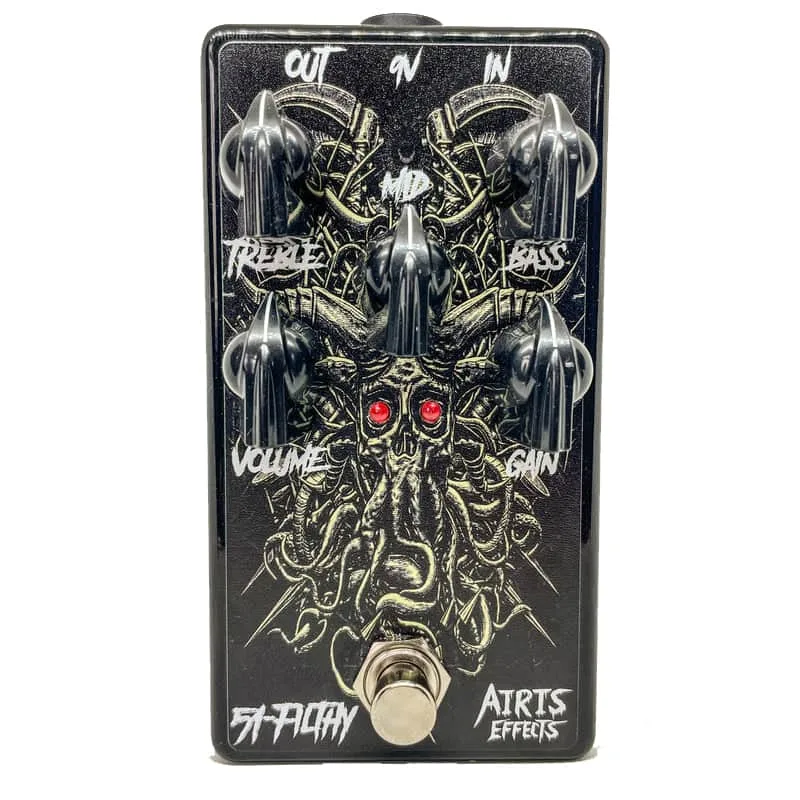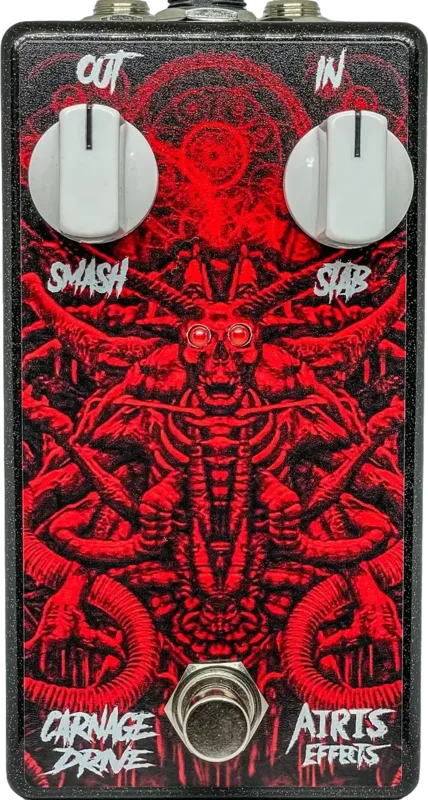

The Carnage Drive is an analog distortion and overdrive pedal from Airis Effects, built around the idea of covering a wide range of drive tones with as few controls as possible. RockBoard's PedalPedia describes its main goal as giving players "the absolute maximum amount of versatility in as few controls as possible," aiming for what it calls all great tones and zero bad tones with no effort to dial in1. It sits in the distortion and overdrive territory, and players comparing high gain pedals from the same maker may also come across the Airis Effects 51-Filthy, a separate high gain preamp design.
How it works
The pedal's design centers on two things: a small control set and a dedicated extra gain stage. RockBoard's PedalPedia says it added that extra gain stage "so that it's truly the loudest it could possibly be without decimating the amp's input," meaning the pedal pushes hard while leaving the front of a tube amp intact1.
The controls are few, and each does a specific job:
| Control | What it does |
|---|---|
| Smash | Adds a bit of gain; at full settings RockBoard's PedalPedia says it is "the most brutal and vicious it could be"1 |
| Stab | Adds bite and attack, and tightens the sound as you increase it1 |
On Stab, the maker is direct about the character it brings: "The Stab control not only adds in a truckload of bite and attack, but it also tightens as you increase it." At higher settings, RockBoard's PedalPedia says the pedal is brighter and tighter than almost anything it has offered1. For a player, that means Stab is the control to reach for when a riff needs to sit forward in the mix, and to back off when the amp itself should carry more of the voice.
Power and setup
The Carnage Drive runs on 9V DC, center negative, the standard polarity for most pedalboard supplies1. As with any analog drive pedal, a clean regulated supply keeps noise down, and it is worth checking what your power brick can share before adding it to a daisy chain with high draw pedals.
Hearing it
A demo of the Carnage Drive by Kyle Bull, in English, is listed on the maker's product page, and it is the place to hear how the Smash and Stab controls respond across the pedal's range1.
Videos
Truck Driver Shawn
The Shred Vault
Questions
Is the Airis Effects Carnage Drive analog?
Yes. The Carnage Drive is an analog circuit, according to the maker's product information. That means the signal is processed entirely in the analog domain rather than converted to digital, which is the usual approach for a straightforward drive pedal and lets it sit on a board alongside other analog pedals without any conversion stages.
What power supply does the Carnage Drive use?
The Carnage Drive runs on a 9V DC supply with a center negative plug, the standard arrangement for most guitar pedals. Use a regulated pedal power supply or a dedicated output on a pedalboard power brick rather than an unregulated adapter, and keep it off a daisy chain with pedals that draw heavily or use opposite polarity.
What does the Stab control do?
Stab shapes the attack side of the pedal. According to Airis Effects, the Stab control adds a truckload of bite and attack, and it also tightens the sound as you increase it. At higher settings the pedal is brighter and tighter than almost anything the company has offered, which suits players who want a firm low end under heavy gain.
Is there a demo video of the Carnage Drive?
Yes. A demo of the Carnage Drive by Kyle Bull, in English, is listed alongside the pedal on its maker's product page, so players can hear how the Smash and Stab controls behave before trying one.
Sources (1)
- The Carnage Drive by Airis Effects, RockBoard PedalPedia, 2026