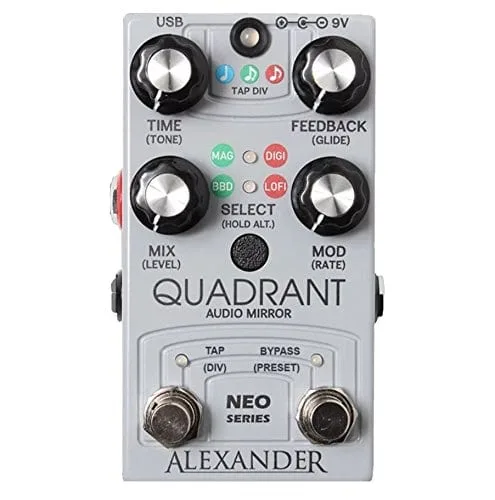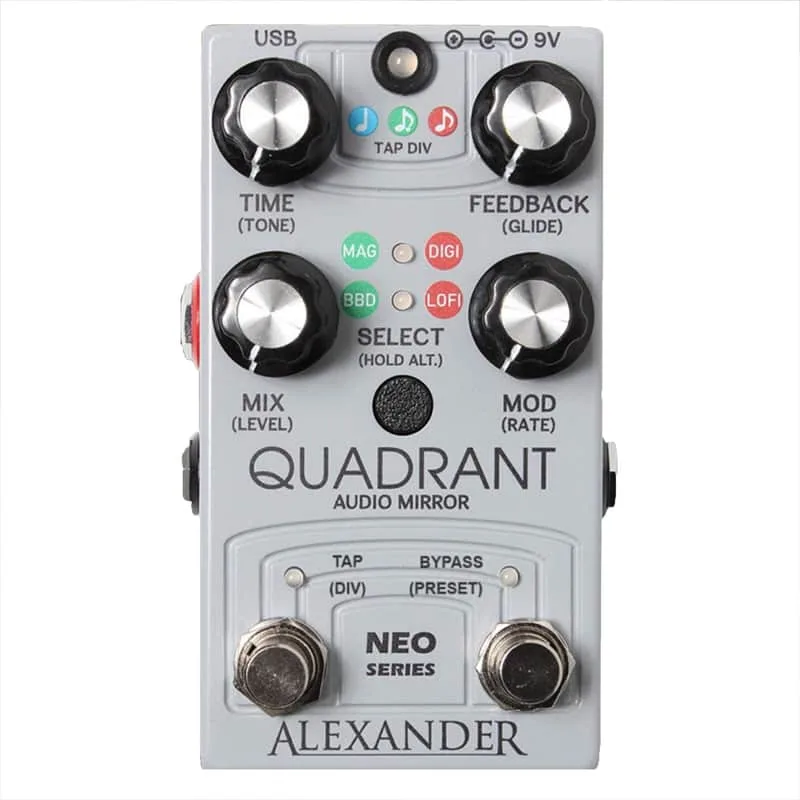


The Alexander Pedals Quadrant Audio Mirror is a compact Neo Series stompbox delay, available now for $1991. It carries the usual set of rate, feedback, mod and mix controls, with the rate control reaching up to 915ms1.
Delay types and controls
Four delay types are onboard: magnetic, analog, digital and lo-fi1. Around them sits what MusicRadar called "the usual set" of controls1:
| Control | What it does |
|---|---|
| Rate | Sets the delay time, up to 915 ms1 |
| Feedback | Sets the number of repeats1 |
| Mod | Sets modulation on the repeats1 |
| Mix | Blends the wet and dry signal1 |
| Glide | Adjusts how the delay time changes: low settings give a seamless change, while higher settings produce pitch-shifts when the time is adjusted1 |
The Glide knob is the pedal's distinguishing control. MusicRadar described it as adjusting "how the delay time changes: low settings result in a seamless change; upping the dial results in pitch-shifts when adjusted"1. In practice, that means a player can choose between the smooth time-stretching of a digital delay and the warpy, note-bending response of older tape and analog units when the rate knob is turned or the delay time is swept.
Presets, tap tempo, MIDI and expression
Sounds can be saved and recalled in four presets, cycled by holding the right footswitch1. Expression pedal and MIDI compatibility, plus tap tempo, are also onboard1, so the pedal can be synced to a tempo, swept from an expression pedal or worked into a MIDI-controlled rig.
Where it sits in Alexander's delay range
The Quadrant is a compact Neo Series stompbox from Alexander Pedals, available now for $1991. Its delay time reaches up to 915ms via the rate control, alongside feedback, mod and mix controls1.
Videos
Chicago Music Exchange
Eirik Stordrange
Distortion LTD
Questions
What delay types does the Quadrant Audio Mirror have?
Four delay types are onboard: magnetic, analog, digital and lo-fi. The magnetic and analog flavors lean toward the character of older delay lines, while digital gives a cleaner repeat and lo-fi degrades it. MusicRadar reported these four types when Alexander Pedals unveiled the pedal at NAMM 2018, alongside the standard rate, feedback, mod and mix controls.
Does the Quadrant Audio Mirror have tap tempo?
Yes. MusicRadar's NAMM 2018 report lists tap tempo as onboard, along with expression pedal and MIDI compatibility. That means you can set the delay time by tapping the footswitch in time with the music rather than turning the rate knob by hand.
How do you change presets on the Quadrant Audio Mirror?
The pedal holds four presets, and you cycle through them by holding the right footswitch. Sounds you dial in can be saved and recalled from those four slots, which makes it practical for switching between different delay settings during a set.
Can the Quadrant Audio Mirror be used with an expression pedal?
Yes. Expression pedal compatibility is onboard, as reported by MusicRadar at the pedal's 2018 unveiling, along with MIDI compatibility and tap tempo. An expression pedal lets you sweep a parameter, such as delay time, in real time with your foot.
What does the Glide knob do?
The Glide knob adjusts how the delay time changes when it moves. At low settings the change is seamless, so shifting the delay time does not affect the pitch of the repeats. Turning the Glide knob up produces pitch-shift effects when the delay time is adjusted, a character familiar from tape and analog-style delays.
Sources (1)
- NAMM 2018: Alexander Pedals unveils Quadrant Audio Mirror delay, MusicRadar, 2018-01-11