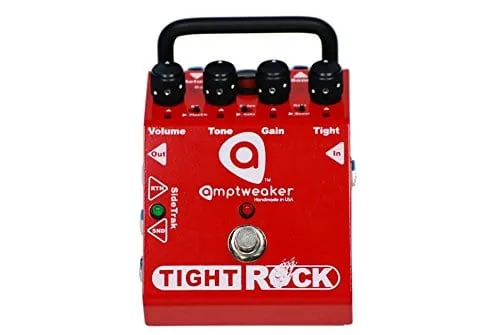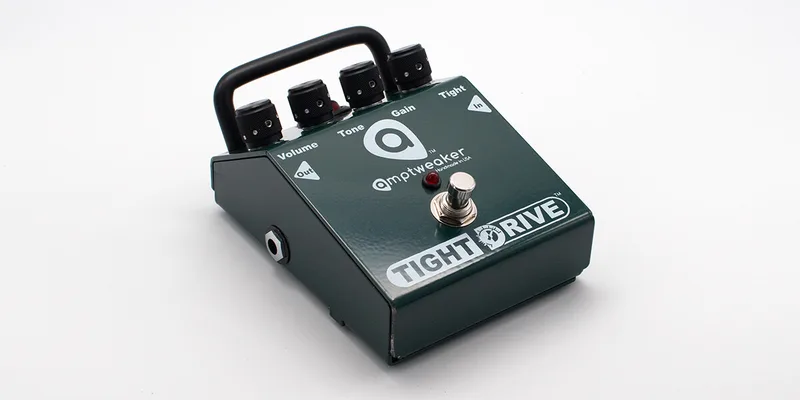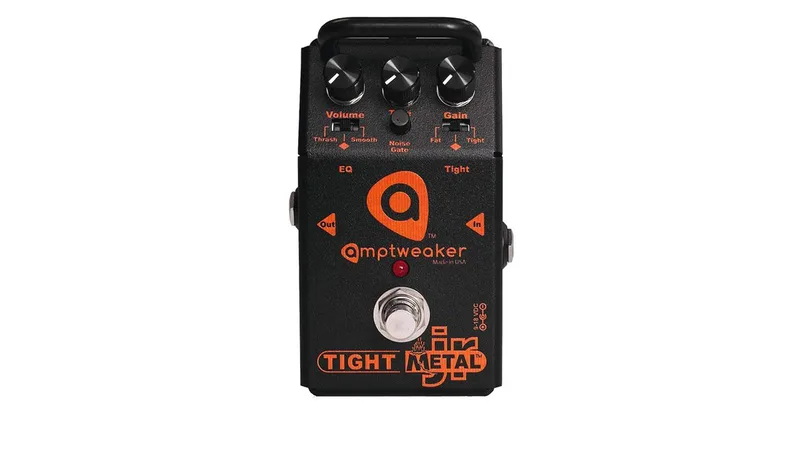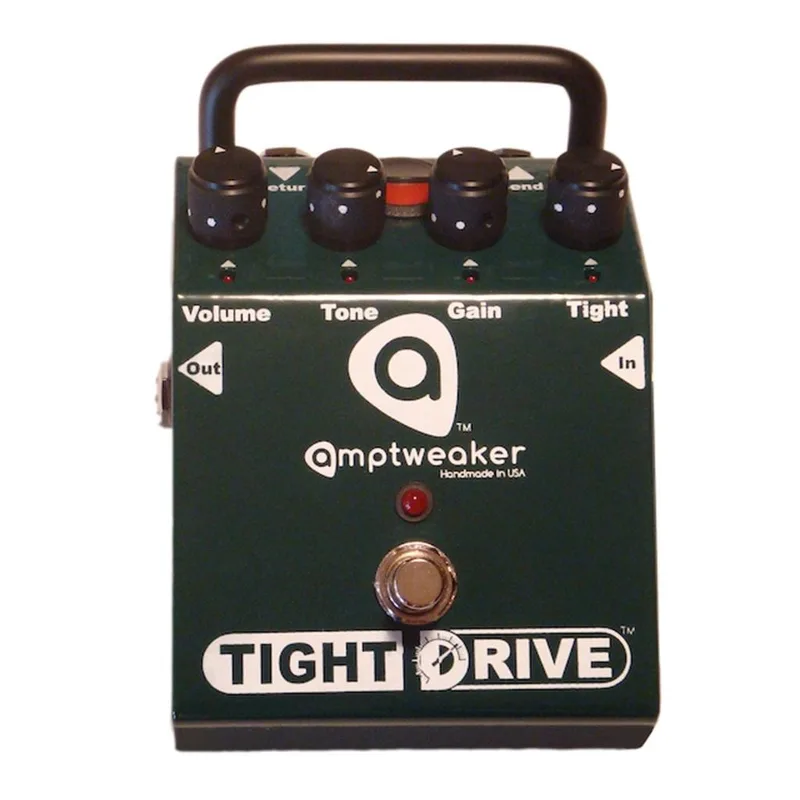



The Amptweaker TightDrive is an analog overdrive pedal, the first pedal from AmpTweaker, the company founded by high-gain amp designer James Brown. Amptweaker describes it as covering everything from a nuanced push to the front end of your amp all the way to heavy overdrive and distortion, with the maker calling it exceptionally responsive and detailed1. What sets it apart from most overdrives is the Tight control, which shapes how smooth or aggressive the low end sounds and feels, plus a built-in noise gate and a SideTrak effects loop for inserting other pedals into its signal chain.
The pedal was introduced at the January 2010 Winter NAMM show2, and Premier Guitar's review put its street price at $1803. Amptweaker's own site lists the Tight Drive at $189.004.
What the TightDrive does
Amptweaker pitches the TightDrive as redefining the standard overdrive, from a clean-ish push into your amp's front end to heavy overdrive and distortion territory, all in an all-analog circuit the maker says carries none of the latency associated with digital technology1. A built-in noise gate, described by the maker as fast and responsive, keeps the output quiet when you stop playing, which pairs naturally with the pedal's tighter, more aggressive low-end voicing1.
The circuit was traced by Aion FX in 2023, and their analysis gives a technical picture of how the pedal gets its character: a pre-drive bass cut, high-threshold zener clipping, and a Big Muff-style tone stack6. That pre-drive bass cut is what feeds the Tight control's effect on attack and response. Aion FX also notes that the Tight Drive predated the Tight Metal and Tight Rock by a year, with a topology that is overall very similar to those two later pedals but simplified6.
Premier Guitar's reviewer found the pedal's response and sound differ from amp to amp, writing that the TightDrive is not a one-size-fits-all effect where a single setting works with different amps3. In other words, expect to dial it in for each amp you play through.
The controls
The front panel carries Volume, Tone and Gain controls, a Fat & Tight switch, and the Tight control1. James Brown described the thinking behind the Tight control at the pedal's announcement:
"The result is the included Tight control which allows the player to dial in how smooth or aggressive the low end sounds"
| Control | What it does |
|---|---|
| Volume | Sets the pedal's output level |
| Gain | Sets the amount of overdrive, from a nuanced push to heavy overdrive/distortion1 |
| Tone | Shapes the frequency balance through a Big Muff-style tone stack6 |
| Tight | Dials in how smooth or aggressive the low end sounds and feels7 |
| Fat & Tight switch | Selects between the two low-end voicings1 |
Premier Guitar's review of the Bass TightDrive notes that the Tight control on the standard TightDrive offers a multitude of distortion flavors, mostly affecting the amp's attack and response8. The pedal also has a pre/post switch for its effects loop, selecting whether a looped pedal sits before or after the overdrive circuitry7.
The SideTrak effects loop
The effects loop is the TightDrive's most unusual feature. It lets you plug another pedal into the TightDrive's own signal path, with the pre/post switch choosing whether that pedal hits your signal before or after the overdrive circuit7. Premier Guitar's review notes that several artists who currently use the pedal have used the loop to dial in their exact feel and tone, since it puts mod capability directly in the player's hands3.
On the Bass TightDrive variant, the loop is even more flexible: a switch selects whether the loop sits before the pedal's first preamp stage or after its final output stage8.
Power: 9V or 18V
The TightDrive runs on 9V or 18V DC. Amptweaker's guidance is to run it at 18V for more headroom or 9V for more drive and compression1. Current draw is 13mA with a 9V adapter and 15mA at 18V, and the power supply is not included1.
The 9V battery lives in a sliding drawer secured with a magnetic latch, so changing the cell requires no tools3. There is also a standard DC adapter jack3.
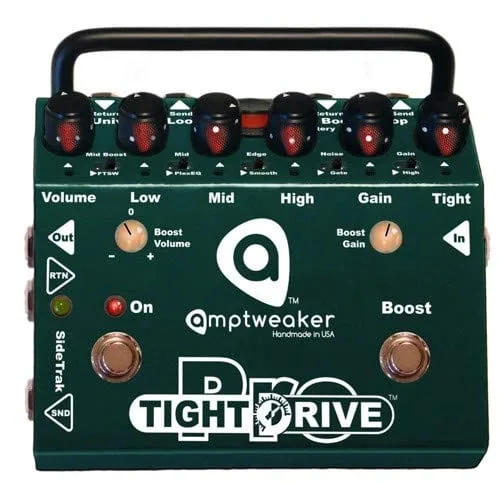
The later TightDrive Pro takes this further: it accepts batteries or a barrel adapter at 9 or 18V, with two 9V connectors under its magnetic door so you can run it at 18V on batteries for more headroom. Premier Guitar's reviewer found that an 18V adapter gives what sounds like a lot of extra volume on the Pro's boost, requiring very low boost volume settings to reach unity gain9.
Where it came from
The TightDrive has an unusual origin story. Renowned amp builder James Brown announced a new venture in which he would take public suggestions for products, and the TightDrive Overdrive pedal was the first product of that method under the Amptweaker name, developed from hundreds of online consumer product ideas7. It was introduced at January NAMM 20102.
A bass version followed quickly. At that same January 2010 NAMM show, Brown met bassist Greg Weeks, who tested the guitar version and suggested tweaks to the range of the Tone and Tight controls for his playing style, leading to the Bass TightDrive introduced in May 20102. Premier Guitar's review of the Bass TightDrive called it a clear winner, a magnificent choice for bassists looking to cover a lot of sonic ground, with great sound, tonal versatility and rugged construction8.
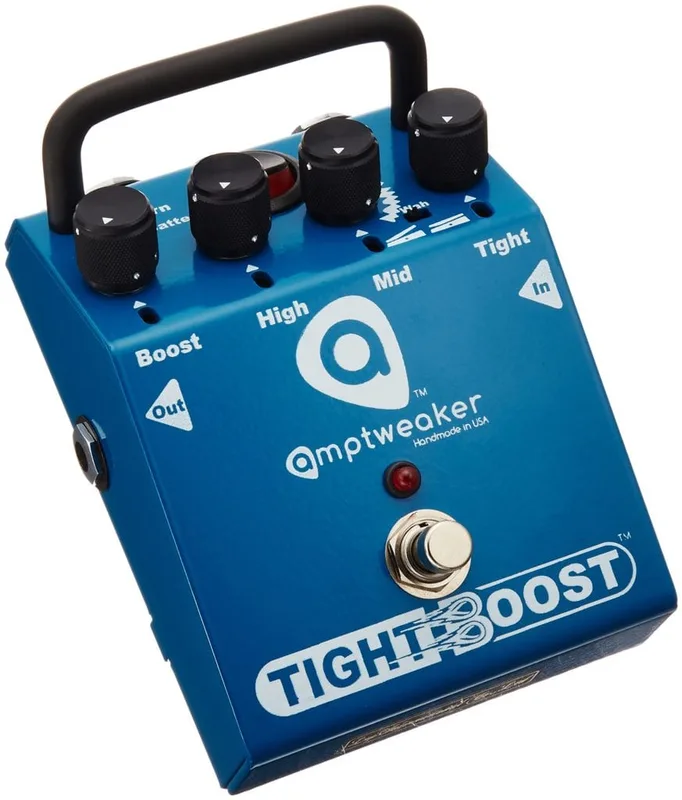
The TightDrive also spawned a family of pedals. The TightBoost, a cleaner-boost variation, was announced in August 201010. The TightMetal distortion, introduced at NAMM 2011, took what MusicRadar's press release called the TightDrive and TightBoost overdrive platform to the next level10. Aion FX's circuit analysis puts the relationship plainly: the Tight Metal and Tight Drive are 95% the same as each other, just voiced differently11. The TightDrive Pro later expanded the original with a "plexi"-inspired voicing switch, high-end cut, and two fat switches, which Premier Guitar's reviewer described as an exponentially more capable and flexible TightDrive delivering everything from light OD to heavy distortion9.
Who uses it
Premier Guitar's review notes that several artists currently use the pedal and have used its effects loop to dial in their exact feel and tone3. The pedal is handmade in the US in a robust 14-gauge steel chassis3, and Amptweaker covers it with a 5-year limited warranty1.
For more on the category, see overdrive pedals.
Videos
Amptweaker
Amptweaker
Amptweaker
Questions
Does the Amptweaker TightDrive take a battery?
Yes. The 9-volt battery sits in a sliding drawer secured with a magnetic latch, so you can swap the cell without tools. There is also a DC adapter jack, and the pedal draws 13mA at 9V or 15mA at 18V. The power supply is not included with the pedal.
Is the Amptweaker TightDrive true bypass?
Yes. Amptweaker lists the Tight Drive as true bypass, and Premier Guitar's review confirms a true-bypass footswitch. When the pedal is off, your signal passes through without buffering, which matters if you run long cable runs or plan to stack it with other true-bypass pedals.
What is the difference between the TightDrive and the TightMetal?
The TightMetal is a heavier distortion pedal built on the TightDrive platform, introduced at NAMM 2011 a year after the TightDrive. According to Aion FX, which traced the circuit, the two are 95% the same as each other, just voiced differently. The TightDrive covers nuanced push through heavy overdrive, while the TightMetal goes further into distortion.
What does the effects loop on the TightDrive do?
The SideTrak loop lets you insert another pedal into the TightDrive's own signal path, with a pre/post switch to place it before or after the overdrive circuitry. On the Bass TightDrive, a switch selects whether the loop sits before the pedal's first preamp stage or after its final output stage, so you can shape where an added effect lands.
Sources (11)
- Tight Drive, amptweaker.com, 2024-07-08
- Gear Watch: Amptweaker TightDrive Bass Overdrive Pedal, No Treble, 2010-05-08
- Amptweaker TightDrive Pedal Review, Premier Guitar, 2010-07-20
- Tight Rock, amptweaker.com, 2025-12-08
- Amptweaker Introduces TightBoost Pedal, Premier Guitar, 2010-08-23
- Blaze Dynamic Overdrive / Amptweaker Tight Drive, Aion FX, 2023-11-24
- Amptweaker Launches User-Requested TightDrive Pedal, Premier Guitar, 2010-01-15
- Amptweaker Bass TightDrive Pedal Review, Premier Guitar, 2010-07-20
- Amptweaker TightDrive Pro Review, Premier Guitar, 2014-11-25
- NAMM 2011: Amptweaker introduce TightMetal distortion pedal, MusicRadar, 2011-01-11
- Tracing Journal: Amptweaker Tight Drive, Aion FX, 2023-11-24
 James Brown