

The AMT Electronics AMT FX M-Drive mini is a compact distortion pedal built around JFET circuitry, a transistor design AMT uses to shape the gain stages. The maker describes it as designed for guitarists looking for distortion sounds similar to that of the Marshall JCM800 amplifier, the British gain amp whose overdrive channel defined a large share of hard rock and metal tones1. It is part of AMT's Drive Series and is listed as available now1.
Controls
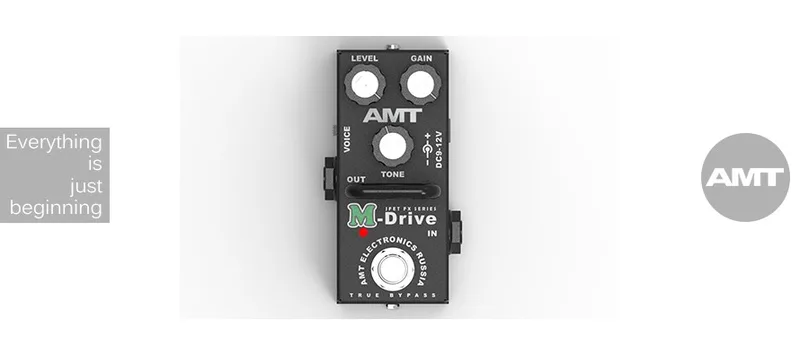
The mini keeps its panel to four controls plus a switch, each with a defined job1:
| Control | What it does |
|---|---|
| GAIN | Sets the pedal sensitivity and the amount of drive or distortion |
| LEVEL | Sets the overall output level; the range provides a standard minimum of -10dB and reaches +8dB at maximum |
| TONE | A simplified control for general tone matching of the pedal to your amplifier |
| VOICE | A switch that cuts some mids |
The LEVEL range is worth noting for level-matching: with a floor of -10dB and a maximum of +8dB, the pedal can sit quietly under the amp's own volume or push the front end noticeably harder1.
Where it goes in the chain
AMT designs the Drive Series effects to be connected in front of the clean channel inputs of guitar combos or amplifiers1. In practice that means the M-Drive mini supplies the distortion itself and the amp stays clean, which is how the JCM800-style voicing is meant to be heard. The maker also cautions that when using Drive Series effects, the resulting sound is mainly influenced by the combo or amplifier you use, as well as the speakers installed in the cabinet, so the same pedal can read differently through different rigs1.
Noise gate and bypass
Two features sit outside the tone controls. The pedal includes a noise gate, set globally rather than per preset, which is useful at high gain settings where the circuit's noise floor becomes audible2. And the bypass is true bypass: AMT states there is no tone coloration, signal degradation, or loss while the pedal is not in use1.
AMT positions the M-Drive mini in its Drive Series, effects the maker says are designed to be connected in front of the clean channel inputs of guitar combos or amplifiers1. The pedal remains available now, with GAIN, LEVEL and TONE controls covering drive amount, output level and tone matching to your amplifier1.
Power
The M-Drive mini needs a standard 9V DC supply with a negative center pin, the common polarity for pedalboard supplies1. Its draw is less than 4mA, low enough that it shares a daisy-chained or multi-output supply without strain1.
Related AMT Drive pedals
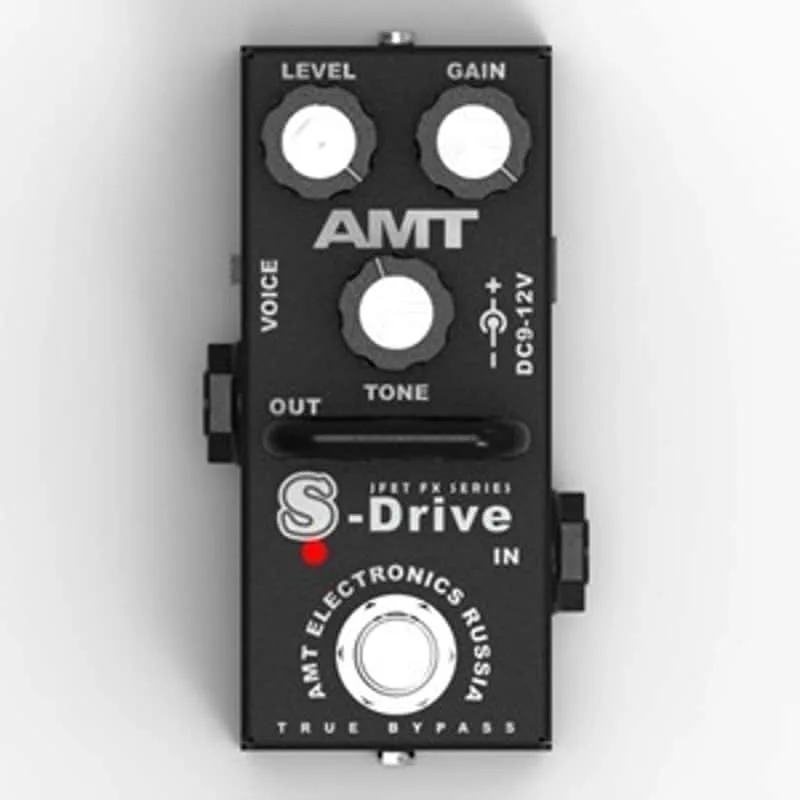
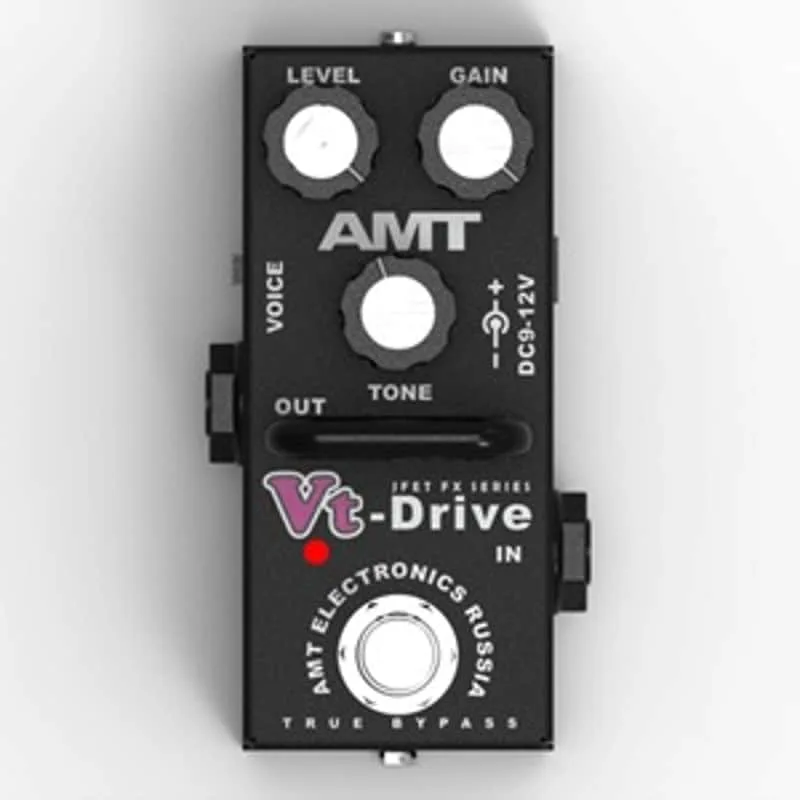
The M-Drive mini sits in a family of similarly voiced AMT minis, each with its own character: the S-Drive mini, P-Drive mini, O-Drive mini, VT-DRIVE mini, C-DRIVE mini, E-DRIVE mini and B-DRIVE mini1.
Videos
Montreux Guitars
Guitar Bonedo
Dmitriy Pereverzev
Questions
Does the AMT M-Drive mini have a noise gate?
Yes. AMT lists a noise gate as a feature of the M-Drive mini, and it is described as a global setting, meaning it applies across the pedal rather than being set per preset. Players using high gain settings, where the JCM800-style distortion can pick up hum and hiss, can use the gate to quiet the pedal between phrases.
Is the AMT M-Drive mini true bypass?
Yes. AMT states the pedal uses true bypass circuitry, so when it is switched off the guitar signal passes through without tone coloration, signal degradation, or loss. That matters on a pedalboard where several pedals sit in the signal path and each stage of buffering can affect the sound.
What power supply does the AMT M-Drive mini need?
The M-Drive mini runs on a standard 9V DC supply with a negative center pin, the same polarity used by most modern pedals. AMT notes its voltage consumption is low, drawing less than 4mA, which makes it easy to run from a shared multi-output supply alongside other pedals.
Should the M-Drive mini go in front of a clean channel or a distorted one?
AMT designs its Drive Series effects, including the M-Drive mini, to be connected in front of the clean channel input of a guitar combo or amplifier. The pedal supplies the distortion itself, so plugging it into an already distorted channel stacks two stages of gain and departs from the JCM800-style voicing it is built around.
What does the Voice switch do on the M-Drive mini?
The Voice switch cuts some of the midrange. It is a quick way to change the pedal's character: with mids intact the sound sits forward in a band mix, while cutting them moves it toward the scooped, heavier voicing some players prefer for high gain styles.
How much current does the M-Drive mini draw?
AMT specifies current draw of less than 4mA. That is low by pedal standards, so the M-Drive mini puts very little demand on a power supply and can share an output of a multi-pedal supply with several other low-draw pedals.
Sources (2)
- AMT FX M-DRIVE mini, AMT Electronics, 2026
- AMT FX M-DRIVE mini, Media center of AMT Electronics