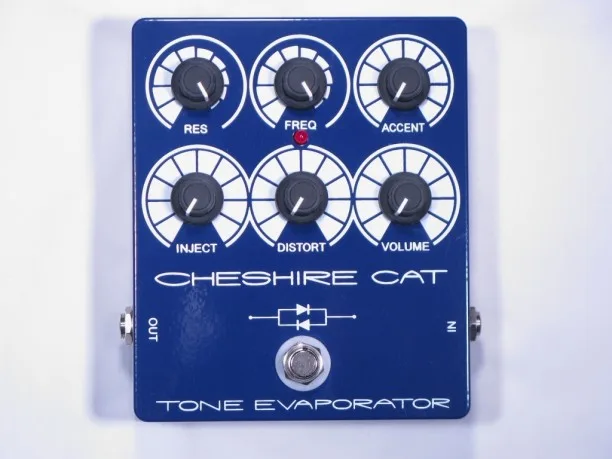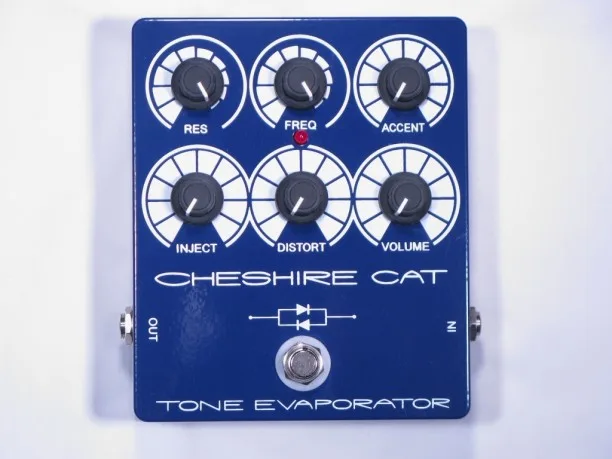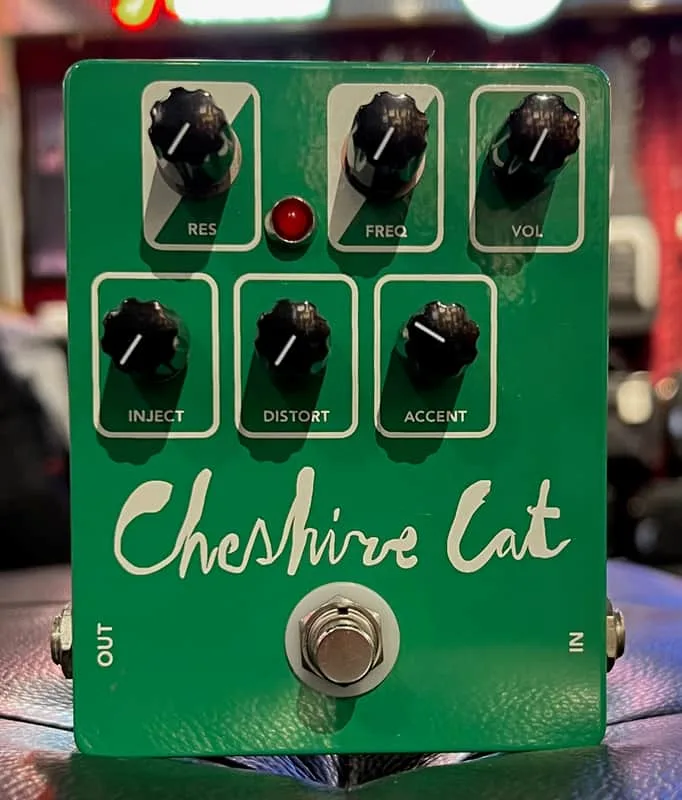
The Amzel Electronics Cheshire Cat Tone Evaporator is a distortion pedal from Amzel Electronics, reviewed at $2481. Its inject control sets it apart from a conventional distortion pedal: turned down, it works as one, while with distort at zero the volume can be set so the pedal level matches the thru level, giving what the reviewer called "a very pleasing lift to the guitar's upper mids and a hint of gain," functioning like a high-quality colored boost1.
What sets it apart from a conventional distortion pedal is the Tone Evaporator circuit: the tone filter is designed to affect only the part of the signal that exceeds the distortion threshold, while leaving the basic guitar sound alone1. Delicious Audio's review puts it another way: the pedal focuses on customizing the tone of the plateau portion of the clipped waveform, giving you the ability to make that flat clipped segment into a frenzied mess all its own2.
Controls
The pedal has six knobs in two rows. The bottom row shapes the overall sound; the top row focuses in specifically on the distortion "clipped" part of the tone2.
| Control | What it does |
|---|---|
| Distort | Sets the distortion for the whole tone, not just the actual distortion2 |
| Volume | Output level2 |
| Inject | Changes the way the three circuits interact: at zero it disables the filters and dynamics, and at higher values it increases the distortion and activates the Res(onance), Freq(uency) and Accent controls3. It also controls the degree to which the top-row knobs impact the clipped tone2 |
| Resonance | Affects the unit's filter response; with Res at full, sweeping the Freq knob has an effect like the Q control on an envelope filter, yielding choked tones and vowel-like tonal characters1 |
| Frequency | Functions like a basic tone control1 |
| Accent | One of the three top-row knobs focused on the clipped part of the tone2 |
Because the Inject knob sits between the two rows, it can be used like a mix control: once you find your tone, you can make it more or less pronounced, which Guitar.com found useful in the studio for adjusting the sound for different parts of a song1.
Using it as an ordinary distortion, or a boost
Distort and Volume are the basics: keep the Inject control turned down and you have the services of a conventional distortion pedal1. Guitar.com found that with Inject all the way down, the basic sound is very usable1.
There is a second use at the other end of the range. With Distort at zero, you can set the Volume so the pedal level matches the through level. The result, per Guitar.com, is a very pleasing lift to the guitar's upper mids and a hint of gain, functioning like a high-quality colored boost1, a role usually filled by a dedicated boost pedal.
Edging the Distort up brings on a very amp-like character, where your playing dynamic controls the balance between clean and distorted sounds, from crunchy chords to a full-on, compressed Velcro-fuzz vibe1, territory that overlaps with fuzz pedals and overdrive pedals.
Delicious Audio's reviewer listed guidepost settings that include a conventional distortion tone, a few different enhanced distortion tones for added texture, a noisy distortion, and the "fried" tone, with the Inject, Accent and Resonance all maxed out and the Frequency dialed back2.
The green and blue versions
The original Cheshire Cat shipped in a blue enclosure3. In 2015 Amzel released a new green version, which Guitar.com reviewed: it boasts higher-quality potentiometers and a smaller footprint than the original blue version1. Guitar.com's reviewer had warm words for the original, calling it "one of those `secret weapon' pedals you find yourself wondering about when you sneak a"1.
The casing is on the large side, so it may not be ideal for space-saving boards, though Delicious Audio's reviewer thought it had a great look2. The green version's smaller footprint addresses some of that1.
What reviewers said
Delicious Audio's Ryan Dembinsky came away enthusiastic:
"Now here's a clever pedal that was a blast to demo."
He summed it up as "it's a flexible distortion pedal that covers a variety of needs"2, and praised the concept as a great idea in terms of a new way to think about distortion overall2. Guitar.com's verdict was shorter: "The purr-fect friend for distortion tweakers…"1.
Questions
What does the Inject knob do on the Amzel Cheshire Cat?
The Injector knob changes the way the pedal's three circuits interact with each other. At zero it disables the filters and dynamics sections, and at higher values it increases the distortion and activates the Resonance, Frequency and Accent controls. Delicious Audio's review describes it as controlling the degree to which the top-row knobs impact the clipped tone, and Guitar.com notes it can be used like a mix control to make a found tone more or less pronounced.
Can the Cheshire Cat be used as an ordinary distortion pedal?
Yes. Guitar.com's review says that with the Inject control turned down it works as a conventional distortion pedal, and that with Inject all the way down the basic sound is very usable. With the Distort knob at zero, the Volume can be set so the pedal level matches the through level, giving a lift to the guitar's upper mids and a hint of gain, functioning like a high-quality coloured boost.
What is the Tone Evaporator circuit?
It is the Cheshire Cat's approach to distortion: instead of filtering the whole signal, the tone filter is designed to affect only the part of the signal that exceeds the distortion threshold, leaving the basic guitar sound alone. Delicious Audio describes it as customizing the tone of the plateau portion of the clipped waveform, turning the flat clipped segment into what the reviewer called a frenzied mess all its own.
What is the difference between the green and blue Cheshire Cat?
The green version, released in 2015, boasts higher-quality potentiometers and a smaller footprint than the original blue version. Guitar.com's review of the green pedal calls the original blue Cheshire Cat one of those secret weapon pedals, and the two share the same control layout and Tone Evaporator circuit.
What does the Freq knob do on the Cheshire Cat?
According to Guitar.com, the Freq knob functions like a basic tone control in normal use. But it also affects the unit's filter response: with the Resonance knob at full, sweeping the Freq knob has an effect like the Q control on an envelope filter, yielding choked tones and vowel-like tonal characters.
Sources (3)
- Amzel Cheshire Cat review, Guitar.com, 2015-08-07
- Pedal Reviews: Amzel Electronics’ Cheshire Cat Tone Evaporator, Delicious Audio, 2014-12-11
- New Pedals: Amzel Electronics' Cheshire Cat Tone Evaporator, Delicious Audio, 2014-07-14