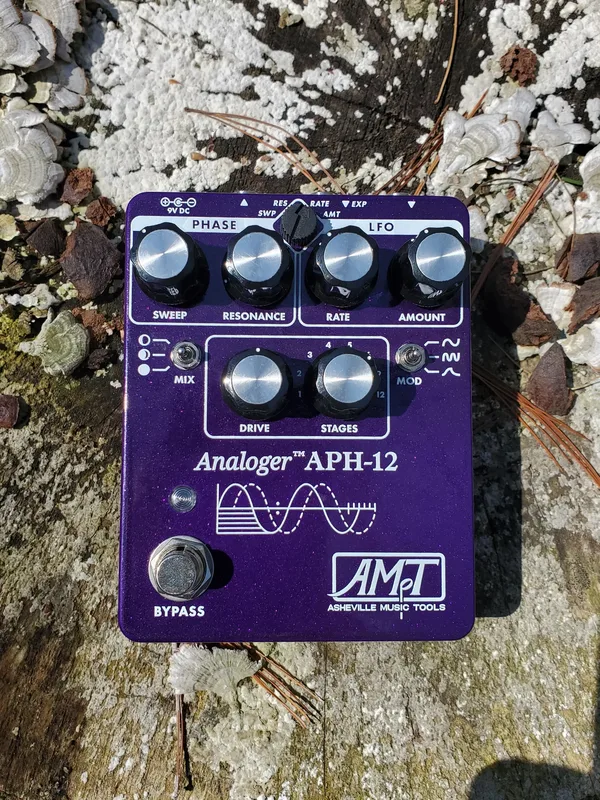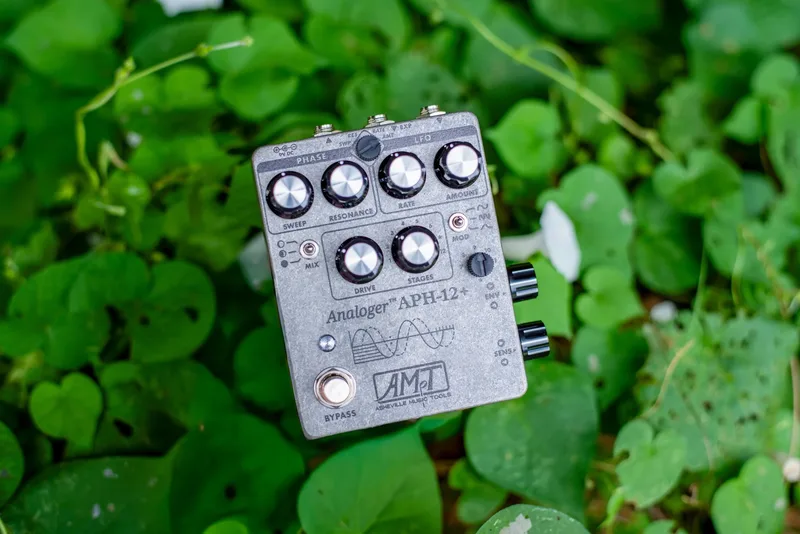


The Asheville Music Tools Analoger APH-12 is a fully analog phaser whose defining feature is a selectable stage count: a 12-position rotary knob chooses anywhere from 1 to 12 stages of phase shifting, where most phasers fix you at 2, 4 or maybe 81. The signal, modulation and control paths are 100% analog, and the filters are based on an OTA style filter IC from designer Dave Rossum2.
It was designed by Hawker, the engineer behind the discontinued Moog Moogerfooger pedal series, and Premier Guitar's reviewer identifies him as Rick "Hawker" Shaich, who dedicates the pedal in its manual to the memory of Grateful Dead bassist Phil Lesh3. Guitar Pedal X reports it was around 3 years in the making4. It launched in April 2025 at $3975, and Guitar Pedal X's Stefan Karlsson still lists it as available direct from the Asheville Music Tools site as of May 20264.
A phaser with 1 to 12 stages
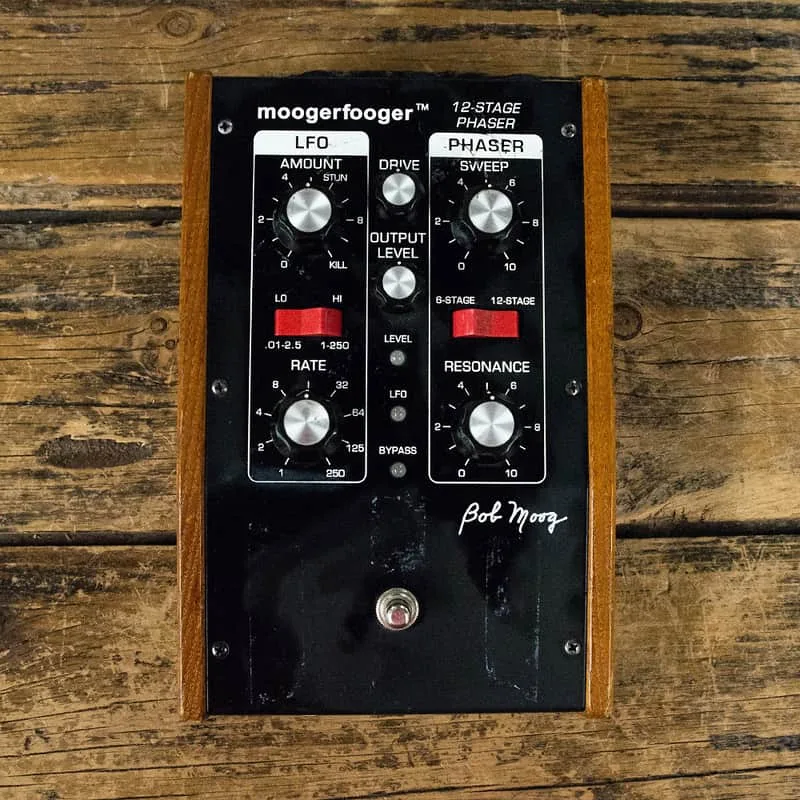
The stage selector is the heart of the pedal. A 12-position rotary knob picks the phase stage count, and the available settings are 1 through 6, 9 and 12, eight options in total, with odd numbers running out of phase41. Where the Moog MF-103 offered just 6- and 12-stage phasing, the APH-12 also does 2- and 4-stage phasing plus single-stage and odd-numbered staging that Premier Guitar's reviewer found yields unusual colors3.
The low and odd settings are where this circuit goes where pedals rarely have before. Delicious Audio notes that the low-count (1-2-3) and odd-number (5-7-9-11) stage settings are "something rather unexplored in the pedal realm before this circuit"1. Concretely:
- 1 stage: a high pass filter that makes for a great tremolo sound1
- 2 stages: a notch filter1
- 3 stages with envelope control: Delicious Audio says it "can challenge any auto-wah out there"1
- 12 stages with a slow sweep: the maker points out "there is nothing quite like a 12-stage phaser with a 2 minute sweep"2
The LFO is a sine wave, with a Slow range of under 0.01Hz to 2.3Hz (3.3Hz with CV control) and a Fast range of under 0.3Hz to 78Hz, around 115Hz with CV4. The sweep center runs from 25Hz to 10kHz typical, extending from 3Hz to under 50kHz using the LFO, envelope or external control voltage4.
The controls
Six knobs and two switches run the pedal, and Guitar Pedal X found "a tonne of range across those 6 dials and 2 switches"4.
| Control | What it does |
|---|---|
| Sweep | All-pass filter / manual control; sets where the filter centers4 |
| Resonance | Resonance / regeneration, from off to self-oscillation using the EXP input coupled with knob position4 |
| Rate | Modulation speed (LFO is a sine wave)4 |
| Amount | Modulation depth / width, from OFF to about 60% of Sweep4 |
| Drive | Up to 30dB of boost with increasing saturation and mid emphasis as gain rises4 |
| Stage selector | 12-position rotary, 8 settings: 1-6, 9, 12; odd numbers out of phase41 |
| MOD switch | LFO selector: Fast, Slow, Envelope4 |
| MIX switch | 3 positions: FX (mostly dry), 50/50, VIB (100% wet)4 |
The MOD switch's envelope position gives envelope-followed modulation, post drive control, that follows your playing dynamics2. The manual ships with 11 presets, including Classic 4-Stage, IKO IKO and Swirlitzer 12, each giving full knob and switch positions as starting points4.
Power and connections
Power comes from a standard 9VDC center negative 2.1mm x 5.5mm barrel supply2. The maker rates the draw at under 125mA, with 70 to 100mA typical and up to 200mA at startup2, so plan headroom on a shared supply. Connections are 1/4" TS in and out plus the EXP jack4. Input impedance is over 1MΩ, output impedance 1KΩ max, and maximum output signal is -0.9dBµ / 0.7VRMS4. Maximum input signal is -10dBµ / 0.25VRMS at 1% THD, or +1dBµ / 0.87VRMS at 10% THD4.
The bypass footswitch is true bypass with a mechanical switch, and its LED indicates the LFO rate or the envelope pre-amount signal2.
Expression and CV control
The EXP jack is a TRS input usable with either an expression pedal or control voltage, with a CV range of 0 to 5V, the ring supplying a current-limited roughly 5V output, and the control input on the tip4. A 4-way switch assigns the external control to Sweep, Regeneration, Rate or Amount, and the external control is additive to the front panel knob, extending its range rather than replacing it2.
That additive design matters: with CV pushing the rate, the Fast range extends from 78Hz to around 115Hz, and the Slow range from 2.3Hz to 3.3Hz4. The envelope follower gives positive sweep control of modulation with fast attack and medium release4.
Versions: Launch Edition and Plus
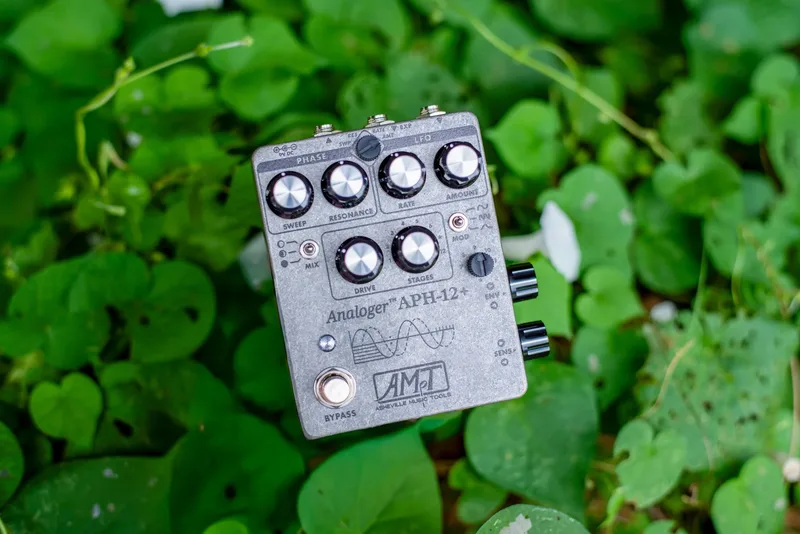
The APH-12 came in three versions. The Launch Edition was a launch-day-only run, numbered 128 through 148, each with a custom retro finish by artist Justin Hock; it is discontinued and sold out with no plans to restock7. The standard APH-12 is the current version. The APH-12 Plus builds on the Purple Phaze lineage with expanded stage selection and new modulation options, including a new input sensitivity control providing pre and post-gain sources with both positive and negative modulation, and a bipolar expression/CV input with a -5V to +5V range; it was released in limited quantities in the small batch series and is sold out6.
The Plus draws more current than the standard pedal: under 140mA, 90 to 115mA typical, up to 200mA at startup6. If you power both from one supply, budget for the higher figure.
What reviewers said
Premier Guitar's reviewer compared it directly to the Moog MF-103, noting that many aspects of its features and functionality mirror the MF-103 but with a very different architecture3. On conventional phaser sounds, the reviewer found them "deeply satisfying and, in terms of depth and character, rival or better my own favorite phasers"3. The verdict overall:
"the North Carolina-built APH-12 is an outstanding modulation, filtering, and noise machine"
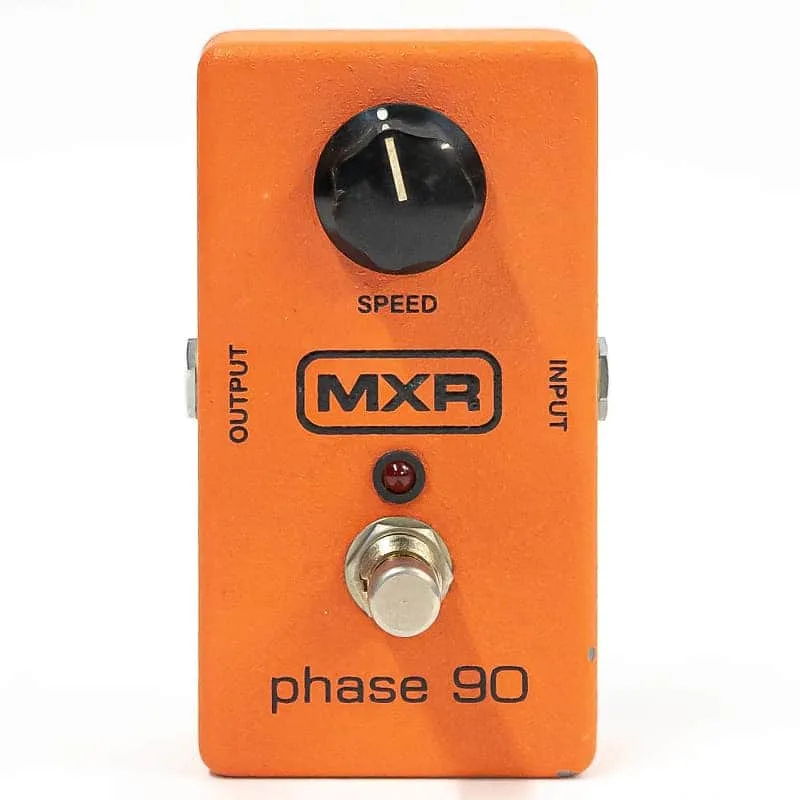
The same review noted the tradeoff: the pedal "lacks the one-knob simplicity of a Phase 90," though the reviewer found the process of decoding its secrets "instructive, engaging, immersive, and intuitive in its way, and addictive"3. At 12 stages, the reviewer found it "excels at shaping intense modulations that can be slotted surgically in a mix"3.
Guitar Pedal X's Stefan Karlsson, reviewing it as the 29th phaser in his reference collection, called it "a really satisfying Phaser all-round" and said it "might very well be my favourite Phase-Shifter to date," while also noting it "makes you work for it a little more on the dial-in"4. He liked the Purple Sparkle finish and the Hammond die-cast aluminum enclosure4.
Videos
Asheville Music Tools
Asheville Music Tools
collector//emitter
News
Questions
Is the Analoger APH-12 true bypass?
Yes. The APH-12 uses true bypass with a mechanical footswitch for effect on and off. The LED on the bypass switch indicates the LFO rate or the envelope pre-amount signal, so you can see what the modulation is doing even while dialing in sounds.
How much current does the APH-12 draw?
The maker rates it at 9VDC drawing under 125mA, with 70 to 100mA typical and up to 200mA at startup. That startup surge is worth knowing if you run it from a shared or current-limited power supply.
Who designed the Asheville Music Tools APH-12?
The pedal is designed by Hawker, identified in Premier Guitar's review as Rick Hawker Shaich, the engineer behind the discontinued Moog Moogerfooger pedal series. The manual dedicates the pedal to the memory of Grateful Dead bassist Phil Lesh.
What is the difference between the APH-12 Launch Edition and the APH-12 Plus?
The Launch Edition was a limited launch-day run, numbered 128 through 148, with custom retro finishes by artist Justin Hock, and it is discontinued with no plans to restock. The Plus builds on the same lineage with expanded stage selection, a new input sensitivity control, and a bipolar expression and CV input. The Plus is currently sold out.
Can the APH-12 do tremolo and auto-wah sounds?
Yes. The maker says the 1-stage setting acts as a high pass filter that makes a great tremolo sound, and Delicious Audio notes that 3 stages with envelope control can challenge any auto-wah. It also covers vibrato, Leslie-style warble, envelope-filtered tones and multi-peak EQ shaping.
What presets come with the APH-12 manual?
The manual includes 11 presets, among them Classic 4-Stage, IKO IKO, and Swirlitzer 12. Each preset gives knob positions for Sweep, Resonance, Rate, Amount, Mix, Drive, Stages and the MOD switch, so they work as starting points for exploring the pedal.
Sources (7)
- Asheville Music Tools Analoger APH-12 Phaser, Delicious Audio, 2026-09-25
- Asheville Music Tools APH-12, 12 Stage Analog Phaser, Asheville Music Tools
- Asheville Music Tools Analoger APH-12 Review, Premier Guitar, 2025-07-23
- Guitar Pedal X, Guitar Pedal X, 2026-05-07
- Guitar Pedal X, Guitar Pedal X, 2025-04-24
- Asheville Music Tools APH-12 Plus, Asheville Music Tools
- APH-12 12-Stage Phaser, Asheville Music Tools