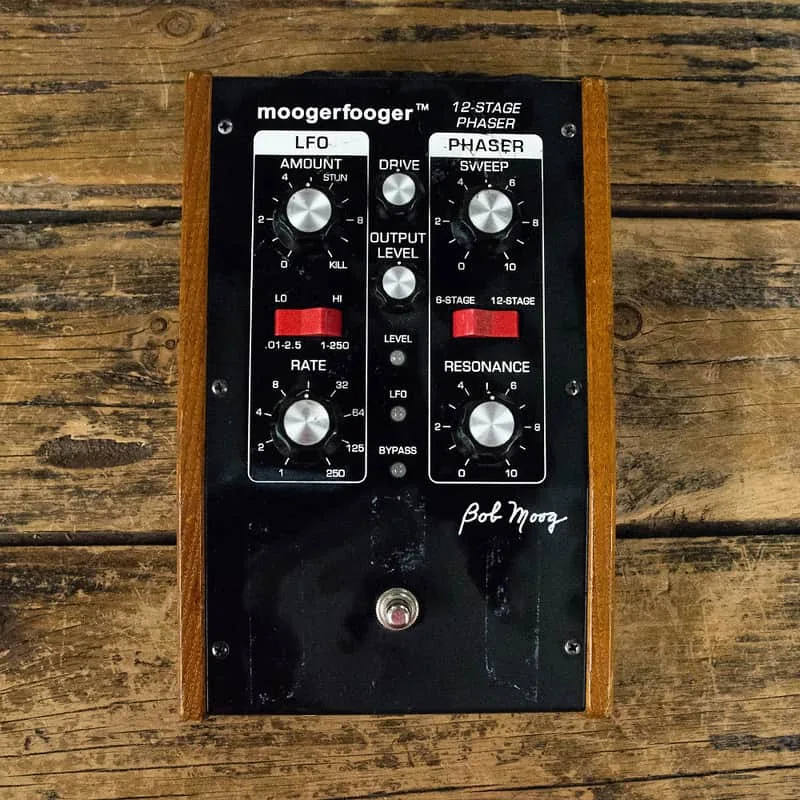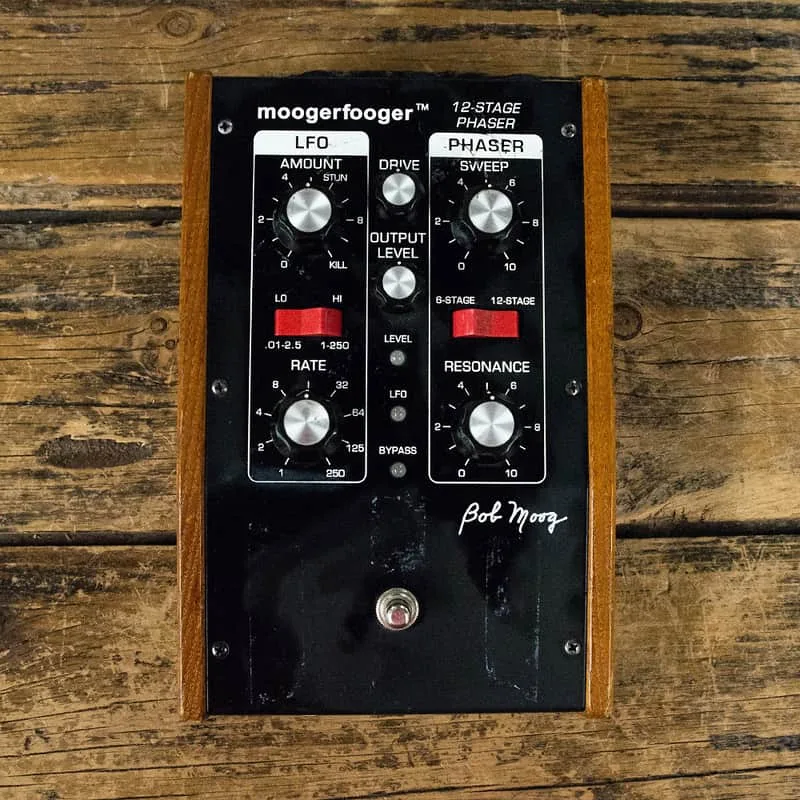


The Moog MF-103 12-Stage Phaser is an analog phaser pedal from Moog's Moogerfooger line, designed by Bob Moog and first produced in 199912. RockBoard's PedalPedia describes it as a direct descendant of its modular synthesizers, built to work with any sound source, and as two complete modular functions in one box: a 12-stage phaser with resonance, plus a wide-range LFO2. RockBoard's PedalPedia says it is capable of "conjuring ultra-rich sweeps, deep swirls, vocal gyrations and bi-phase effects"2.
The unit is a floor pedal in the Moogerfooger house style: a rugged black chassis with Minimoog-style knobs and switches and wooden side panels1. It has a mono input but stereo outputs1, and unlike most guitar pedals it uses CV and expression control rather than MIDI12.
The Moogerfooger line is discontinued. When Moog announced the end of the line in 2018, the MF-103 was one of only three models still in production, alongside the MF-101 Low Pass Filter and MF-102 Ring Modulator3. Behringer announced a clone of the MF-103, the BM-13 Phaser, in 20254.
What it does
A phaser splits the input signal and shifts the phase of one path, then recombines it, creating notches in the frequency response that sweep up and down. The MF-103's 12-stage mode places six dips in the frequency response, while the 6-stage mode places three1. More stages mean more notches, which gives a deeper, more textured sweep than the 4-stage designs common in guitar phasers.
The LFO that drives the sweep runs from 0.1 Hz to 250 Hz1, a range wide enough for very slow, barely moving sweeps up into speeds well past what a player would use for a conventional phaser effect. Resonance adds feedback around the notches, sharpening them.
The controls
The front panel carries four main knobs, two smaller level knobs, and a stage switch15.
| Control | What it does |
|---|---|
| LFO Rate | Sets the speed of the sweep, 0.1 Hz to 250 Hz1 |
| LFO Amount | Sets how much the LFO moves the phaser1 |
| Phaser Sweep | Moves the phaser frequency response over a six-octave range5 |
| Phaser Resonance | Adds feedback around the notches1 |
| Input level | Sets input level; the input can be overdriven1 |
| Output level | Balances the phaser signals with the bypassed signal5 |
| Stage switch | Selects 6- or 12-stage phasing, choosing between the internal circuits used to control the phase shifting15 |
Pedal of the Day's reviewer, Mike B, noted that the Drive control "adds some gain into the phaser's output, giving it a bit of bite and edge"5. The input stage can also be overdriven1, so the MF-103 can push into grit before the phasing is even applied, a trait it shares in spirit with overdrive and distortion pedals rather than with clean studio phasers.
Beyond the knobs, the MF-103 carries CV/Gate connections for LFO rate, LFO amount, LFO waveform, Phaser resonance and Phaser sweep1, and Moog fitted it with multiple CV and expression pedal inputs and outputs so each parameter can be manipulated and interconnected with other Moogerfooger analog effects2. Mike B highlighted "the ability to control the vast majority of these parameters with Expression pedals"5; his review unit even arrived with an expression pedal in the box5. For players building a modern rig, this is the MF-103's divide from most pedals: where a typical phaser offers at most one expression input, this one is built to sit inside a control network, and there is no MIDI at all1.
Where it came from
Moog released the MF-103 in 199914, part of the Moogerfooger line that brought Moog's modular synthesizer circuits into floor pedals. Writing at gearnews.com when the line ended, Robin Vincent noted that the MF-103 "was something a bit fresher" than a straight synth-module design6. The line ran for nearly two decades: by the time Moog sunset the Moogerfoogers in 2018, only three models remained in production, and the MF-103 was one of them3.
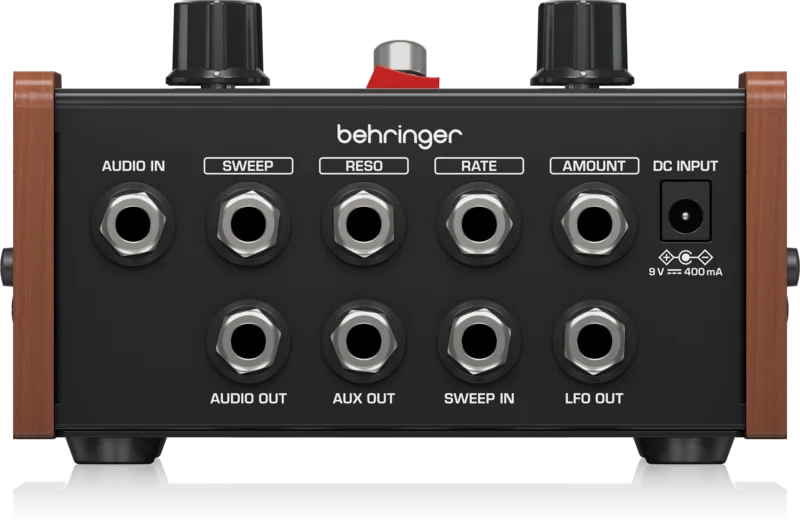
The circuit has since found a second life. Behringer announced the BM-13 Phaser in 2025, an analog 12-stage phaser modeled after the Moog pedal first issued in the 1990s4.
What reviewers said
Published coverage of the MF-103 has been positive. Mike B at Pedal of the Day, reviewing it during the site's Moog Week, wrote simply:
"This phaser is just incredible"
Mike B, Pedal of the Day5
His review focused on the range of the controls and the expression-pedal integration as the unit's standout features5.
Videos
Sweetwater
Guitar Gear
jfusion10
Questions
Does the Moog MF-103 have MIDI?
No. The MF-103 has no MIDI. Instead, all of its parameters can be controlled by CV/Gate, and it carries multiple CV and expression pedal inputs and outputs so it can interconnect with other Moogerfooger analog effects and modular gear. For players who want MIDI control, a MIDI-to-CV converter would be needed.
Is the MF-103 stereo?
Yes, in its outputs. The MF-103 has a mono input but stereo outputs, so the phased signal can be spread across two amps or two channels of a mixer. The dry signal going in is a single mono feed.
Can the MF-103 work as a 6-stage phaser?
Yes. A switch on the unit selects between 6-stage and 12-stage phasing, choosing between the internal circuits used to control the phase shifting. The 6-stage mode has three dips in its frequency response, while the 12-stage mode has six, giving a deeper, more pronounced effect.
Is the Moogerfooger MF-103 still made?
No. When Moog announced the end of the Moogerfooger line in 2018, the MF-103 was one of only three models still in production, alongside the MF-101 Low Pass Filter and MF-102 Ring Modulator, and the whole line was then sunset. Behringer announced a clone, the BM-13 Phaser, in 2025.
Sources (6)
- Moog MF-103 12-Stage Phaser, Vintage Synth Explorer, 2026
- MF-103 12-stage Phaser by Moog, RockBoard PedalPedia, 2026
- Moog sunsets Moogerfooger effects, Guitar.com, 2018-08-28
- Behringer's new ring modulator will literally fill the gap left by Moog's Moogerfooger, Guitar World, 2023-02-22
- Moog Moogerfooger MF-103 12-Stage Phaser, Pedal of the Day, 2015-12-15
- Moog Music announces that Moogerfooger has reached the end of the line, gearnews.com, 2018-08-27