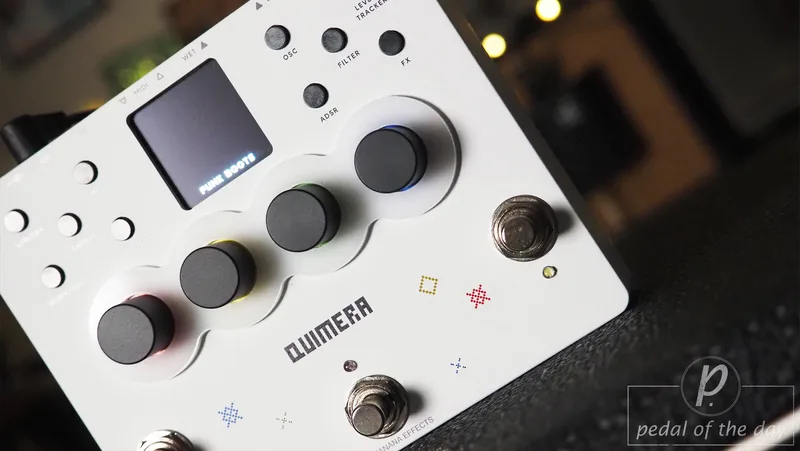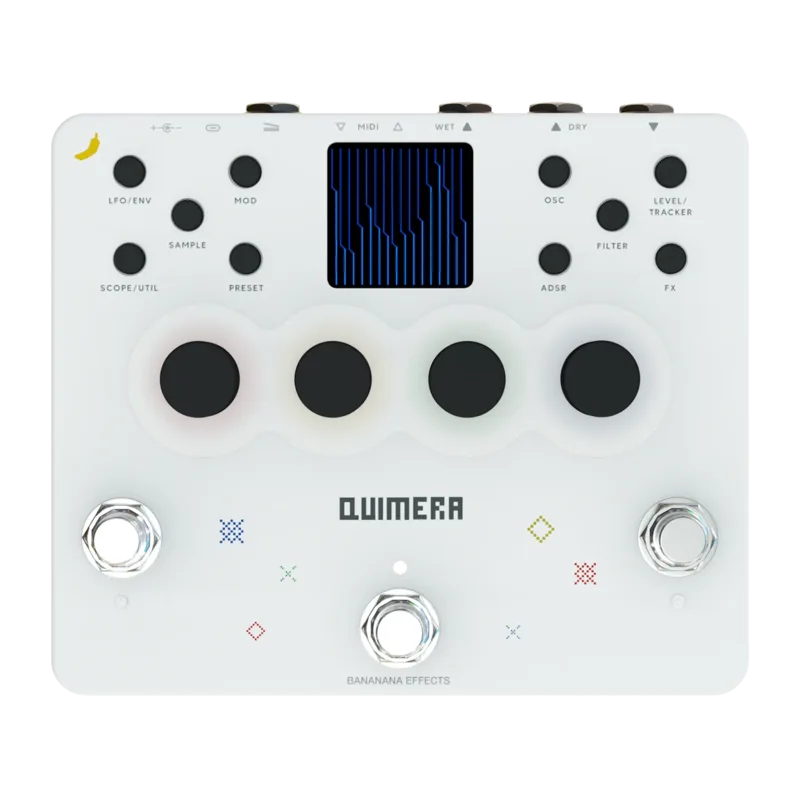


The Bananana Effects QUIMERA is a polyphonic guitar-to-synth pedal: it tracks what you play in real time and re-synthesizes it through its own oscillators, filters, envelopes and effects rather than layering a synth sound on top of your guitar signal. Bananana Effects describes it as "a real synth, in pedal form," and Pedal of the Day called it "a real synthesizer, packed into a pedal"12. It runs on an ARM Cortex-M7 processor, and its total measured latency is 12.5 ms, which the maker compares to standing about 4.3 m from your amp1.
The tracking is polyphonic, so chords as well as single notes are re-synthesized. Bananana Effects says the pedal keeps "every nuance" of your playing while it rebuilds the sound, and its tracking engine samples the input every 5 ms, analyzes it, and sends pitch and envelope data to the oscillators12.
How it makes sound: oscillators, filters, envelopes and LFOs
The QUIMERA has three oscillator engines. BASIC offers ready-to-use classic waveforms, from square and sawtooth to retro-game tones and organ-like sounds, with 20 waveforms included and hard sync at 1 to 4 cycles, with the sync ratio modulatable by LFO, ADSR or envelope. Alongside BASIC there is a morphing wavetable synth and a sample oscillator with multiple playback modes1.
The signal path layers two independent oscillators, a main OSC A and a sub OSC B: you can detune one, or modulate the other with an LFO31. OSC A selects from WAVE 1 to 100 in three groups (HARDSYNC, MORPHING TABLE, SAMPLE), while OSC B selects from WAVE 1 to 20 and is used in OSC A HARDSYNC mode. PITCH adjusts each oscillator from -24 to +24 semitones, and TUNE detunes OSC B from -50 to +50 cents3.
| Block | What it does |
|---|---|
| OSC A / OSC B | Two independent oscillators; detune one, modulate the other with an LFO31 |
| CUTOFF and FORMANT filters | FREQ modulatable by LFO, ADSR or envelope; KEY TRACK matches FREQ to the output pitch in Hz1 |
| 3 ADSR engines | Independent envelopes optimized for AMP, FILTER and MOD, each with its own character1 |
| 2 LFO engines | Seven waveforms (SINE, RAMP UP, RAMP DOWN, TRIANGLE, SQUARE, S&H, RANDOM) with rate controls and MIDI sync31 |
| Envelope follower | Reads input level and can control any parameter based on playing dynamics1 |
The two LFOs can be routed to volume for tremolo, pitch for vibrato, or to hard sync and the wavetable index1. LFO SYNC settings are not applied when the waveform is set to RANDOM3.
Effects, presets and footswitches
After the synth engine, the QUIMERA includes 14 effects in four categories: Drive, Mod, Delay and Reverb. You choose one effect from each category, and all parameters are saved per preset, so a finished sound can be built using the QUIMERA alone12.
There are 128 preset slots, stored as .qps files in PRESET1 to PRESET128 folders on the USB drive. Presets can be backed up, imported to another QUIMERA, and shared. Each of the three footswitches (L/C/R) can be freely assigned to a preset, giving Bank A/B/C x Switch L/C/R, or 9 total slots for live recall3. The footswitches also handle bypass, preset recall, momentary operation and bank switching. To change banks you press and hold L and R together for 1 second or longer; the unit temporarily goes into bypass, and a bank change cannot be canceled once confirmed3.
Connections and power
The rear panel carries an IN jack for your instrument, an EXP IN expression pedal input, a DRY OUT that passes the dry thru signal for parallel routing or as a split for recording, and a WET OUT for your amplifier, mixer or audio interface3. MIDI IN and MIDI OUT are on 3.5 mm TRS jacks (Type-A), with settings for the receiving channel, the transmitting channel and pitch bend range, plus per-preset LOCAL MIDI settings3.
Power the QUIMERA from a 9V DC center-negative adapter rated at 500 mA or higher. Lower-rated supplies may fail to boot or cause unstable behavior, and because the pedal contains digital circuitry, daisy-chaining power with other pedals may introduce noise. Bananana Effects recommends an isolated output power supply. Power over USB-C is not supported31.
Connections are straightforward: the IN jack takes the instrument, and EXP IN accepts an expression pedal for hands-free control of up to four registered parameters1. On the output side, DRY OUT passes the dry thru signal for parallel routing or recording splits, while WET OUT feeds an amplifier, mixer, or audio interface3. The pedal runs on an ARM Cortex-M7 processor and uses a buffered bypass rather than true bypass1.
Samples and wavetables over USB-C
Connecting the QUIMERA to a computer over USB-C mounts it as a USB drive, so presets, wavetables and samples are managed with simple file operations, and firmware updates arrive the same way1.
You can load your own material:
- Samples: place files in the SAMPLE1 to SAMPLE10 folders. Mono 16-bit WAV at 44.1 kHz or 48 kHz, maximum length 7.6 seconds; longer files are automatically trimmed31.
- Wavetables: import into OSC A WAVE 81 to 90 via the TABLE1 to TABLE10 folders. Mono 16-bit WAV at 44.1 kHz or 48 kHz, table length 128 or 256 samples x 64 continuous frames31.
For deeper control, ENCODER ASSIGN registers up to four parameters to the knobs on the Scope screen, with settable minimum and maximum values. EXPRESSION ASSIGN does the same for an expression pedal, and MODWHEEL (CC1) ASSIGN registers up to four parameters for MIDI Mod Wheel control3.
What reviewers said
Pedal of the Day reviewed the QUIMERA in March 2026 and highlighted the same points the maker makes: the real-time tracking, the low latency, and the all-in-one sound design. The reviewer noted that after pitch tracking, the signal runs through oscillators and effects while total measured latency stays at 12.5 ms, and that all parameters are saved per preset and instantly recallable2.
"QUIMERA is a real synthesizer, packed into a pedal"
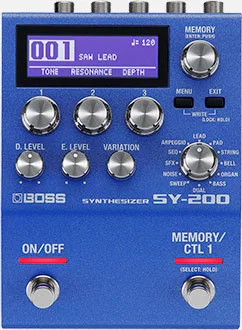
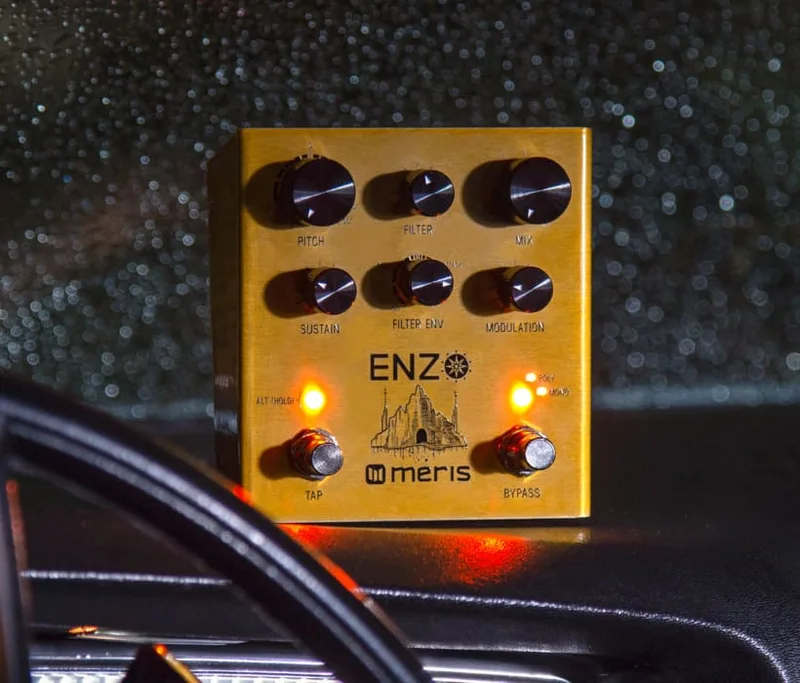
Compared with other synth pedals such as the Boss SY-200 or the Meris Enzo, the QUIMERA's distinguishing features are its user-loadable samples and wavetables over USB-C, its three oscillator engines, and its file-based preset system that lets you back up and share sounds between units31.
Videos
BanananaEffects
BanananaEffects
BanananaEffects
Questions
How much latency does the QUIMERA have?
Bananana Effects measures total latency at 12.5 ms, from input through pitch tracking, oscillators and effects. The maker compares this to standing about 4.3 meters from your amp. Its tracking engine samples the input every 5 ms and sends pitch and envelope data to the oscillators.
Can the QUIMERA be powered over USB?
No. The USB-C port is used only for preset, wavetable and sample management and firmware updates. Power comes from a 9V DC center-negative adapter rated at 500 mA or higher. The manual states plainly that power supply via USB is not supported.
Can I load my own samples into the QUIMERA?
Yes. The QUIMERA mounts as a USB drive over USB-C, and you place your own samples in the SAMPLE1 to SAMPLE10 folders. Samples are mono 16-bit WAV files at 44.1 kHz or 48 kHz, with a maximum length of 7.6 seconds; longer files are automatically trimmed.
Does the QUIMERA have MIDI?
Yes. It has MIDI IN and MIDI OUT on 3.5 mm TRS jacks (Type-A). You can set the receiving and transmitting channels and the pitch bend range, and LOCAL MIDI provides per-preset MIDI settings. The LFOs also support MIDI sync.
Can the QUIMERA be daisy-chained with other pedals?
Bananana Effects recommends against it. Because the QUIMERA contains digital circuitry, daisy-chaining power with other pedals may introduce noise. The maker recommends an isolated output power supply, and the pedal draws 500 mA or more.
Sources (3)
- QUIMERA, Bananana Effects
- Bananana Effects QUIMERA Polyphonic Synthesizer Sampler, Pedal of the Day, 2026-03-13
- MANUAL_QUIMERA, Bananana Effects