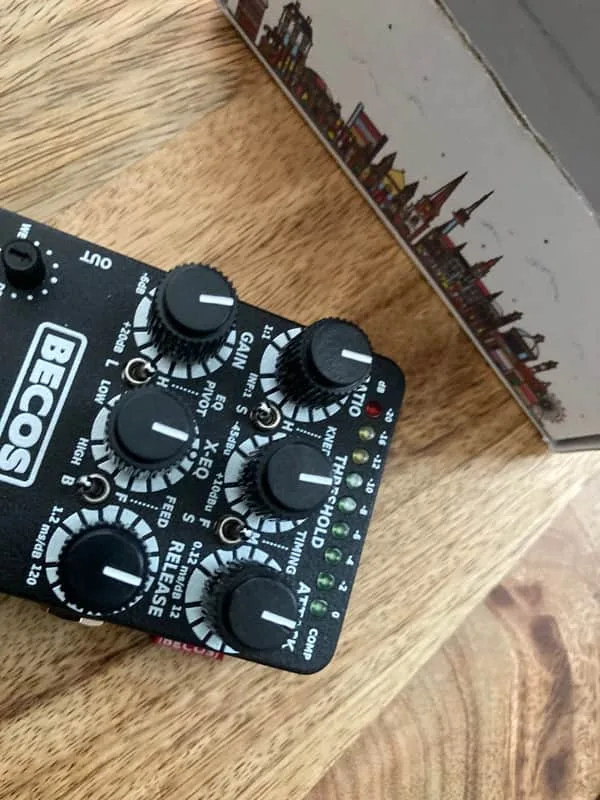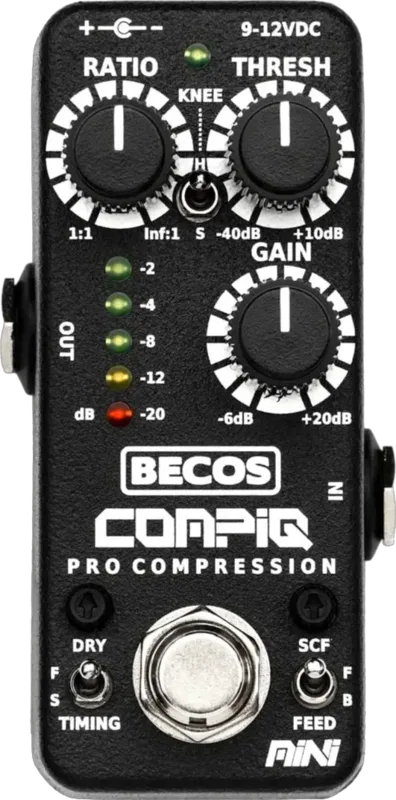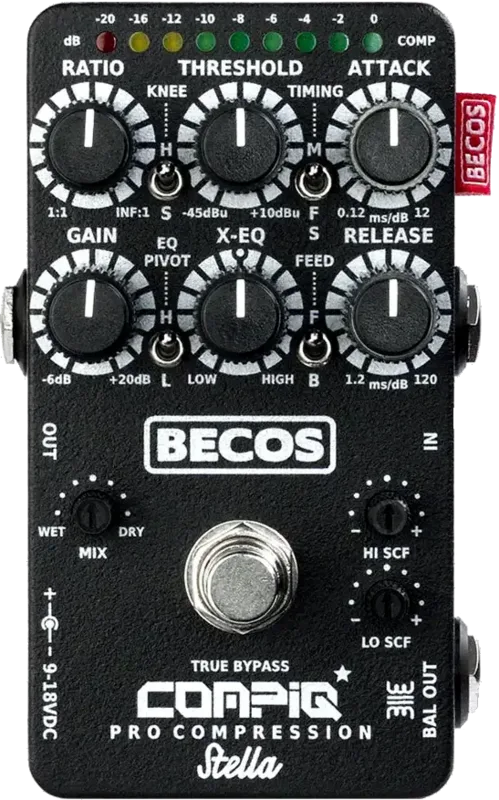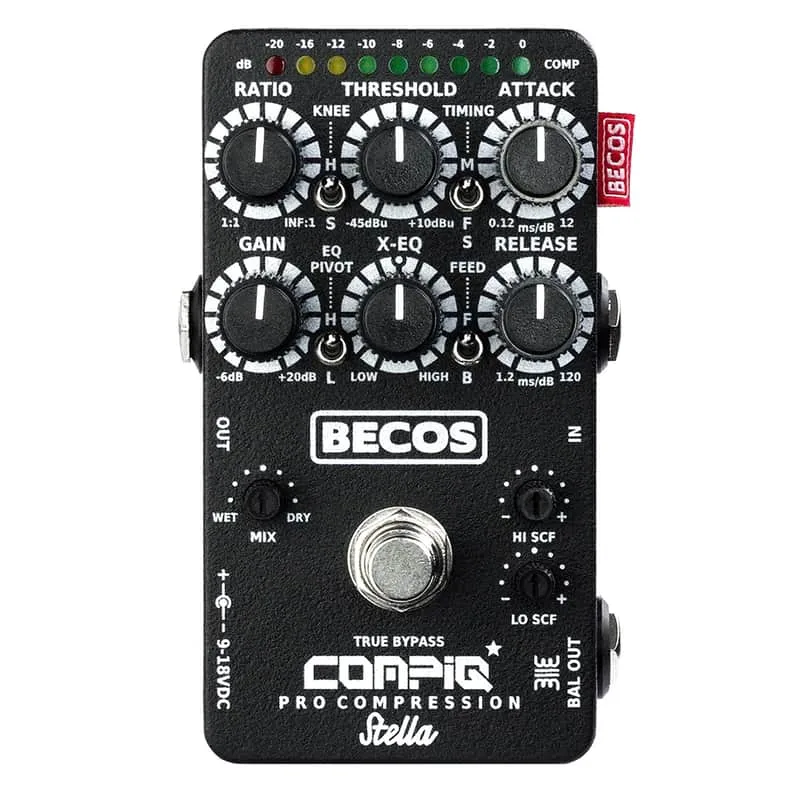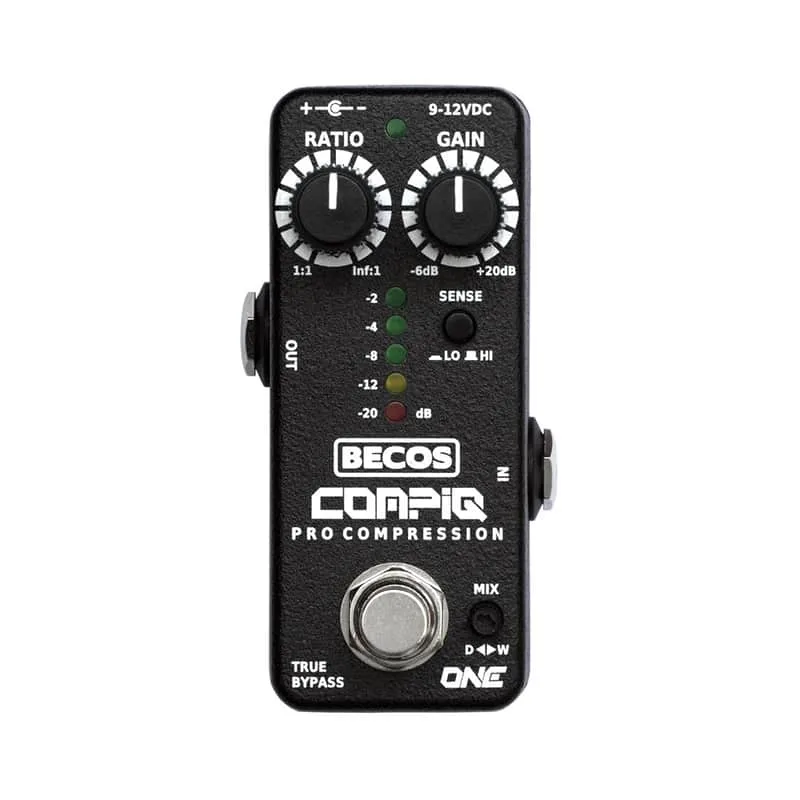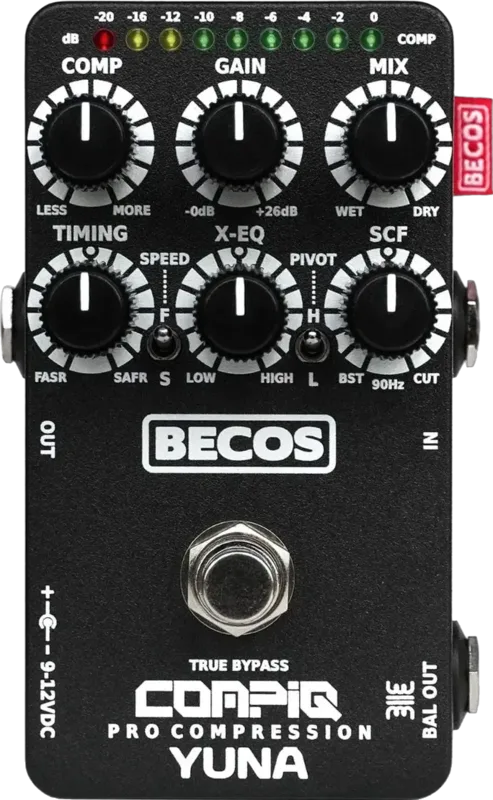


The Becos FX CompIQ Pro Yuna is a soft-knee Blackmer VCA compressor pedal for guitar and bass, a studio-style design built around the same voltage-controlled amplifier architecture as the company's larger CompIQ Pro Stella. Where the Stella puts 13 controls on its surface, the Yuna makes do with 8, folding ratio and threshold into a single Comp control and moving several deeper settings onto internal DIP switches and jumpers1.
Guitar Pedal X's Stefan Karlsson described it at launch as a pedal that "essentially delivers a slightly more streamlined take on the CompIQ Pro Stella," a soft-knee Blackmer VCA studio-style compressor that gives full coverage with fewer controls and easier dial-in1. The name is Japanese-inspired: Yu-Na (優結 / ゆな / ユナ), meaning gentle, kind, superior, and binding or gluing2.
A soft-knee VCA compressor for guitar and bass
A VCA (voltage-controlled amplifier) compressor works the way studio rack units do: a detector circuit reads the signal level and turns down a gain cell in proportion to how far the input exceeds a threshold. The Yuna uses a Blackmer VCA, the same high-performance gain cell family found across the Becos CompIQ line, including the Stella Pro MK241. Its detector is a true RMS-level design, which reads average signal energy rather than instantaneous peaks, with reference levels at -10dBu, -20dBu (the default for instrument level) and -30dBu, set by jumper1.
The knee is soft only. Soft-knee compression eases in gradually as the signal approaches the threshold rather than clamping at a single point, which tends to make the compression less audible as it works. Players who want hard-knee action as well would need to look at the Stella, which offers both3.
RockBoard's PedalPedia page describes the Yuna as delivering the essential compression and tone-shaping controls bassists and guitarists look for, with high-grade components that give professional sound and lively response without distortions or artifacts2. Measured figures from the launch coverage back up the clean-sounding claim: output noise of -95dBV at 0dBV gain, THD of 0.1% at 1kHz with 0dBu in/out through the 6th harmonic (0.18% through the DITOS output), and a flat frequency response from 30Hz to 22KHz1.
The controls and internal settings
The Yuna's eight surface controls are the working day-to-day set. The deeper configuration lives inside the enclosure1.
| Control or setting | What it does |
|---|---|
| Comp | Combines ratio and threshold in one knob1 |
| Voicing (internal DIP switch) | Selects Flat, Spark, Tight or Punch voicing1 |
| Feed jumper (internal) | Feed-Forward or Feed-Back compression topology1 |
| RMS jumper (internal) | Detector reference level: -20dBu, -10dBu or -30dBu1 |
| DITOS ground lift (internal daughterboard) | Lifts ground on the optional balanced output1 |
The Comp control is the Yuna's main simplification. Instead of separate ratio and threshold knobs as on the Stella, one knob sweeps both together, which is what makes the pedal quicker to set. The trade-off is granularity: Guitar Pedal X's review of the related CompIQ Pro Mini noted that the streamlined Becos pedals are "less granular than Stella and Yuna" in the Mini's case, positioning the Yuna between the Mini and the full Stella in control depth5.
The internal Feed jumper chooses between feed-forward and feed-back topologies. Feed-forward reads the input signal to drive the gain cell, feed-back reads the compressed output; the two behave differently in attack character and maximum ratio1.
Power and connections
The Yuna runs on a standard 9V internal battery or a 9-12V DC external supply, center negative, with the supply not included1. Two things matter for pedalboard planning:
The DC plug must be a Ø 5.1/2.1mm barrel, 12mm long1. Shorter barrel plugs, common on some generic supplies, may not reach the internal contact. And battery power is unavailable when the optional DITOS module is installed1.
Current draw is under 45mA at 9V and under 55mA at 12V1, modest enough for most isolated power supplies. Connections are a TS input (input impedance greater than 1.1MΩ, so it loads passive pickups lightly), a TS output, and, with the DITOS option, a transformer-balanced output, all at roughly 100Ω output impedance1. The pedal sits in a genuine Hammond black-powdered aluminum enclosure measuring 61mm long, 102mm deep and 51mm high, weighing 220g, or 245g with the DITOS DI1.
The DITOS output
DITOS is Becos FX's optional transformer-coupled balanced output, offered alongside the standard TS output on the CompIQ Pro Yuna2. The pedal's output impedance is about 100Ω, and the DITOS path measures 0.18% THD against 0.1% for the VCA path1. It adds a little weight: 220 gr. without the DITOS DI, 245 gr. with it1. On the maker's pricing, the Pro Yuna lists at €229 without DITOS and €319 with DITOS, excluding VAT1.
The Yuna's DITOS output is voiced for warm, vintage-style lows and clear, detailed highs2. It is an add-on rather than standard equipment, which is reflected in the pricing: €229 without DITOS and €319 with it, excluding VAT, at the October 2025 launch1; Guitar Pedal X listed the Yuna Pro at $359 in October 20263.
A simplified CompIQ Pro Stella
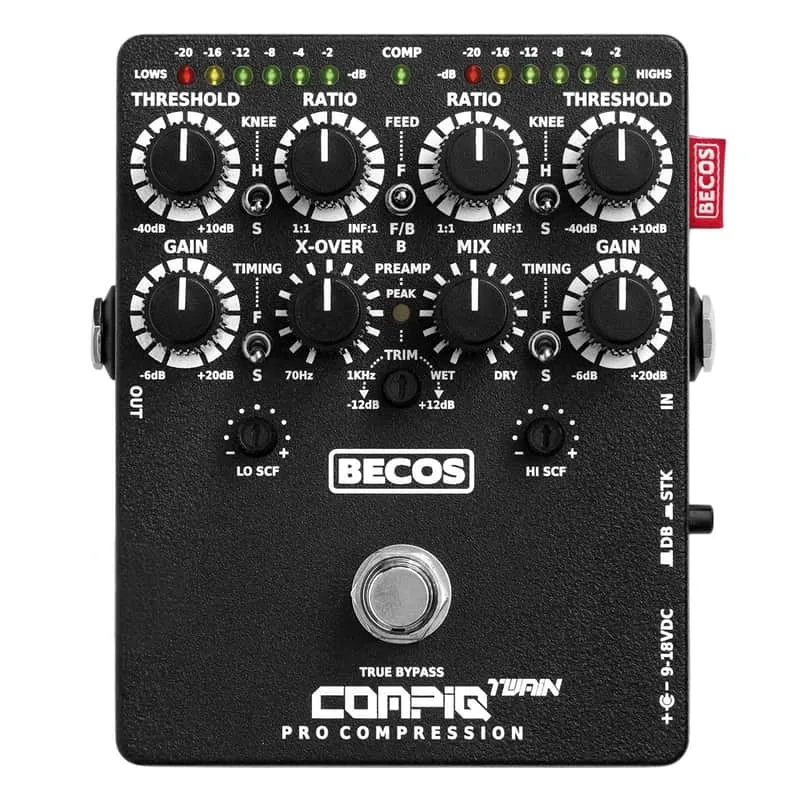
The Yuna sits in a Becos FX compressor range that now spans several formats. The original CompIQ Pro Stella, launched in April 2019, was the company's flagship compressor for guitar and bass with rack-style controls67. The Stella Pro MK2 of March 2024 refined it with selectable feed modes, four voicing options and the optional DITOS module89. The dual-band CompIQ TWAIN and the mini-format pedals fill out the line.
| Pedal | Controls | Knee | Notes |
|---|---|---|---|
| CompIQ Pro Yuna | 8 | Soft only | Streamlined Stella; internal jumpers for feed, RMS, voicing13 |
| CompIQ Stella Pro V2 | 13 | Soft and hard | Full control set, DITOS option3 |
| CompIQ Pro Mini | 8 | Soft and hard | Mini format, less granular than Stella and Yuna35 |
Guitar Pedal X's verdict on the relationship was direct: "The new Yuna is slightly easier to use, and quicker to dial in - wile probably overall 95% the same as the Stella"1. The same reviewer, writing in October 2026 after living with the pedal, summed it up as "so much easier to get to grips with and dial in!" than the Stella3.
What reviewers said
Published coverage of the Yuna itself is so far concentrated at Guitar Pedal X, whose Stefan Karlsson has reviewed the whole Becos compressor line. His launch piece framed the pedal as full coverage with fewer controls and easier dial-in than the Stella1, and his October 2026 review repeated the ease-of-use verdict3.
The Stella the Yuna streamlines has its own review record, which gives a sense of what the shared circuit family sounds like. Bass Gear Magazine's review of the Stella Pro MK2 found it "offers more control than many studio units, and it can be overwhelming at first," while noting the manual is clear and time spent learning each control pays off9. The Yuna's reason for existing is precisely to soften that learning curve.
Videos
BECOS FX and 関谷友貴 - SEKIYA
the wetter bass
News
Questions
Does the Becos CompIQ Yuna run on a battery?
Yes, it runs on a standard 9V internal battery, except when the optional DITOS transformer-balanced output module is installed, which rules out battery power. It also takes 9-12V DC external power, center negative, through a 5.1/2.1mm barrel plug that needs to be 12mm long.
What is the difference between the CompIQ Yuna and the Stella?
The Yuna is a streamlined take on the CompIQ Pro Stella, with 8 controls instead of the Stella's 13, and soft-knee operation only, where the Stella offers both soft and hard knee. Guitar Pedal X's reviewer called the Yuna slightly easier to use and quicker to dial in, while probably overall 95% the same as the Stella.
Is the CompIQ Yuna true bypass?
Yes. The Yuna is a full analog circuit with true bypass, so with the pedal switched off the signal passes through without active processing. It carries a 3-year warranty direct from the manufacturer, international and transferable.
What is the DITOS output on the Becos Yuna?
DITOS is an optional transformer-balanced output on a daughterboard that sends a separate signal direct to a mixing desk or PA system. On the related Stella Pro MK2, the DITOS board provides a transformer-coupled balanced output in 1/4-inch TRS format for direct recording or signal sending, and the main output stays functional.
Can I use the CompIQ Yuna on bass?
Yes. The Yuna delivers compression and tone-shaping controls aimed at both bassists and guitarists, and its output frequency response is flat from 30Hz to 22KHz, which covers the low fundamentals of a bass. Its internal RMS reference levels are jumper-settable to match instrument level.
Where is the Becos CompIQ Yuna made?
The Yuna is hand-assembled in Vienna, Austria, in a genuine Hammond black-powdered aluminum enclosure. Earlier Becos compressors such as the original CompIQ Pro Stella were made in Romania; the company's current pedals are built in Vienna.
Sources (9)
- Guitar Pedal X, Guitar Pedal X, 2025-10-08
- Yuna by Becos FX, RockBoard PedalPedia, 2026
- Guitar Pedal X, Guitar Pedal X
- BECOS FX Releases the CompIQ Stella Pro Compressor MK2, Bass Gear Magazine, 2024-03-07
- Guitar Pedal X, Guitar Pedal X, 2026-08-11
- Review: Becos CompIQ Pro Stella Compressor, guitar.com, 2019-07-15
- Becos FX's CompIQ Pro Stella gives you rack-style compression in a compact pedal, MusicRadar, 2019-04-10
- CompIQ Stella Pro Mk2 by Becos FX, RockBoard PedalPedia, 2026
- Becos CompIQ Stella Pro MK2 Compressor Pedal, Bass Gear Magazine (bassgearmag.com), 2024-10-09