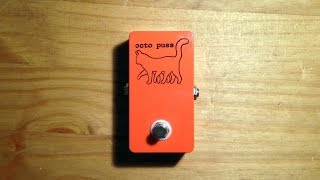


The Bigfoot Engineering Octo Puss is a passive octave-up guitar effects pedal, listed by RockBoard's PedalPedia as an octaver, that combines modern and vintage components to generate a note one octave above what you play1. Its octave up generator uses germanium diodes, which RockBoard's PedalPedia says give authentic vintage tones, and those are paired with what RockBoard's PedalPedia calls a premium studio quality audio transformer for better frequency response and tracking than other analog octave pedals1. MusicRadar's reviewer Trevor Curwen heard the same intent in the design, writing that the pedal recreates vintage octave pedal character "with that character recreated by the use of original germanium diodes and a transformer"2.
How it works and where it sits on a board
Because the Octo Puss is passive, it draws its working conditions from what is around it rather than from an internal powered circuit. It runs on a 9V DC center negative supply at 5mA according to Bigfoot's specifications, but the review is clear that it needs neither battery nor adaptor12. The practical consequence is chain placement: MusicRadar states that "it has to be plugged in after a buffered pedal", since the passive design restricts where it can sit2. If your board starts with a wah or a buffer pedal, the Octo Puss goes after it. The same passivity also means there is no LED to confirm the effect is engaged2.
The Octo Puss has no LED indicator and no battery compartment. Its passive design means it must be placed after a buffered pedal in the signal chain2.
What reviewers said
MusicRadar's verdict was positive on both sound and build. Trevor Curwen's review sums it up2:
"Works brilliantly with a distortion pedal. Good build quality and value."
That pairing point is worth noting for players building around gain: the octave up effect was reviewed as working well ahead of a distortion pedal, which is a common arrangement for octave-up sounds2.
The Octo Puss Prime
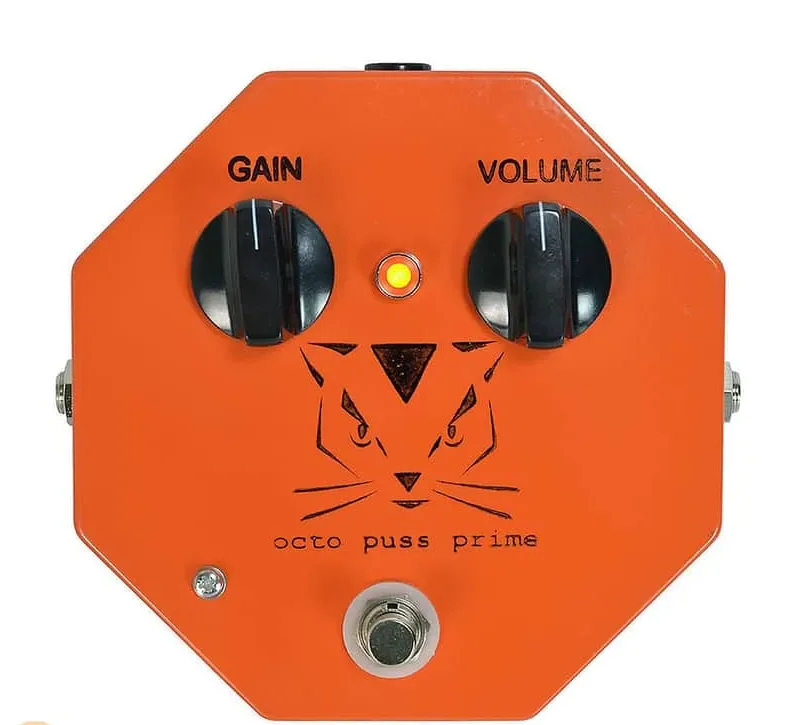
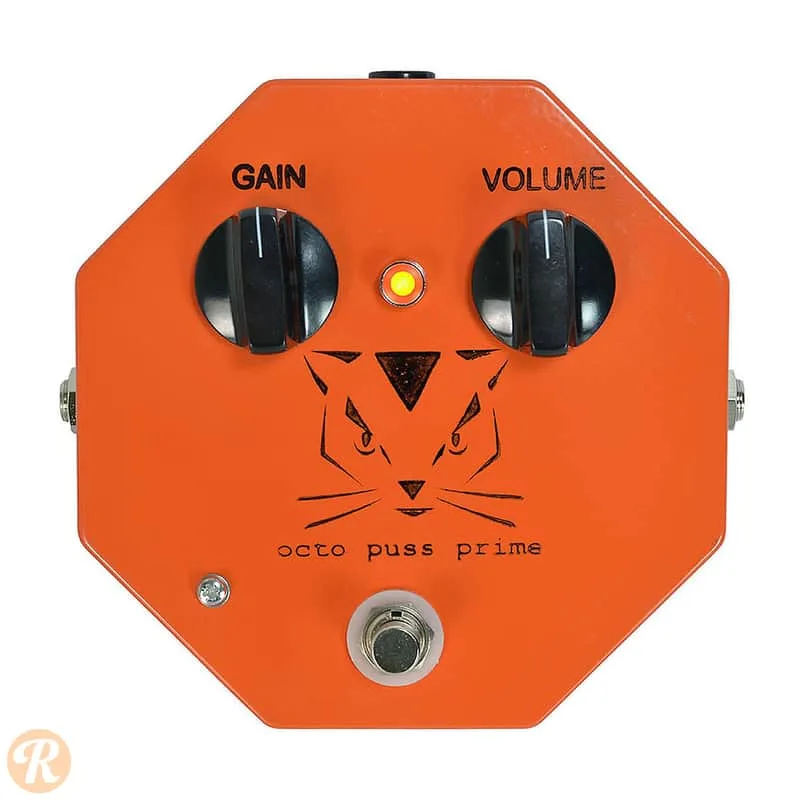
Bigfoot also makes a related pedal, the Octo Puss Prime, a fuzz octave guitar effects pedal that shares the same octave up generator: germanium diodes for vintage tones combined with the same premium studio quality audio transformer for frequency response and tracking3. Where the original is listed simply as an octaver, the Prime is listed as a fuzz octaver, adding a fuzz stage to the octave circuit3. RockBoard's PedalPedia describes the Prime as inspired by Jimi Hendrix, Jack White and Josh Homme3. Its power figures match the original: 9V DC center negative at 5mA3.
| Octo Puss | Octo Puss Prime | |
|---|---|---|
| Effect type | Octaver | Fuzz octaver |
| Octave generator | Germanium diodes plus audio transformer | Germanium diodes plus audio transformer |
| Power | 9V DC center negative, 5mA | 9V DC center negative, 5mA |
| Battery | None, passive | Not listed by the maker |
For a wider look at where this pedal sits among its alternatives, see the site's page on octave and pitch pedals.
Videos
Bigfoot Engineering
Bigfoot Engineering
Bigfoot Engineering
Questions
Does the Bigfoot Octo Puss need a battery?
No. MusicRadar's reviewer Trevor Curwen describes the Octo Puss as passive, requiring neither battery nor adaptor. Because the circuit is passive it draws very little current when used with a 9V DC center negative supply, and it has no LED indicator to show it is on. Its placement in the pedal chain matters more than its power: it has to be plugged in after a buffered pedal to work as intended.
Does the Octo Puss have an LED?
No. MusicRadar's review notes that the Octo Puss has no LED indicator. That follows from its passive design: the pedal needs neither battery nor adaptor, so there is no powered status light. Players used to a light confirming the effect is engaged will need to rely on their ears instead.
Why does the Octo Puss need a buffered pedal in front of it?
The Octo Puss is a passive pedal, and its passive design restricts where it can sit in a chain. MusicRadar's review states that it has to be plugged in after a buffered pedal. A buffer pedal ahead of it provides the low-impedance signal the octave circuit needs to track properly, so on a board it should follow a buffered pedal rather than sit first in line after the guitar.
What is the difference between the Octo Puss and the Octo Puss Prime?
Both pedals share the same octave up generator, which uses germanium diodes for vintage tones and a premium studio quality audio transformer for better frequency response and tracking. The Octo Puss Prime adds a fuzz stage, so Bigfoot lists it as a fuzz octaver, and the maker says it was inspired by Jimi Hendrix, Jack White and Josh Homme. The original Octo Puss is listed simply as an octaver.
How much current does the Octo Puss draw?
Bigfoot's product page lists the Octo Puss at 5mA on a 9V DC center negative supply. The Octo Puss Prime shares the same figures. That is a light load by pedal standards, though the pedal itself is passive and needs neither battery nor adaptor according to MusicRadar's review.
Sources (3)
- Octo Puss by Bigfoot Engineering, RockBoard PedalPedia, 2026
- Bigfoot Engineering Octo Puss review, MusicRadar, 2013-12-04
- Octo Puss Prime by Bigfoot Engineering, RockBoard PedalPedia, 2026