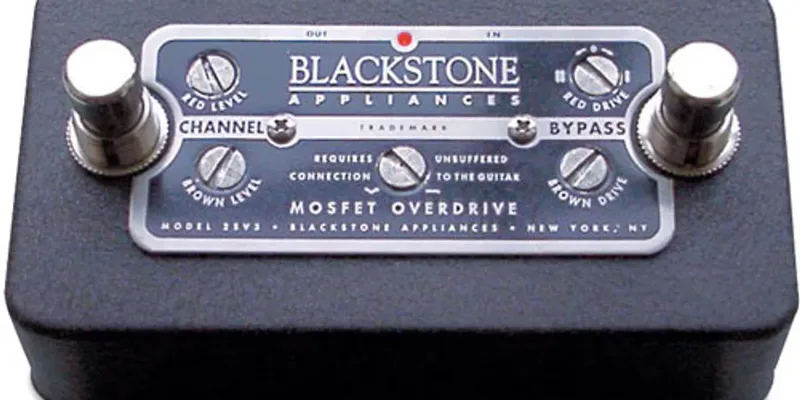
The Blackstone Appliances Mosfet Overdrive 2S is a two-channel overdrive pedal that also reaches into distortion territory. Premier Guitar's reviewer found that tamer settings offered classic rock crunch, while maxing out the Drive served up distortion bordering on fuzz territory1. Blackstone maintains that the MOSFET design avoids intermodulation and fizzy high-order harmonics in the same manner as vintage amps1. The pedal is handcrafted by Jon Blackstone in New York City, in a cast aluminum chassis with a powdercoat finish and FR-4 (epoxy-fiberglass) plated-through-hole circuit boards1.
The controls
Each channel has a Level control on the left and a Drive adjustment on the right, with a fifth master control after them1.
| Control | What it does |
|---|---|
| Red Level | Level control on the left of the Red channel1 |
| Red Drive | Starts with a healthy crunch at noon; clockwise adds midrange girth to single-coils, counterclockwise reduces bass and emphasizes higher frequencies, preventing humbuckers from getting muddy1 |
| Brown Level | Level control on the left of the Brown channel1 |
| Brown Drive | Turned clockwise, boosts drive from a mild grit to a fat roar that still cleans up when the guitar volume is lowered1 |
| Master EQ | Post-distortion EQ providing a 10dB mid cut at 750Hz1 |
Inside, a jeweler's screwdriver can be used to simultaneously adjust Gain and Treble settings for the second stage of both channels1.
The LED indicator reads more orange than brown in Brown mode, and at some angles a red tinge can be confusing at first glance. In Red mode it is bright red with no confusion1.
Buffered or unbuffered
Removing the backplate reveals, in addition to the 9-volt battery, a small switch that converts the pedal from unbuffered to buffered operation1. The placement advice follows from that:
- In unbuffered mode, place the pedal immediately after your guitar in the effects chain, like some fuzz pedals1
- If you need to place it after another effect, engaging the buffering prevents fizziness at high-gain settings1
How it responds to the guitar
The circuit interacts with the inductance of your guitar's pickups, translating playing dynamics into changes in waveform distortion, like some vintage fuzz pedals1. Premier Guitar's reviewer found that at the Brown channel's moderate-drive setting, the pedal cleaned up completely when he backed off his guitar volume, and called it very dynamic in that sense1. Plugging in a Fernandes Tele-style guitar pushed the drive a little harder and sounded, in his words, more Robben Ford-ish1.
"While not as saggy as some overdrives and amps, it 'gives' enough to let you feel natural playing it."
On pick attack, the reviewer found it less responsive than some pedals he has played, but said it never felt stiff to play1.
What the reviewer said
Premier Guitar's verdict was that while the Mosfet Overdrive 2S is not the most transparent or natural-sounding pedal he has heard, it is one of the most musical, with a sound of its own that is inspiring to play1. His buying advice: buy it if you want an extremely musical, articulate overdrive pedal, and skip it if you seek a saggier, amp-style sound1. For players weighing it against other circuits, it sits between the gentler push of an overdrive pedal and the harder clipping of distortion pedals, with its own take on both.
Questions
What is the difference between the Red and Brown channels?
Each channel has a Level control on the left and a Drive adjustment on the right. The Red Drive starts with a healthy crunch at noon, and turning it clockwise adds midrange girth to single-coils, while turning it counterclockwise reduces bass and emphasizes higher frequencies, which keeps humbuckers from getting muddy. The Brown Drive, turned clockwise, boosts drive from a mild grit to a fat roar that still cleans up when the guitar volume is lowered.
Is the Blackstone Mosfet Overdrive 2S buffered or unbuffered?
It can be either. Removing the backplate reveals a small switch that converts the pedal from unbuffered to buffered. In unbuffered mode, the recommendation is to place the pedal immediately after the guitar in the effects chain, like some fuzz pedals. If you need to place it after another effect, engaging the buffering prevents fizziness at high-gain settings.
Does the Mosfet Overdrive 2S take a 9-volt battery?
Yes. Removing the backplate reveals a 9-volt battery inside the pedal, alongside the switch that converts it from unbuffered to buffered operation.
Where is the Blackstone Appliances Mosfet Overdrive 2S made?
The Mosfet Overdrive 2S is handcrafted by Jon Blackstone in New York City. The pedal is built with a cast aluminum chassis with a powdercoat finish and FR-4 (epoxy-fiberglass) plated-through-hole circuit boards.
What does the master EQ control do?
The fifth control is a post-distortion EQ that provides a 10dB mid cut at 750Hz. It sits after the distortion stages, so it shapes the overall tone of both channels rather than one of them.
Does the Brown channel clean up with the guitar volume?
Yes. Premier Guitar's reviewer found that at the Brown channel's moderate-drive setting, the pedal cleaned up completely when he backed off his guitar volume, calling it very dynamic in that sense. The Brown Drive itself is described as going from a mild grit to a fat roar that still cleans up when the guitar volume is lowered.
Sources (1)
- Blackstone Appliances Mosfet Overdrive 2S Pedal Review, Premier Guitar, 2010-04-15