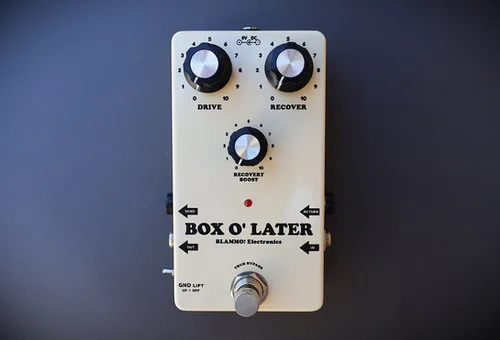
The BLAMMO! Electronics Box o' Later is an op-amp boost pedal with a built-in effects loop, described by its maker as a "solid boost circuit plus a built-in effects loop with control over each stage." It is the work of Ryan Colgan, known online as The Tone Geek, and it takes its inspiration from a super-rare John Mayer boost pedal designed by Alex Dumble that was never released to the public1.
BLAMMO! describes the pedal as doing several jobs at once: "It's an active loop for pedals/amps, a signal attenuator, a unity buffer, and a +24db clean boost." In practice, that means it can sit on a board as a boost pedal, act as a go-between for other pedals, or live in an amp's loop1.
Where the circuit comes from
The Box o' Later is BLAMMO!'s take on a pedal with a small legend around it: a boost designed by Alex Dumble for John Mayer, never sold to the public and known mainly from gut-shot photographs. BLAMMO! is upfront that this is not a clone in the strict sense. Because the original circuit is unavailable for tracing and only gut-shot pictures exist, the company describes the Box o' Later as "not a one for one copy." It was made as a small, limited run for players who can't build one themselves1.
BLAMMO! has released other takes on classic boost circuits, including the Zap Master treble booster and the TNYDUMBLE, another pedal tied to the Dumble story.
Controls and construction
The pedal keeps its main controls on the board rather than the outside panel, which is worth knowing before you buy1:
- Board mounted potentiometers for the main controls1
- Internal trim pots for impedance and gain for the first stage1
- Side mounted IN/OUT jacks1
- All through-hole construction1
The main potentiometers are board mounted, so adjusting them means opening the pedal rather than turning knobs on the top panel. If you plan to change levels often, that is worth factoring in.
Power and switching
The Box o' Later runs from a top mounted 2.1mm center negative DC jack and draws 35mA1. It uses true bypass, and the footswitch is a relay based, no-click style design, so engaging the pedal doesn't produce the pop some mechanical switches make1.
Questions
Is the BLAMMO! Box o' Later true bypass?
Yes. BLAMMO! Electronics lists the Box o' Later as true bypass, so when the pedal is off, your guitar's signal passes straight through without any buffering or loading from the circuit. The pedal also uses a relay-based, no-click footswitch, so switching is quiet as well as clean.
Does the Box o' Later have a footswitch that clicks?
No. The Box o' Later uses a relay-based, no-click style footswitch, according to BLAMMO! Electronics. That means the switching is handled by a relay rather than a mechanical switch, so you don't get the audible pop or click some pedals make when engaged.
How much current does the Box o' Later draw?
BLAMMO! Electronics lists the current draw at 35mA. The pedal runs from a top-mounted 2.1mm center negative DC jack. That draw is modest enough for most standard pedalboard power supplies, but it's worth checking your supply's per-output budget if you daisy-chain several pedals.
Is the Box o' Later a copy of the Dumble pedal?
Not exactly. BLAMMO! Electronics describes it as designer Ryan Colgan's take on a super-rare John Mayer boost pedal designed by Alex Dumble and never released to the public. Because the original circuit is unavailable for tracing and only gut-shot pictures exist, the Box o' Later is not a one-for-one copy.
Where is the Box o' Later made?
The Box o' Later is handmade in Portland, Oregon by BLAMMO! Electronics. The company describes the build as all through-hole construction, and the pedal ships in a cream colored powder coated 125b enclosure.
Can the Box o' Later's effects loop be used with an amp?
Yes. BLAMMO! Electronics describes the loop as an active loop for pedals and amps, so it can sit in an amp's effects loop as well as run pedals between its send and return. The designer describes it as an active loop, a signal attenuator, a unity buffer, and a +24dB clean boost in one box.
Sources (1)
- Box o' Later, BLAMMO! Electronics
 John Mayer