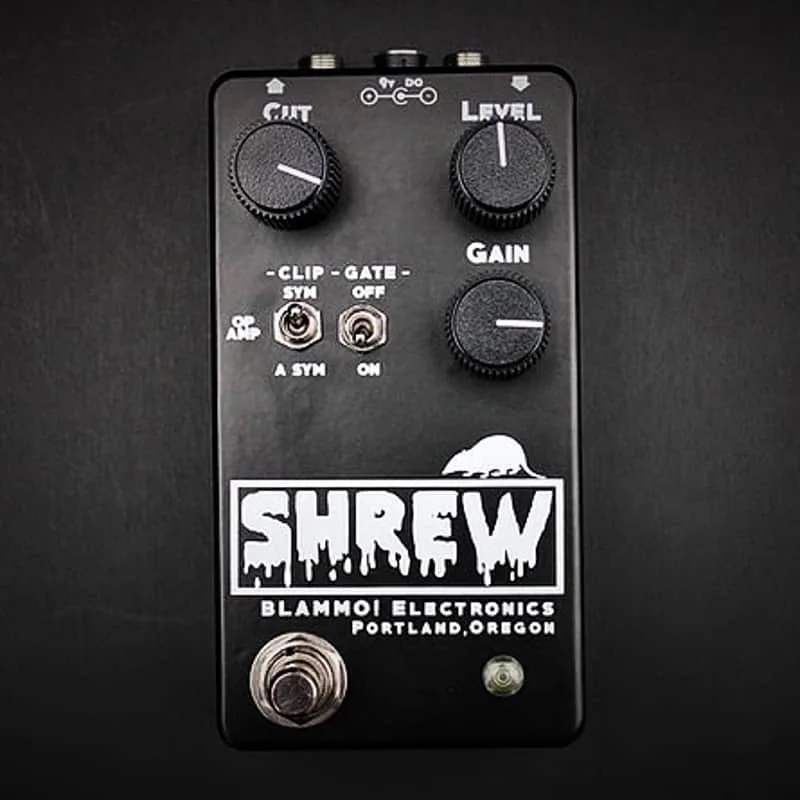


The BLAMMO! Electronics Shrew is a low-noise distortion pedal, handmade in Portland, Oregon. BLAMMO! describes it as their take on a classic op-amp based distortion circuit, with modern upgrades and more tonal flexibility than the original designs it draws from1. The current version, the Shrew V2, fits that circuit in a smaller, compact case and adds a noise gate that was missing from the first version2.
The list price is $154.99 as listed by the maker in October 20261.
An op-amp distortion with a noise gate
Op-amp distortion circuits, the family the Shrew belongs to, use an operational amplifier to push the signal into clipping rather than relying on transistors alone. BLAMMO!'s version keeps that classic architecture but adds two things the originals did not have: a variable clipping stage and a built-in noise gate12.
The noise gate is the feature that gives the pedal its "low noise" name. As the maker describes it12:
"The noise gate is designed to quite the hiss and hum heard between notes, or when not playing, that's inherent to high gain circuits but also adds a snappier attack under the finger tips which is great for faster players"1
In the V2, the gate can be turned on or off with a push button in the middle of the pedal, so players who want the sustain of an ungated high-gain circuit can switch it out2.
The controls
The Shrew's control set is built around two ideas: choosing your clipping character, and controlling noise12.
| Control | What it does |
|---|---|
| CLIP knob | Controls the hard clipping diodes. Far left gives symmetrical clipping from two germanium diodes (D9J and 1N34A); dialed all the way right gives an asymmetrical option that uses an LED. The knob blends between them1 |
| Noise gate push button (V2) | Turns the noise gate on or off. The gate removes hiss and hum between notes and adds a snappier attack2 |
The Clip knob is itself an upgrade over the first version, where clipping was selected with a switch rather than blended continuously2. For a player, the difference matters: symmetrical clipping (both halves of the waveform clipped equally) tends toward a tighter, more even distortion, while asymmetrical clipping clips one half of the waveform harder, which generally produces a more open, ragged character. The germanium diodes at the far left end and the LED at the far right end give you the two extremes, with everything in between available by turning the knob.
Power and switching
The Shrew runs on a standard 9V DC supply with a 2.1 mm center negative plug, the same format as most pedals on the market, and draws 31mA1. There is no battery option; power comes through the DC jack only2. At 31mA it is a light load, easy to run from a multi-output power brick alongside other pedals.
The footswitch is a relay based true bypass system with soft switching that doesn't click1. True bypass means the signal passes through the pedal unprocessed when it is off, and the relay switching means the change happens without the audible pop that mechanical true bypass switches can produce.
The Shrew uses a center negative 9V DC jack only. There is no battery compartment, so it needs a pedal power supply to run12.
History: from the original to V2
The Shrew has gone through two versions. The original V1 had the same op-amp distortion circuit but selected its clipping with a switch rather than a knob, and it had no noise gate2.
- A smaller, compact case, with the enclosure slimmed down12
- The clipping switch replaced by the blendable Clip knob2
- A new noise gate, switchable via a push button2
- Improved power filtering2
- The footswitch upgraded to relay based true bypass with soft switching2
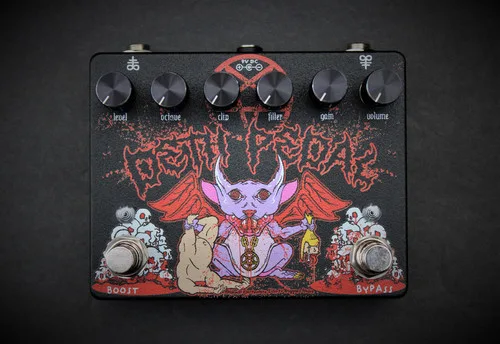
BLAMMO! has also built other pedals in a similar spirit, including the Blues Blaster overdrive and the limited edition Deth Pedal collaboration with Dirty Haggard, which itself featured a clipping potentiometer and an internal noise gate.
Videos
Brett Kingman
Harsh Tones, Inc.
Brett Kingman
Questions
Does the BLAMMO! Shrew take a battery?
No. The pedal is powered through a 2.1 mm center negative 9V DC standard power jack, and no battery option is listed. You will need a standard 9V pedal power supply to run it.
Is the BLAMMO! Shrew true bypass?
Yes. The Shrew uses a relay based true bypass system, so when the pedal is off your signal passes through without the circuit coloring it. The relay design also means the footswitch engages without an audible click.
Does the Shrew click when you switch it on or off?
No. BLAMMO! upgraded the footswitch to a relay based true bypass system that doesn't click, using soft switching. This applies to the current version of the pedal.
What does the Clip knob do on the Shrew?
The Clip knob controls the hard clipping diodes. Set far left (anti-clockwise) you get symmetrical clipping from two germanium diodes, a D9J and a 1N34A. Dialed all the way right you get an asymmetrical clipping option that uses an LED, and the knob blends between them.
What power supply does the BLAMMO! Shrew need?
A standard 9V DC pedal supply with a 2.1 mm center negative plug, the same format used by most pedals. Current draw is 31mA, so it is easy on a multi-output power brick. There is no battery option.
Sources (2)
- Shrew | BLAMMO! Electronics, BLAMMO! Electronics
- BLAMMO! Electronics Shrew V2, Delicious Audio, 2026-09-15