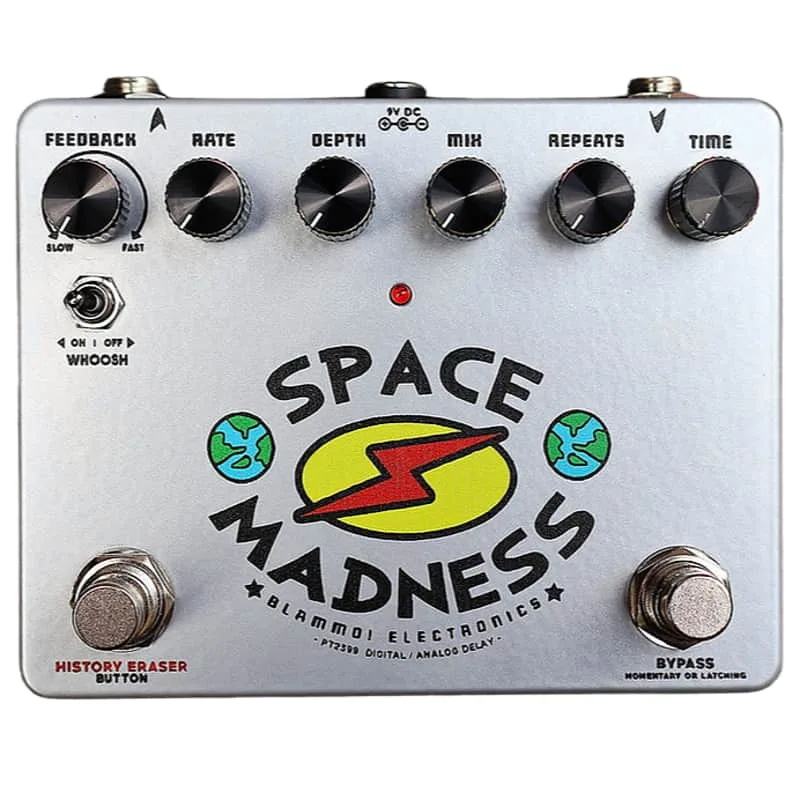



The BLAMMO! Electronics Space Madness is a dual PT2399 based delay pedal, built around two of the same chips that power a large share of modern digital delay circuits. BLAMMO! Electronics says it can do short and long delay times well, with a noise out switch that is highly controllable plus an LFO that wobbles the repeats1. Delicious Audio's Paolo De Gregorio describes it as a 0 to 1500 ms delay with modulation and a noise generating switch, and notes the circuit is based around the "infamous but always-inspiring PT2399 chip"2.
Why two PT2399 chips
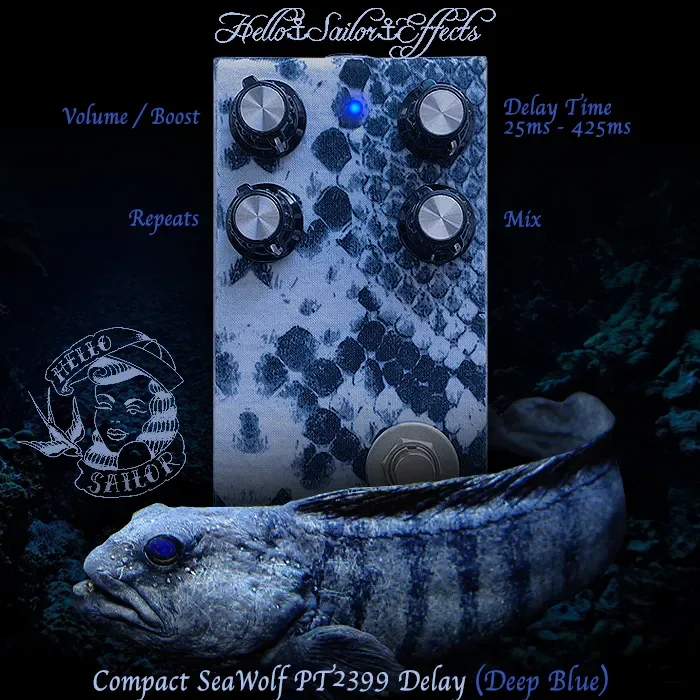
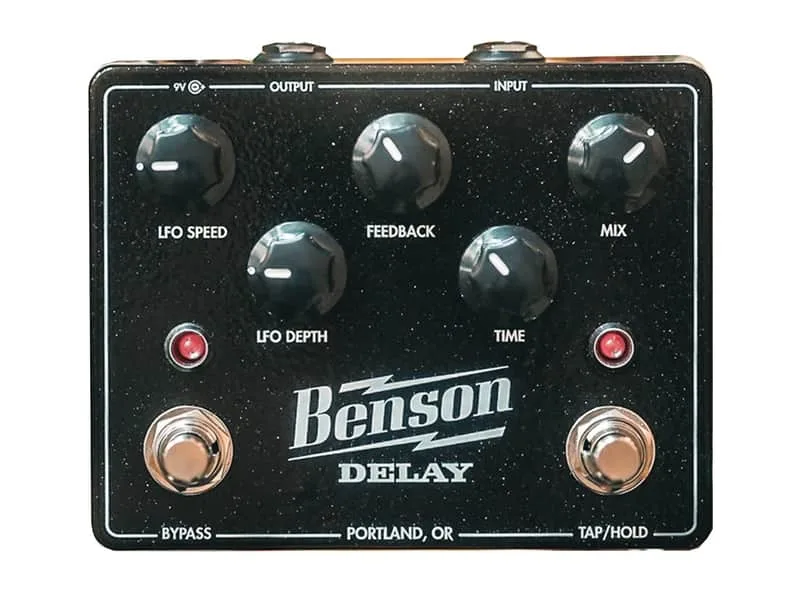
The PT2399 is a common delay chip, and a single one sets a ceiling on delay time. GuitarPCB, which publishes PT2399 based projects, says the chip "provides smooth delay effects with a maximum delay time of approximately 600 milliseconds," with possible subtle artifacts at the maximum that vary with each chip's tolerance3. A dual chip design is how the Space Madness reaches its 0 to 1500 ms range2, and other makers take different approaches to the same chip: the Hello Sailor Effects SeaWolf PT2399 Delay runs 25 ms to 425 ms4, while the Benson Amps PT2399 delay reaches 30 ms to 1250 ms and was described by Guitar Pedal X as "an excellent analog voiced PT2399 delay with LFO flutter and tap-tempo"214.
The controls
The Space Madness pairs standard delay and modulation knobs with a second footswitch dedicated to oscillation12.
| Control | What it does |
|---|---|
| Rate | Controls the speed of the LFO1 |
| Depth | Basically a mix control for the LFO1 |
| Feedback | Decides how quickly the self oscillation happens and works interactively with the mix and repeats knobs1 |
| Other knobs | Control the parameters for the delay and the modulation2 |
| Woosh switch | In the on position, applies modulation to the oscillation2 |
| History Eraser footswitch | Sends the pedal into self oscillation and connects to the Time knob through the Whoosh switch, causing spaceship like blasts and stretched out whirling sounds; officially called the History Eraser Button1 |
The History Eraser is the pedal's signature feature. Delicious Audio describes the second footswitch as generating "a momentary oscillation" whose speed is controlled by the Feedback knob, ending with a woosh2. In practice, holding the switch pushes the repeats into runaway oscillation, and with the Woosh switch engaged the oscillation itself is modulated, which is where the pedal's whoosh character comes from.
Power, bypass and build
The Space Madness runs on the standard 2.1mm center negative 9 volt power supply, Boss style, and draws 65 mA1. That is a normal isolated pedalboard supply output, but it is above the draw of many compact delays, so a low current daisy chain output may not be the right home for it.
The Space Madness uses buffered bypass, not true bypass1. Worth knowing if you plan to place it in a true bypass loop or a looper switcher.
The enclosure is a silver powder coated box with a UV printed graphic, measuring 4.72" x 3.71" x 1.33"1. BLAMMO! Electronics says the pedal is assembled by hand with care in Portland, Oregon1.
What reviewers said
Delicious Audio's write up dates from August 2024, when the pedal was, in the publication's words, "a pedal without a webpage, for now"2. It has since gained a product page on the BLAMMO! Electronics site, where the current listing carries the specifications above1.
Videos
60 Cycle Hum
AndyDemos
Noise Generator
Questions
Is the BLAMMO! Space Madness true bypass?
No. BLAMMO! Electronics lists the Space Madness with buffered bypass rather than true bypass. A buffer holds the signal level through long pedalboard cable runs, which some players prefer on a board with many pedals, but it is worth knowing before you slot it into a true bypass loop setup.
What is the History Eraser footswitch on the Space Madness?
The History Eraser is the second footswitch. BLAMMO! Electronics says it sends the pedal into self oscillation and connects to the Time knob through the Whoosh switch, causing spaceship like blasts and stretched out whirling sounds. Delicious Audio describes it as generating a momentary oscillation whose speed is controlled by the Feedback knob.
How long can the delay time go on the Space Madness?
Delicious Audio lists the delay range as 0 to 1500 ms. That is well beyond the roughly 600 ms a single PT2399 chip provides, which is where the pedal's dual PT2399 design comes in.
What power supply does the Space Madness need?
A standard 2.1mm center negative 9 volt supply, the Boss style used by most pedals. BLAMMO! Electronics lists the current draw at 65 mA, so a normal isolated output handles it, but it is above what a low draw daisy chain budget might assume.
Where is the BLAMMO! Space Madness made?
BLAMMO! Electronics says the Space Madness is assembled by hand with care in Portland, Oregon.
Sources (4)
- Space Madness, BLAMMO! Electronics
- BLAMMO! Electronics Space Madness, Delicious Audio, 2024-08-02
- NostalgiTone-Space-Modulator, GuitarPCB, 2024-09
- Guitar Pedal X, Guitar Pedal X, 2025-03-11