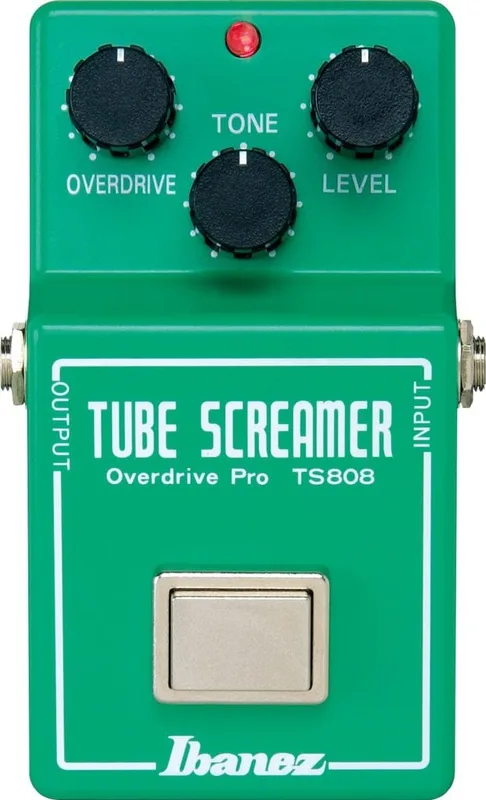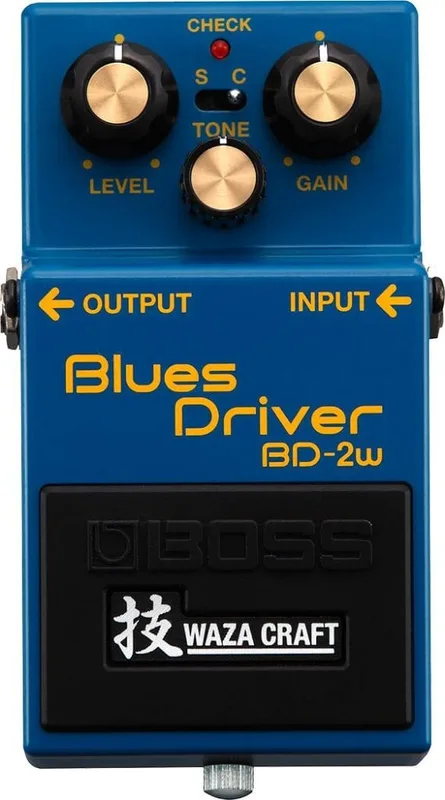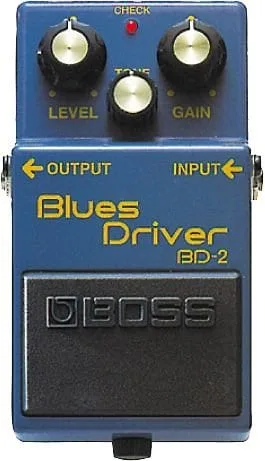


The Boss BD-2 Blues Driver is a transistor-based analog overdrive pedal, released in 1995, that aims to put the sound of a dimed tube amp in a box. Where an Ibanez Tube Screamer is designed mainly to push your tubes, Boss designed the Blues Driver with a flatter EQ profile and a very reactive first gain stage, aiming to capture the complexities of a cooking tube amp on its own12. Guitar World's reviewer summed it up as an overdrive that "delivers an incredibly dynamic, almost transparent overdrive that reflects the carefully curated gear in your rig," calling it a solid choice for professionals and beginners alike3.
It is a fully analog, transistor-based pedal that uses multiple gain stages to emulate an amplifier's natural breakup3, and JHS Pedals describes it as "a very iconic pedal"4. Guitar World's buying guide notes there are plenty of OG models from 1995 still knocking around2.
What the Blues Driver does to your sound
The BD-2 delivers what the Guitar FX Layouts blog calls "the creamy, yet crunchy sound associated with great blues guitar," with tube amp simulation built into the circuit7. Its launch price in the US was $1093, and it has stayed an affordable pedal: Guitar World listed it at $115 in 20266, and MusicRadar has included it in a roundup of cheap alternatives to boutique overdrives36.
The design intent is what separates it from the mid-hump overdrives. Where a Tube Screamer aims to boost your tubes, the BD-2 was designed to have a flatter EQ profile and a very reactive first gain stage, capturing the complexities of a cooking tube amp1. Its tonestack is amp-style, derived from a Fender combo-style circuit, with fixed values1. The range is wide: JHS Pedals describes the BD-2W, the Waza Craft version of the same circuit, as covering "really light breakup/light overdrive, all the way to a high gain overdrive/almost distortion"8.
The controls: Level, Tone and Gain
The user-facing panel is simple: Gain, Volume (Level) and Tone controls, plus a footswitch3. What each knob does:
| Control | What it does |
|---|---|
| Gain | A remarkably wide range, from almost completely clean to a good amount of saturation, though not quite reaching thick distortion on its own1 |
| Level | Sets output level; on max it is not the loudest pedal, but it can push your preamp a good amount or give a solo boost1 |
| Tone | A little more limited, most useful in knocking off the high end of the pedal as needed1 |
One criticism shows up in Guitar World's overdrive buying guide: the treble control can get a little harsh at higher settings2.
Power and connections
The BD-2 runs on your choice of battery or mains power9. On mains it wants 9V DC, center negative, drawing 20mA3. You access the battery compartment by lifting the footswitch out of the way after unthreading the thumb screw at the front of the pedal3. Connectivity is one 1/4" input and one 1/4" output3, and the bypass is buffered, not true bypass3. The aluminum chassis is solid enough that Guitar World's reviewer felt you could build houses with it3, and the pedal carries a five-year warranty5.
Circuit and versions, from the original to the BD-2W
Inside, the BD-2 is a rather complex circuit with a few similarities to a preamp stage: an amp-style tonestack with fixed values, and a unique initial gain stage using a pair of transistors behaving like an op-amp1. Boss uses differential transistor pairs in a handful of circuits, including the BD-2 and the OD-310. For clipping, the pedal uses 1SS133 diodes, with D3 on its own and D7, D8, D9 and D10 in pairs7.
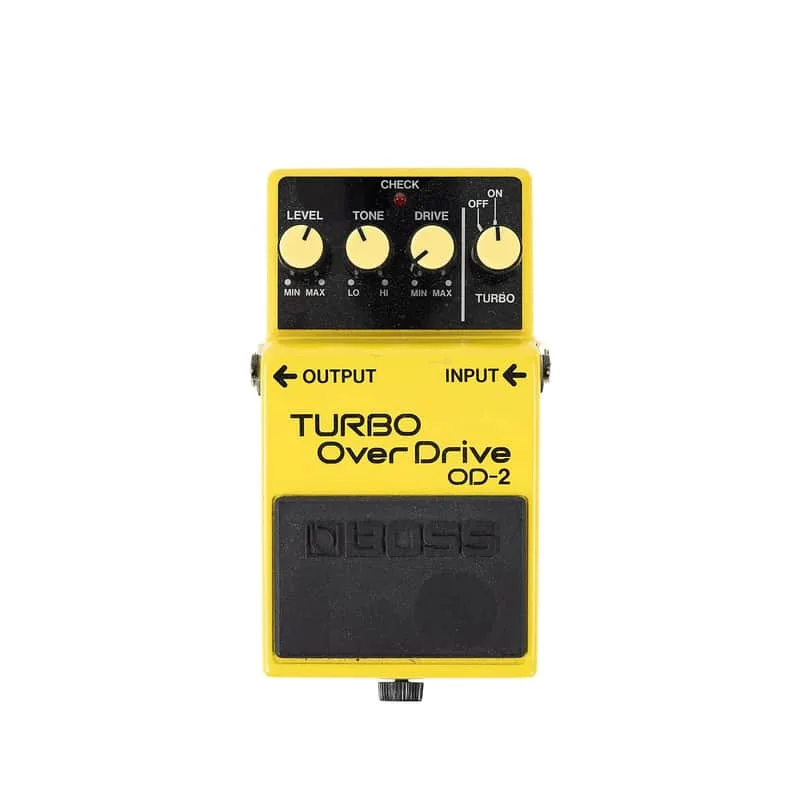
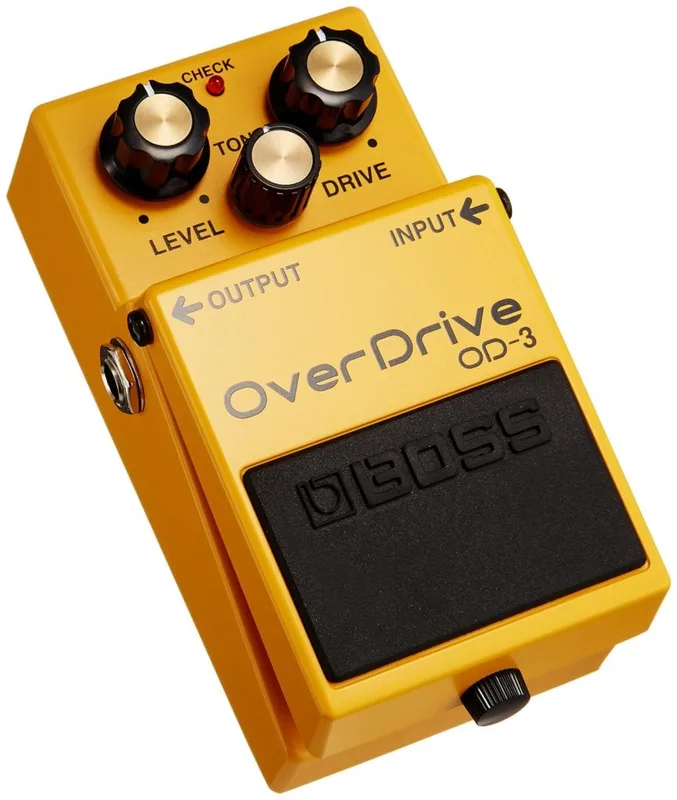
Aion FX places the BD-2 in Boss's overdrive lineage: it can be seen as a "rebranded" in-between member of the same series as the OD-2 and OD-3, since it shares much of the same circuitry as both11.
The BD-2 is also one of the most modded pedals around. The gain pot is a 250K dual log part because it controls resistance in two separate parts of the circuit, which is what makes dual-gain adaptations possible12. On JHS Pedals' Short Circuit series, Josh Scott added a capacitor wired to a toggle switch, describing the result as "Better bass, better treble, smoother gain." The toggle sits below the N of the Gain label, turns the mod on in the up position, and the whole build took an hour and 45 minutes on the livestream13.
On That Pedal Show, Mick and Daniel have used the BD-2 on their own boards, and Andy Timmons was noted using the Blues Driver with a fair amount of gain and his guitar volume backed off, best demonstrated on a Strat14. A Keeley-modded BD-2 they covered in 2016 is no longer made, with links pointing to the BD-2W instead15.
The BD-2W and related pedals
The BD-2W Blues Driver Waza Craft is Boss's premium take on the circuit, based on the classic BD-2 Blues Driver with all-discrete analog circuitry16. It has two modes, and on That Pedal Show Mick Taylor noted the one on the left has a bit more bass cut17.
The BD-2 circuit has also reached players through modified versions: the Keeley mod version of the BD-2 is no longer made, and it links to the BD-2W as its successor15.
Videos
Premier Guitar
Wampler Pedals
Marty Music
Questions
Does the Boss BD-2 take a battery?
Yes. The BD-2 runs on your choice of a 9V battery or mains power. You reach the battery compartment by unthreading the thumb screw at the front of the pedal and lifting the footswitch out of the way. On mains power it wants 9V DC, center negative, drawing about 20mA.
Is the Boss BD-2 true bypass?
No. The stock BD-2 uses Boss's buffered bypass, like most Boss compact pedals. Builders who clone the circuit on stripboard often convert it to true bypass by removing the buffer switching components, but the factory pedal is buffered.
Where is the Boss BD-2 made?
The BD-2 is manufactured in Taiwan, in Boss's familiar compact aluminum chassis. Boss compact pedals are built to take abuse, and the BD-2 carries a five-year warranty in comparison with the shorter coverage on many competing overdrives.
What diodes does the BD-2 Blues Driver use for clipping?
The BD-2 uses 1SS133 diodes for clipping, with D3 on its own and D7 through D10 arranged in pairs. A common mod swaps D3 for a different diode, such as a 1N4002, to get asymmetrical clipping and a different character.
Can the BD-2 be used as a clean boost?
Partly. The Gain control's range is remarkably wide, going from almost completely clean to a good amount of saturation, so you can run it nearly clean. With the Level control on max it is not the loudest pedal around, but it can push your preamp a good amount or serve as a solo boost.
Sources (17)
- Boss BD-2 Blues Driver review, guitar.com, 2025-06-03
- Best overdrive pedals 2026: mid-hump to transparent tone, Guitar World, 2022-06-07
- Boss BD-2 Blues Driver review, Guitar World, 2026-08-19
- THE JB-2 / ANGRY DRIVER, JHS Pedals
- Ibanez Tube Screamer vs Boss Blues Driver: Which is better?, Guitar World, 2022-03-29
- Boss SD-1 Super Overdrive review, Guitar World, 2026-08-17
- Guitar FX Layouts: Boss BD2 Blues Driver, Guitar FX Layouts (tagboardeffects.blogspot.com), 2013-03-21
- GUITAR RIG ESSENTIALS, JHS Pedals, 2020
- 8 cheap but great guitar overdrive pedal alternatives to boutique classics, MusicRadar, 2020-07-21
- Charon Overdrive / Ibanez CR5 Crunchy Rhythm, Aion FX, 2019-08-03
- Aurum Amp Overdrive / BOSS® OD-2 Overdrive, Aion FX, 2021-11-23
- Guitar FX Layouts: Micro POG Dual Control modification, Guitar FX Layouts (tagboardeffects.blogspot.com), 2014-05-14
- How To Modify A BOSS Blues Drive BD-2 Overdrive Pedal, JHS Pedals (YouTube), 2024-11-25
- That Pedal Show, That Pedal Show, 2017-09-28
- That Pedal Show, That Pedal Show (YouTube), 2016-06-30
- BOSS - BD-2W | Blues Driver, BOSS (www.boss.info)
- What About The Nobels ODR-1? vs TS9 & BD-2w into AC15 & Deluxe Reverb That Pedal Show, That Pedal Show (YouTube), 2021-10-07
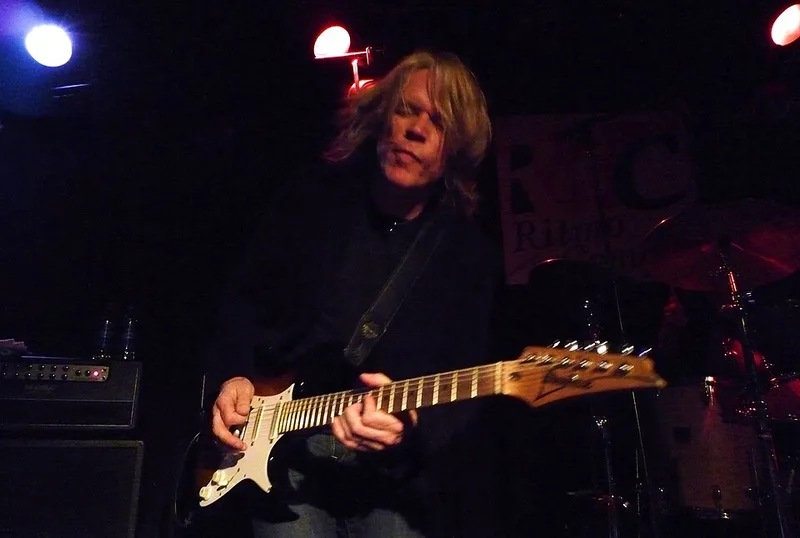 Andy Timmons
 Rabea Massaad