

The BOSS DS-1W is a distortion pedal made by Boss, a Waza Craft special edition of the DS-1 that Boss has built since 197812. It keeps the three-knob format of the original but adds a second voice: Standard mode reproduces the original DS-1 sound, while Custom mode offers fatter distortion with focused midrange, more input sensitivity, and 6 dB more available level for driving amps and pedals13. It reached US stores in October 2022 at $149.99 and is built in Japan with a discrete all-analog circuit4315.
Boss positions it as "The Classic BOSS Distortion, Enhanced with Waza Craftsmanship," part of the Waza Craft family of premium compact pedals14. GuitarPlayer's Rod Brakes described it officially as a "complete redesigning of the original circuits by the original developers"6.
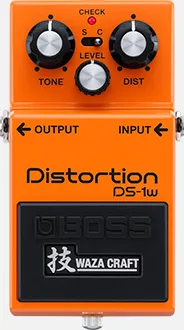
The controls: Level, Tone, Dist and the S/C switch
The front panel follows the original DS-1 layout, with three knobs and a mode switch. Guitar World's launch coverage notes the sound "can be tweaked via Tone, Distortion and Level knobs"9.
| Control | What it does |
|---|---|
| Level | Sets the output volume; in Custom mode the available level is raised by 6 dB for a wider range of gain boost1 |
| Tone | Wide-ranging frequency control, fine-tuned differently for each mode1 |
| Dist | Sets the gain; with Level, it "opens up a variety of saturated and distorted sounds"10 |
| S/C switch | Two-way switch labeled 'S' and 'C' that toggles between Standard and Custom modes6 |
The Tone knob behaves differently depending on the mode. In Standard mode it simultaneously boosts and cuts the low and high frequencies as it is turned; in Custom mode it is tuned to boost mids and presence at once11. Delicious Audio's buying guide puts it in player terms: "the Tone knob can make your guitar cut through during a solo or tame the highs for chord sections"10.
Standard and Custom modes
The two modes are the main thing separating the DS-1W from the regular DS-1. Both run through the same newly revised two-stage gain circuit with discrete analog components111.
| Mode | Character |
|---|---|
| Standard | A discrete circuit version of the original DS-1, with the tight, hard-edged tone and singing sustain of the original pedal61 |
| Custom | Fatter distortion tones with focused midrange and increased touch response, plus 6 dB more level and more input sensitivity13 |
Guitar World reported at launch that Standard mode is a recreation of the first, made-in-Japan iteration of DS-1 tone, delivering:
"Custom mode provides fatter distortion tones with focused midrange and increased touch response"9
Custom mode, by contrast, "sets its sights on harnessing a thick, mid-focused sound that provides even more fatness and cut to stand out in the mix"9. Delicious Audio summarizes the split simply: Custom mode "offers a bigger sound and more input sensitivity"10.
Because Custom mode raises the available level by 6 dB, the pedal also works as a gain booster, and Delicious Audio notes that the two modes offer increased versatility when it is used that way111. Premier Guitar's demo material describes this as letting players "dial in the sound for any application, from sharp rhythms and searing solos to maintaining low-end clarity when boosting amps and other drive pedals"12.
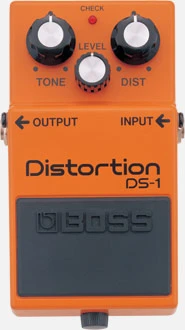
DS-1 versus DS-1W
The standard DS-1 remains in the Boss range at a much lower price, listed at $59 by Delicious Audio in May 2024, against $149 for the DS-1W at the same date10. By April 2025 Gearnews listed the Waza edition at $125.007.
The differences a player actually hears come down to the second mode and the revised circuit. The DS-1W fuses "the look and character of the original with a newly revised discrete all-analog circuit for expanded range and versatility"1. The DS-1W is made in Japan5, and carries the same Boss five-year warranty as the original113.
Delicious Audio's coverage gives useful context on why Boss revisited the circuit at all. The original DS-1, however popular, "was starting to sound a little passé to many guitarists due to its weak dynamic response and tendency to sound thin, making it less than ideal for blues"11. The same guide also notes the DS-1 circuit is "extremely prone to modding," which is part of why so many boutique distortions trace back to it10.
History: from the 1978 DS-1 to the Waza Craft edition
Boss released the DS-1 in 1978210. Boss's own Waza Craft article says the pedal "changed the guitar world, introducing players to a new high-gain sound with rich harmonic overtones"14. Gearnews calls it "the most classic of all distortion pedals, and Boss's best-selling pedal of all time"7.
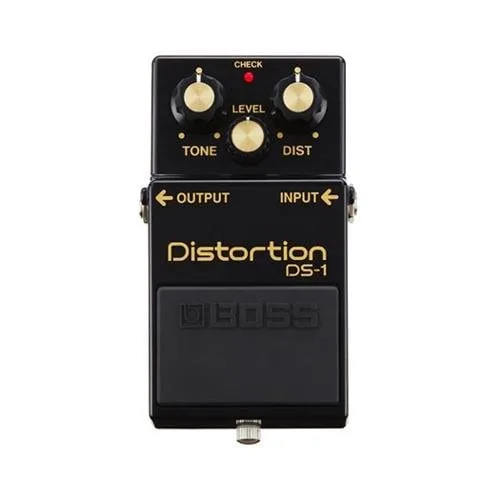
The DS-1W arrived in 2022 as the latest addition to the Waza Craft family of premium compact pedals410. Guitar World's Alex Lynham described it as the moment "Boss reissued the DS-1 in the form of the DS-1W Waza Craft"15, and Guitar.com's Josh Gardner framed it as "taking the iconic DS-1 circuit and giving it a Japan-made overhaul"16. The Waza treatment extends to small details: the pedal carries a 70s-style silver battery compartment thumbscrew, a nod to the original's era16.
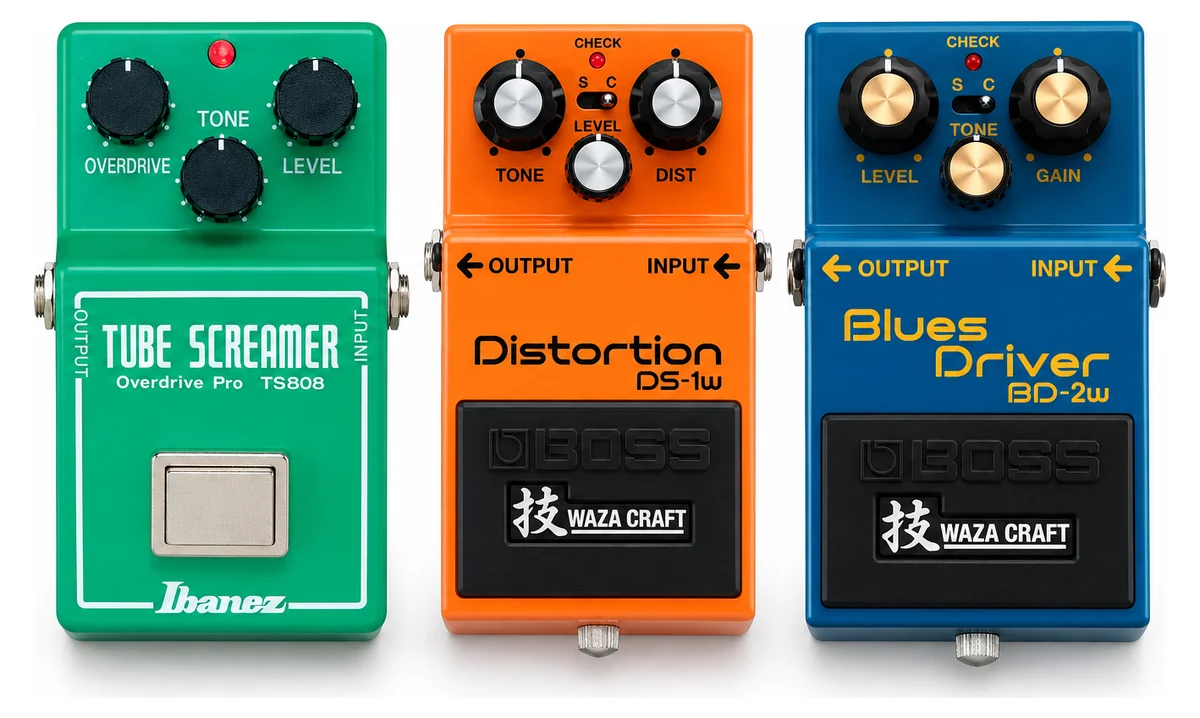
Boss's Waza Craft line, as the maker describes it, delivers premium versions "featuring a complete redesign of the original circuits by the original developers"8.
What reviewers said
Reviews of the DS-1W were largely positive, with Custom mode drawing the most praise.
- MusicRadar's review listed "Custom mode is a significant upgrade on the original" among its plus points17.
- Guitar.com's 2026 buying guide concluded that "it's the newly added 'custom' mode that really impresses"18.
- Delicious Audio called the DS-1W "an expected update to what's in all likelihood the best-selling pedal ever"11.
The wider DS-1 line has also earned recognition in the press: Guitar World's cheap distortion pedals guide named the DS-1 "Best distortion overall" in January 202419. That Pedal Show compared the DS-1W Waza Craft against vintage and standard DS-1 units in an October 2022 episode20.
Delicious Audio's buying guide flags two limitations worth knowing: the original DS-1 "won't do 'bluesy warm' nor 'fat,'" and the pedal is "not the best choice if you have a solid state amp"10. Both criticisms are aimed at the original circuit's character, which Standard mode preserves by design.
The DS-1W ships without a battery or power supply. It runs on a 9V battery or a 9V DC center-negative adapter, drawing 15mA85.
Videos
Rhett Shull
Pete Thorn
BOSSchannel
News
Questions
Does the Boss DS-1W take a 9V battery?
Yes. The DS-1W runs on a 9V battery or a 9V DC adapter, neither of which is included in the box. Guitar World lists the power requirement as a 9V battery or 9V DC adapter with a 15mA current draw, and Guitar.com notes it takes a centre-negative PSU. A battery makes it usable without a power supply, though an adapter is the practical choice on a pedalboard.
Is the DS-1W true bypass?
No. The DS-1W uses Boss's buffered bypass, with what the maker calls a premium buffer for clean and clear tone when the pedal is bypassed. This is standard for Boss compact pedals and differs from the true bypass switching found on many boutique distortions. Players who prefer buffers in their chain, or who run long cables, will find this behaves like other Boss units.
What is the difference between the DS-1 and DS-1W?
The DS-1W is a Waza Craft edition of the DS-1 with a redesigned discrete all-analog circuit and two modes. Standard mode recreates the original DS-1 sound, while Custom mode adds fatter tones with focused midrange, more input sensitivity, and 6 dB more available level. The DS-1W is made in Japan and carries a five-year Boss warranty; the standard DS-1 sells for considerably less.
How much current does the DS-1W draw?
Guitar World's review lists the DS-1W's current draw as 15mA, powered by a 9V battery or a 9V DC adapter. That is a low draw by modern standards, so it can share a daisy-chain power supply with other compact analog pedals without straining the supply, provided the polarity and voltage requirements of the chain are met.
Can the DS-1W be used as a boost?
Yes. In Custom mode the available level is increased by 6 dB, which Boss says provides a wider range of gain boost for driving amps and pedals. Delicious Audio also notes that the two modes offer increased versatility when the pedal is used as a gain booster, so it can push an amp or another drive pedal rather than serve only as a distortion.
Where is the Boss DS-1W made?
The DS-1W is made in Japan. GuitarPlayer's review lists its build origin as Japan, MusicRadar describes it as a Japanese-made DS-1, and GuitarPlayer's launch coverage called it a made-in-Japan, souped-up version of the pedal. This is part of the Waza Craft approach, which Guitar.com described as giving the DS-1 circuit a Japan-made overhaul.
Sources (20)
- BOSS - DS-1W | Distortion, BOSS (boss.info)
- Boss DS-1 Distortion Analysis, GuitarPCB
- Boss finally gives the iconic DS-1 the Waza Craft treatment, guitar.com, 2022-10-06
- BOSS Announces DS-1W Distortion, Bass Gear Magazine, 2022-10-06
- Boss DS-1W Waza Craft Distortion Review, GuitarPlayer, 2023-01-04
- Boss's Best-Selling Pedal Gets Waza Crafted With the DS-1W Distortion, GuitarPlayer (www.guitarplayer.com), 2022-10-06
- The Best Distortion Pedals in Every Price Range, Gearnews (www.gearnews.com), 2025-04-14
- Boss DS-1W Distortion review, Guitar World, 2023-01-06
- Boss finally drops the Waza Craft we've all been waiting for, Guitar World, 2022-10-06
- 2024 UPDATE! The Best Distortion Pedals, Delicious Audio, 2024-05-03
- BOSS DS-1w Distortion, Delicious Audio, 2023-06-26
- Boss DS-1W Waza Craft Distortion Demo, Premier Guitar, 2022-10-21
- BOSS DS-1 Distortion, Delicious Audio, 2023-04-26
- What is the Waza Craft Pedal Line?, BOSS (articles.boss.info), 2021-06-08
- Boss DS-1 vs Boss DS-2: What's the difference?, Guitar World, 2023-08-11
- Boss DS-1W Waza Craft review: The original, but better, Guitar.com, 2023-01-30
- Boss DS-1W Waza Craft distortion pedal review, MusicRadar, 2022-12-23
- The best distortion pedals: jagged sounds from ProCo, Boss, EHX & more, guitar.com, 2026-06-24
- Best cheap distortion pedals: get your perfect rock tone for less money, Guitar World, 2024-01-31
- Distortion! Boss DS-1 Waza vs Vintage DS-1 vs Standard DS-1 Vs JHS Angry Charlie & JAM Rattler, That Pedal Show, 2022-10-28