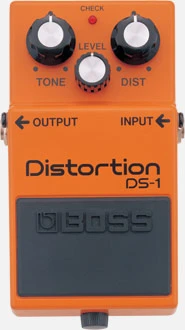


The Boss DS-1 Distortion, introduced in 1978 among the earliest models in the BOSS compact series, is the orange distortion pedal that redefined the sound of distortion for a generation of players. Boss describes its original, unchanged design as delivering a hard-edged attack and smooth sustain, and calls it the top-selling BOSS compact pedal ever, with over 1.5 million units sold according to Guitar World123. Its hard clipping and scooped tone control have made it a player's staple for nearly four decades, and its circuit has since appeared in anniversary and limited editions that dress the same sound in different finishes.
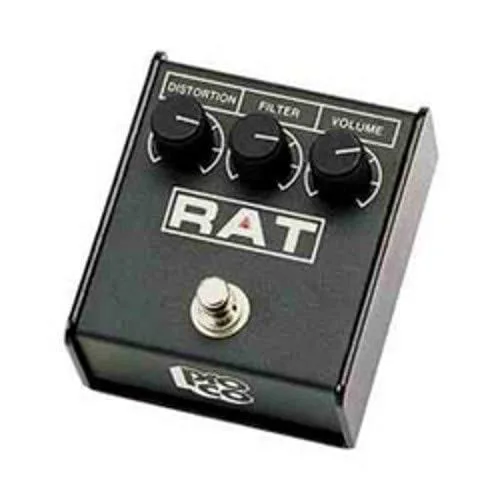
The DS-1 is a hard-clipper: a variable gain circuit with diodes that short the output to ground, producing hard clipping of the input waveform, the same family of clipping used in the Pro Co RAT and the MXR Distortion+45. Boss says its innovative two-stage gain circuit is a critical part of the fullness and definition guitarists love about the pedal, and that it delivers aggressive, well-defined distortion rich in harmonic overtones1.
What it does: hard-clipped distortion with a scooped tone control
The DS-1 gives a compressed, British stack style distortion with an easy control layout of three knobs: Distortion, Tone and Level6. The Distortion pot (a 100KB pot labeled VR1) sets the op-amp gain from 0dB up to 26.5dB8. The Tone control is scooped in the midrange: it consists of a fixed -6dB/octave low-pass filter and a fixed -6dB/octave high-pass filter, mixed by a 20KB pot (VR3)8. The Level pot (VR2) regulates the level by bleeding part of the signal to AC ground8.
Guitar World's buying guide calls the DS-1 a great entry point into the world of distortion, costing around $50 as of January 20267. Gearnews listed the standard DS-1 at $71.00 in November 2024, so street prices have moved between those figures over time9.
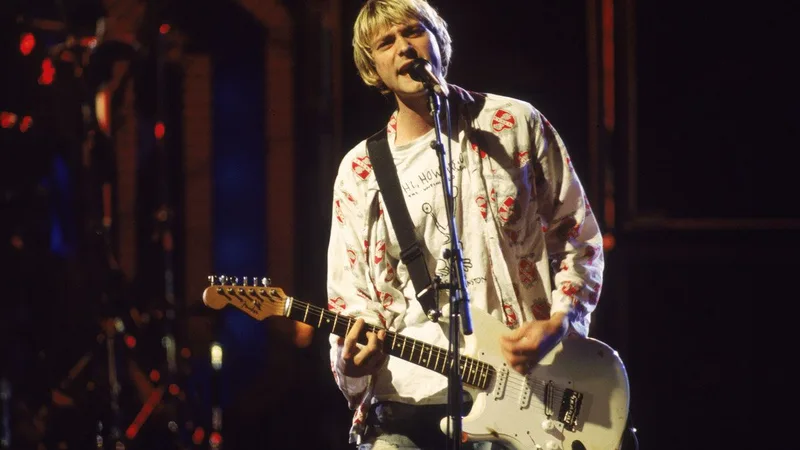
How it sits in a rig matters. On Guitar Pedal X, Stefan Karlsson found the regular edition "sounds very thin and anaemic into a Clean Pedal Platform - but quite magnificent into an already cooking amp, as Kurt Cobain deployed it"10. He also prefers a Keeley-modded DS-1, which he says has more low-end, punch and overall gain, working by default in his rig where the original does not10.
Players documented as using the DS-1 include:
- Kurt Cobain, on Nirvana's "Smells Like Teen Spirit"5
- Steve Vai5
- Mark Hosking of Karnivool, whose DS-1, Boss Flanger and Boss Compressor became part of the original Karnivool sound11
Inside the circuit
Circuit analysis breaks the DS-1 down into five blocks: Input Stage, Transistor Booster, Op-Amp Gain Stage, Tone Control, and Output Buffer plus Power Supply8. The power supply stage is a simple resistor divider providing +9V power and +4.5V bias voltage to the pedal8. The original circuit uses a JFET bypass switch circuit with a momentary push button, with buffers always in the signal path, which is why the pedal is buffered rather than true bypass8.
The distortion stage is followed by a passive tone filter and volume control4. On That Pedal Show, Mick described the gain structure: "it's something like 30 plus db of gain right before it hits the the clipping stage"12. Anasounds puts the maximum gain at 61.5dB (x1200)13. The current DS-1 has a simple circuit: transistor stages with an op-amp core and hard clipping diodes8.
A common mod target is resistor R9. Mods like the 'Vintage Ripper', the 'Fat Mod for DS-1' or the 'Huevos Grandes' increase R9 from 22Ω to 1KΩ, lowering the transistor booster gain from 35dB (56 times) to 17dB (7 times)8.
History and versions
The DS-1 debuted in 1978, and Boss says it has been the secret weapon behind myriad anthemic riffs and soaring solos since1. The pedal has gone through several revisions as components became available8:
| Version | Year | Chip | Made in | Notes |
|---|---|---|---|---|
| First release | 1978 | Toshiba TA7136AP pre-amplifier (not an op-amp), circuit labeled "DS-1" | Japan, silver screw | Warmest distortion, glints of grittiness and smoothness; most expensive and hardest to find8 |
| Second release | 1994 | Rohm BA728N op-amp, circuit re-labeled "DS1-A" | Japan | Not very loud, transparent drive, versatile8 |
| Third release | 2000 | Mitsubishi M5223AL op-amp | Taiwan | Loudest of all; fizzy at high gain; popular mod target8 |
| Fourth release | 2006 | New Japan Radio NJM2904L op-amp | Cheap, easy to find and perfect for mods8 | |
| Fifth version | 2017 | All surface mount components | Every DS-1 before this uses through-hole components14 |
Rhett Shull, walking through these versions on his channel, notes that a 2014 variation of version four is what is mostly seen on Reverb and eBay14. The 1978 first model had some inconveniences like a momentary LED and the need for an external power supply8. Guitar World's Alex Lynham notes the original DS-1 was not op-amp based, using the Toshiba TA7136AP preamplifier for a gritty and warm overdrive tone, and that the pre-1994 DS-1 is open and relatively flat in EQ profile, and heavily clipped15.
Tone enthusiasts deem the earlier Japan-made pedals to sound better than the later ones made in Taiwan4. The quickest visual tell on an original 1978 unit is the silver screw; modern Boss pedals usually have a black screw89.
Limited and anniversary editions
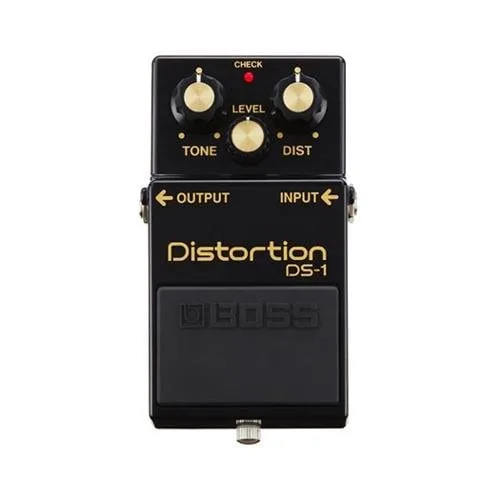
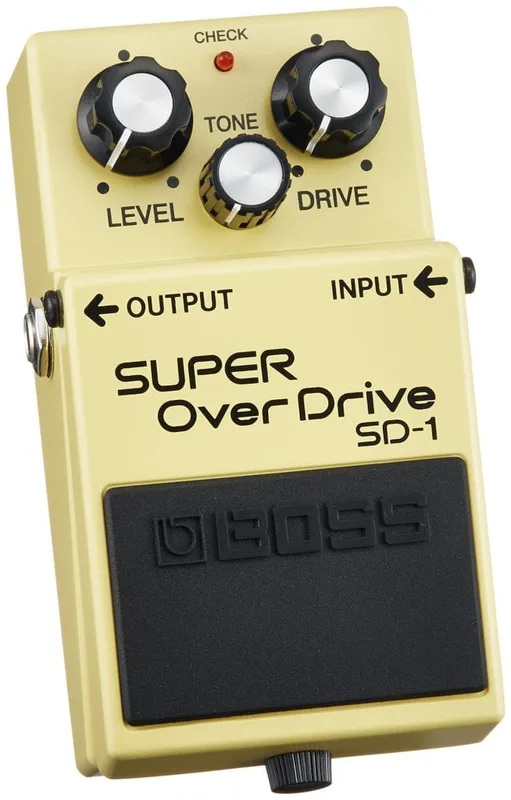
Boss has marked the DS-1's history with several limited runs. At NAMM 2017, Boss announced the 40th Anniversary edition, the DS-1-4A, a limited edition of the DS-1 marking the 40th anniversary of Boss compact pedals2021. It has a black body with gold lettering, gold knobs and a vintage silver thumbscrew21, and it was made only during 2017, at a $59 RRP when announced20. For Boss's 50th anniversary in 2023, the DS-1 Distortion joined the SD-1 Super Overdrive and BD-2 Blues Driver in limited-edition compacts with a bold metallic finish, each in a different color, a silver battery-compartment thumb screw, gold-capped knobs, unique four-digit serial numbers and exclusive packaging1617. Circuit-wise they are the same as the standard models, delivering the same sound and circuitry as the standard versions1817. Each was priced at $82.99 in the US, available through November 2023 while stocks lasted, with 7,000 made of each1817. Guitar.com reported 7,000 available worldwide shared across the three anniversary pedals, while MusicRadar reported 7,000 made of each; the two reports disagree on the total1618.
In November 2024, Boss released the DS-1 White Limited Edition, a limited run in a never-before-seen white colourway with a silver screw, aimed at collectors and Boss fanatics, listed at €899.
Beyond factory editions, the DS-1 has a busy modding scene. The Boss DS-1 Distortion Twin Drive Mods Edition, reviewed by Guitar Pedal X at $203 (£149) via eBay in August 2026, adds a Master Tone control, dual distortion and level controls, LED / Diode Lift / Silicon Symmetric clipping options and a Phat Mod switch19. Karlsson wrote of it: "I have quite a number of DS-1 Modded and Evolved types - and the DS-1 Twin Drive is still one of the very best of those"19. Griffin Effects offers its Rock Hard kit, saying it has taken the 80's metal out of the pedal and made it a sweet tone machine.
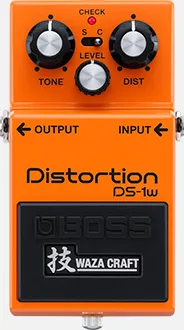
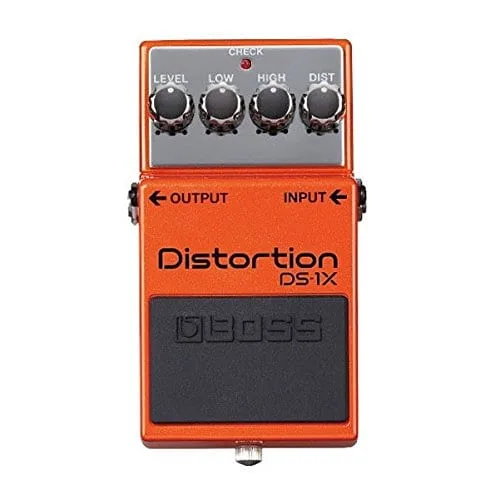
Boss has also carried the DS-1 forward in its own line: the DS-1W Waza Craft version, made in Japan with a BOSS five-year warranty, is based on the legendary DS-1 Distortion13, and the DS-1X is a digital-era sibling in the same family.
Videos
ProGuitarShopDemos
ProGuitarShopDemos
Guitar Interactive Magazine
Questions
Does the Boss DS-1 run on a 9V battery?
Yes. The DS-1 runs on a 9V DC power supply or a 9V battery, with a center negative 9V DC input for the supply. Current draw is low, around 10mA, so a battery lasts a long time at typical use.
Is the Boss DS-1 true bypass?
No. The DS-1 uses a buffered bypass. The original circuit uses a JFET bypass switch circuit with a momentary push button, and the buffers stay in the signal path whether the effect is on or off.
How can you tell a Japan-made DS-1 from a Taiwan-made one?
The earliest 1978 units were made in Japan and carry a distinguishable silver screw, and the 1994 revision was also made in Japan. The 2000 revision was made in Taiwan. Tone enthusiasts generally consider the earlier Japan-made pedals to sound better than the later Taiwan-made ones.
Which DS-1 version is best for mods?
The 2006 fourth revision, which uses the New Japan Radio NJM2904L op-amp, is cheap, easy to find and perfect for mods, according to circuit analysis. Popular mods include the Tri-Gain, JHS, Keeley and Analogman treatments.
Did Kurt Cobain use a DS-1 on Smells Like Teen Spirit?
Yes. Dave Hunter, writing in Guitar Player, names Nirvana's Smells Like Teen Spirit as an iconic example of distortion, where Kurt Cobain used a Boss DS-1. Steve Vai and Karnivool's Mark Hosking have also used the pedal.
How many DS-1 pedals have been sold?
Boss has sold over 1.5 million DS-1 units, according to Guitar World's review of the DS-1W. Boss itself calls the DS-1 the top-selling BOSS compact pedal ever.
Sources (21)
- BOSS - DS-1W | Distortion, BOSS (boss.info)
- BOSS - PX-1 | Plugout FX, BOSS (www.boss.info)
- Boss DS-1W Distortion review, Guitar World, 2023-01-06
- TONEHOME, TONEHOME
- All about fuzz, overdrive, distortion and boost pedals, GuitarPlayer (www.guitarplayer.com), 2026-06-22
- DS-1 Distortion (Vintage) by BOSS, RockBoard PedalPedia, 2026
- Best distortion pedals: Our top high-gain stompboxes, Guitar World, 2022-06-09
- Boss DS-1 Distortion Analysis, GuitarPCB
- Boss DS-1 White Limited Edition: 1978 Distortion, gearnews.com, 2024-11-28
- Guitar Pedal X, Guitar Pedal X, 2026-06-09
- Reverberations: Karnivool, BOSS (articles.boss.info), 2026-07-02
- You're Using Your Boss DS-1 All Wrong! No Really, You Are, That Pedal Show (youtube.com), 2021-10-22
- OD/Disto/Fuzz : The key differences between these 3 effect pedals, anasounds.com, 2019-04-04
- This Is WAY Better Than The Tubescreamer (The Boss DS-1 Sound), YouTube (Rhett Shull channel), 2022-11-15
- Boss DS-1 vs Boss DS-2: What's the difference?, Guitar World, 2023-08-11
- Boss celebrates its 50th anniversary with luxurious limited-edition versions of three of its classic pedals, Guitar.com, 2023-11-16
- “Beloved by generations of players in every musical genre”: Boss' sparkling 50th Anniversary series celebrates its place atop the pedal pile, Guitar World, 2023-11-16
- Boss celebrates its classic pedals with metallic finish 50th anniversary edition DS-1 Distortion , SD-1 Super Overdrive and BD-2 Blues Driver, MusicRadar, 2023-11-16
- Guitar Pedal X, Guitar Pedal X, 2026-08-25
- NAMM 2017: Boss announce 40th anniversary Limited Edition DS-1-4A Distortion pedal, gearnews.com, 2017-01-22
- NAMM 2017: Boss Announces Limited-Edition DS-1-4A Distortion Pedal, Guitar World, 2017-01-19
 Kurt Cobain