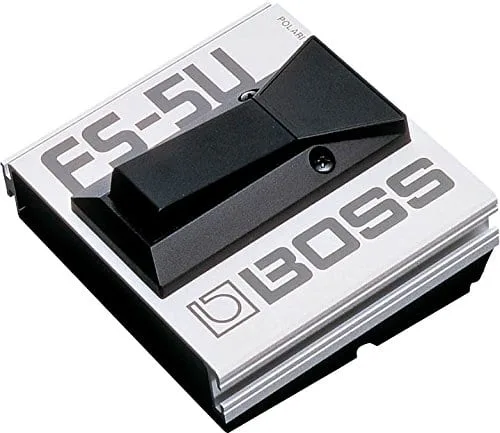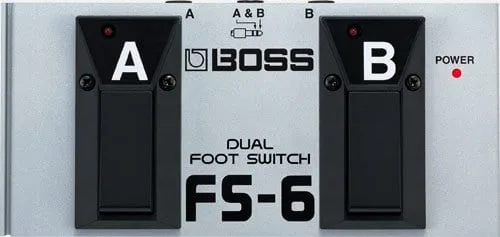


The Boss FS-6 is a dual footswitch: two switches in one housing, side by side, built to control other gear rather than process your signal. Boss describes it as combining latch- and momentary-type switching into one unit, with each footswitch independently assignable to either type1. It connects to instruments, rhythm machines, guitar amps and electronic devices that have control input jacks compatible with the FS-5L and FS-5U2.
For a player, that means one box on the floor can handle two remote-control jobs at once: starting and stopping a looper, changing banks on a switcher, or flipping amp channels, with each button behaving the way the connected gear expects1.
The controls: pedal, polarity and mode switches
The FS-6 gives each of its two switches its own small setup controls, so the two sides can be configured independently1.
| Control | What it does |
|---|---|
| Pedal Switch A, B | The two footswitches you step on |
| POLARITY Switch A, B | Sets the polarity of each switch's output |
| Mode Switch A, B | Assigns each footswitch to latch or momentary operation |
The mode switch is where the FS-6's main trick lives. A latch switch holds its state until you step again, like a light switch; a momentary switch is active only while your foot is on it. Boss states that each footswitch can be assigned latch- or momentary-type1, so one button can latch for a tap-tempo-free on/off function while the other is momentary for something like tap tempo or a hold function, depending on what the connected device requires.
The polarity switches matter because different manufacturers wire their control jacks differently. Being able to flip polarity per switch is what lets the FS-6 talk to gear beyond the Boss range, not just the devices Boss lists as FS-5L/FS-5U compatible2.
Cables and connections
The FS-6 can be wired two ways. It carries separate Jack A and Jack B connectors, both 1/4 inch phone type, for a conventional two-cable run to two devices. It also has a stereo input jack for a single stereo cable connection1, which tidies up the floor run when the destination has a TRS control input.
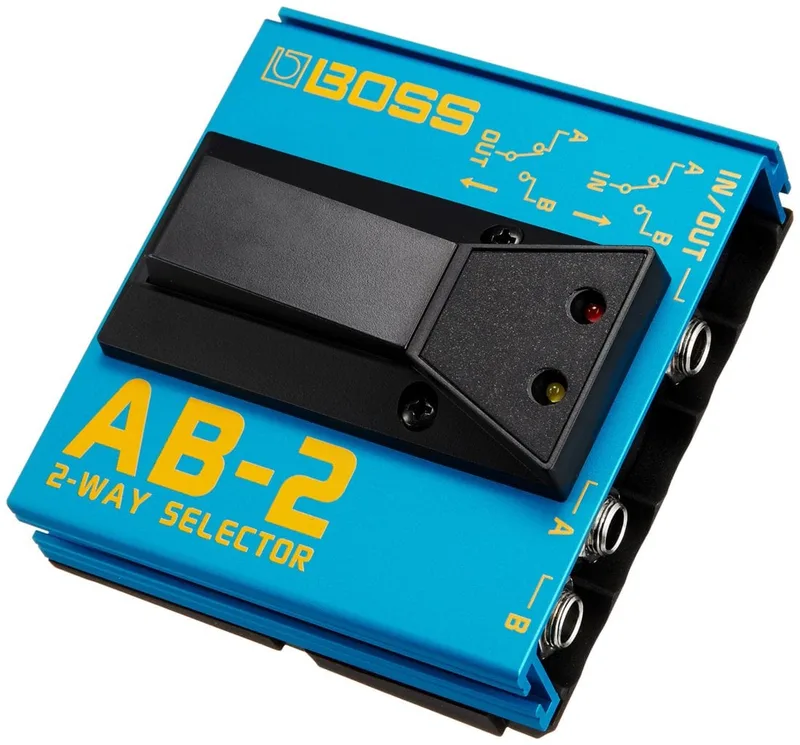
The FS-6 can also be connected to other footswitches for extension, including the FS-5L, FS-5U, another FS-6 and the AB-21.
Power
The FS-6 runs on DC 9V from a dry battery, either a 6F22 carbon or 6LR61 alkaline, with a maximum current draw of 8 mA1. A battery ships in the box along with the owner's manual1. No adapter input appears in the maker's specifications, so this is a battery-powered unit.
Using it with the RC-5 and the MS-3
Two common pairings show what the FS-6 does in practice.
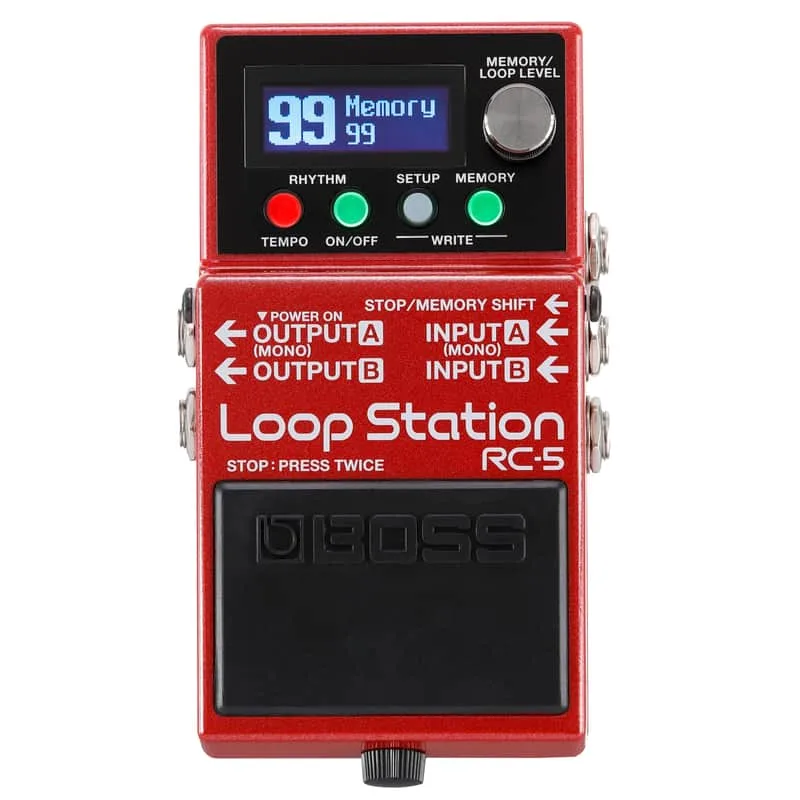
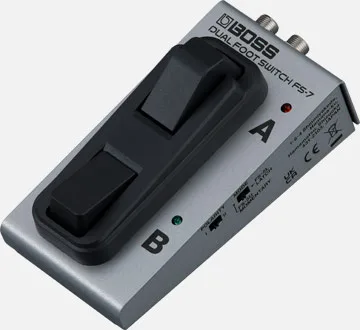
With the RC-5 looper. The RC-5 has an external footswitch connection, and Performer Magazine names the FS-6 among the external switches compatible with it34. Boss's own guidance for gigging with the RC-5 goes further, suggesting you "try connecting an external two-button footswitch such as the BOSS FS-6 or FS-7 for scrolling through your loops"5. The FS-7 is the alternative Boss names for the same job.
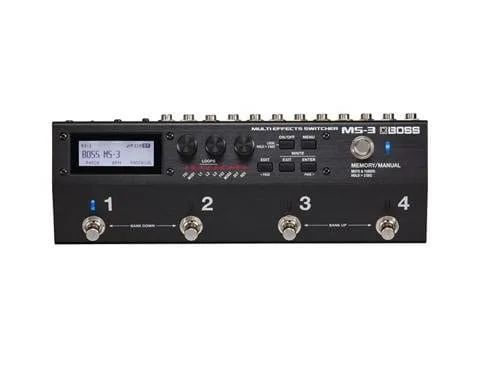
With the MS-3 switcher. In Sweetwater's review video of the Boss MS-3 Multi Effects Switcher, Mitch Gallagher connects the FS-6 to the MS-3's control inputs 3 and 4, with "those two switches are being used to change the bank up and down"4.
"those two switches are being used to change the bank up and down"
Gallagher's demo shows the FS-6 at its simplest: two buttons, each mapped to one function on a larger unit, so the player never bends down mid-song14.
Videos
Product Support
PhatPhish Guitar Studio
cdg2g
Questions
Does the Boss FS-6 work with the RC-5 looper?
Yes. The RC-5 has an external footswitch connection, and the FS-6 is one of the two-button switches Boss names for it. Boss's own guidance for the RC-5 suggests connecting an external two-button footswitch such as the FS-6 for scrolling through your loops, and Performer Magazine names the FS-6 among compatible external switches for the pedal.
Can the FS-6 change banks on the Boss MS-3?
Yes. In Sweetwater's MS-3 review video, Mitch Gallagher connects the FS-6 dual footswitch to the MS-3's control inputs 3 and 4, with its two switches used to change the bank up and down. The FS-6 can also be connected to other Boss footswitches, including the FS-5L, FS-5U, FS-6 and AB-2, for extension.
Does the Boss FS-6 need a battery?
It runs on DC 9V from a dry battery, either a 6F22 carbon or 6LR61 alkaline, and one battery ships in the box along with the owner's manual. Boss lists the current draw as 8 mA maximum. There is no adapter input listed in the specifications.
Can I use one stereo cable with the FS-6?
Yes. The FS-6 has a stereo input jack that allows a single stereo cable connection, so both switches can be reached with one cable run. It also carries separate Jack A and Jack B connectors, both 1/4 inch phone type, plus a combined Jack A and B TRS 1/4 inch output for two-cable setups.
What is the difference between latch and momentary on the FS-6?
A latch switch stays in whatever state you last left it, like a light switch, until you step on it again. A momentary switch is only active while your foot is on it. The FS-6 combines both types in one unit, and each of its two footswitches can be independently assigned to latch or momentary operation.
Sources (5)
- BOSS - FS-6 | Dual Footswitch, BOSS (boss.info)
- BOSS - FS-6 | Dual Footswitch, BOSS (boss.info)
- REVIEW: Boss RC-5 Loop Station Pedal, Performer Mag, 2021-03-16
- BOSS MS-3 Multi Effects Switcher Review, Sweetwater (YouTube), 2017-10-26
- Five RC-5 Tips for the Gigging Musician, BOSS (articles.boss.info), 2021-03-23