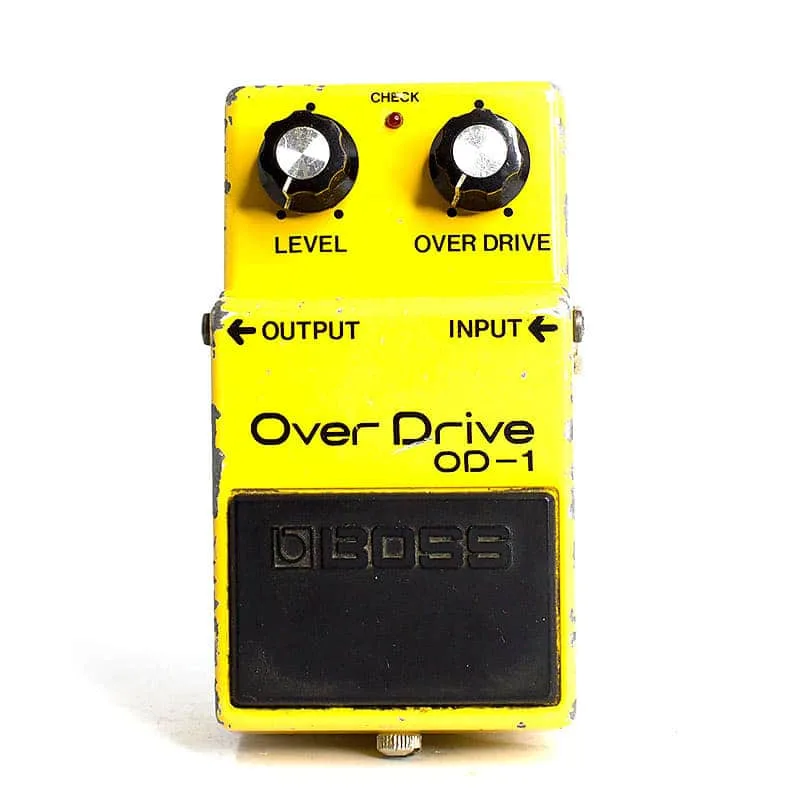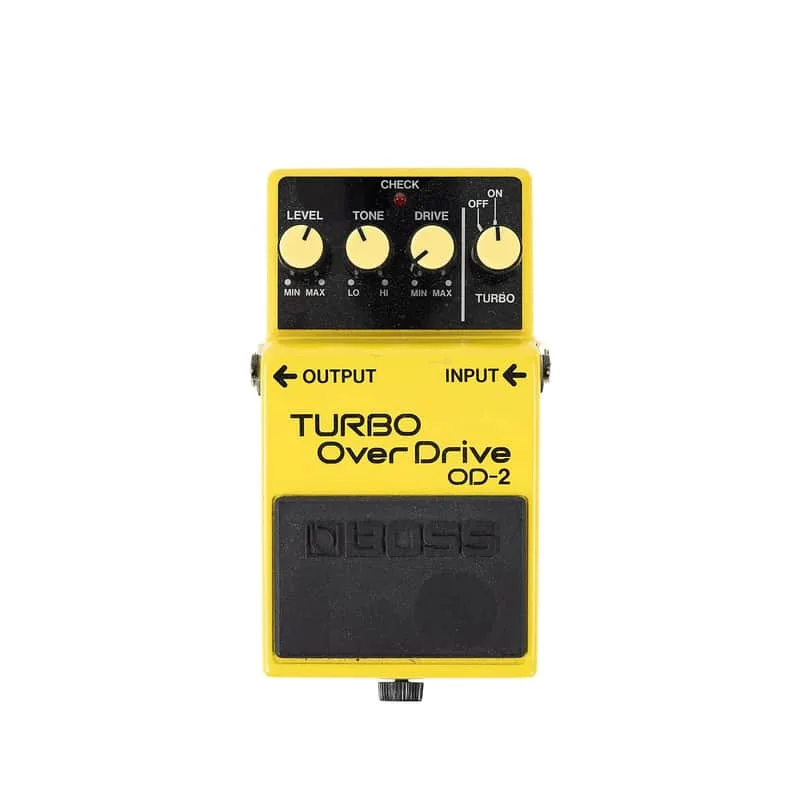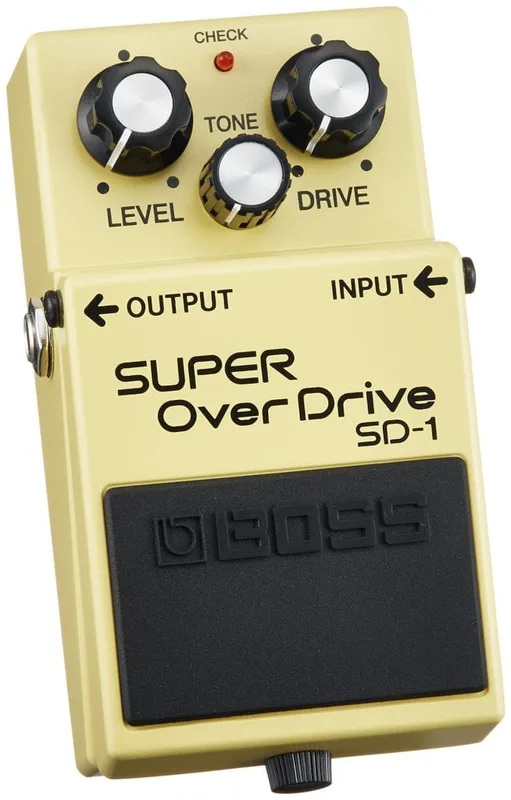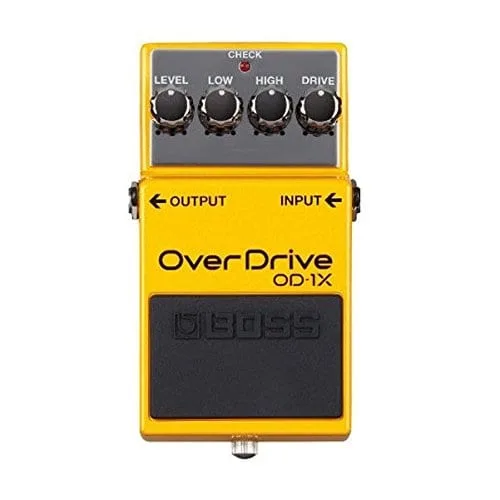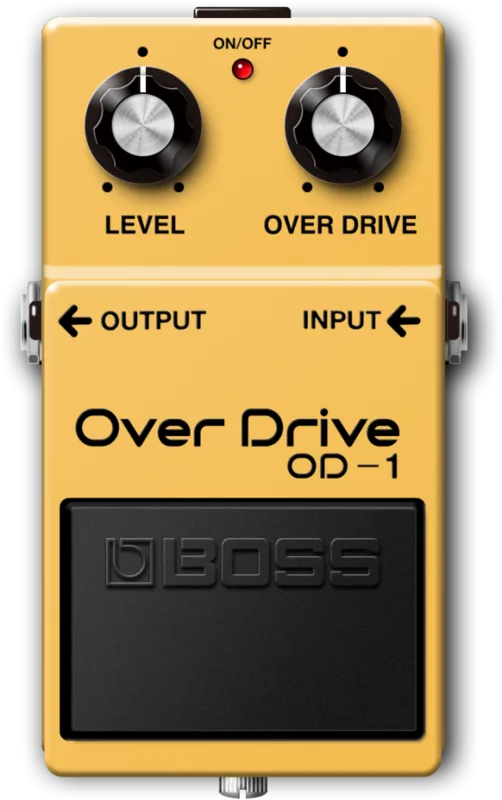


The Boss OD-1 Over Drive is an analog overdrive pedal released by Boss in 1977, and one of the three debut compact pedals in the company's compact line123. Boss says the pedal invented the now ubiquitous "overdrive" category in stompbox effects, and it popularized the term "overdrive" as a distinct category of effect4. It was built to reproduce the sound of a driven tube amp in a small stompbox, and it was discontinued in 198535.
What it does: asymmetrical clipping for tube-amp overdrive
The OD-1's core design is its asymmetrical clipping circuit. Boss describes the pedal as "designed with an asymmetrical clipping circuit that reproduces the pleasing sound of a driven tube amp"8. In a clipping stage, the circuit trims the peaks off the guitar signal's waveform; an asymmetrical design clips the positive and negative halves of the wave differently rather than equally. Boss's own history article explains that this "prevented the distortion of the positive and negative waveform swings equally," which is what gives the effect its tube-like character7.
Analog Man notes that Boss holds a patent on this approach, and that the OD-1 uses it "to give some thick overdrive with an edge"3. Premier Guitar's history of the Tube Screamer likewise records that Boss already had a patent on solid-state asymmetrical clipping9. Boss says the result is "warm, fat tones rich with even-order harmonics"4.
The pedal also had a low-impedance input, which meant players could explore shades of warm, touch-sensitive overdrive by rolling the guitar's volume control, cleaning up or pushing the effect from the instrument itself1.
"Designed with an asymmetrical clipping circuit that reproduces the pleasing sound of a driven tube amp"
The controls: Over Drive and Level
The OD-1 is a two-knob pedal, which Guitar.com notes made it "still a fairly simple overdrive with just two controls" even by later standards10. Boss's history article calls Level and Overdrive its only two controls, and says that with them the OD-1 "became one of the first pedals to truly emulate the sound of an overdriven tube amp"7.
| Control | What it does |
|---|---|
| Over Drive | Sets the amount of drive; the manual calls it "soft distortion"5 |
| Level | Sets the output volume75 |
Guitar World describes the front panel as "two knobs simply labelled Over Drive ('soft distortion' according to the manual) and Level"5. There is no tone control, unlike many later overdrives.
History and versions
The OD-1 appeared in 1977 as one of the first Boss compact pedals52. Guitar World reports that "in some ways, the 1977 OD-1 Over Drive was the successor to Boss's fledgling 'large-box' format DB-5 Driver pedal"5. It stayed in production for eight years, with TONEHOME noting the pedal "was subject to various changes throughout the eight years of production"6. Boss discontinued it in July 19857, and Guitar World says it was supplanted by the OD-2 Turbo Over Drive5. The pedal was briefly reissued as part of the "traffic light" Box-40 commemorative set5.
The chip change: quad versus dual op-amps
The most significant version difference is the op-amp. Early OD-1s, identified by a long dash on the label and a clear switch, used a 14-pin RC3403 op-amp. Later versions replaced it with dual op-amps such as the JRC4558DD6. TONEHOME calls the RC3403 "the fantastic sounding" chip, so the change is a real consideration for anyone buying an original on the used market6.
The OD-1X and the pedal's legacy
The OD-1's circuit line continued in the SD-1 Super Overdrive, which Boss describes as based on the OD-1's circuit2. In 2014 Boss released the OD-1X Over Drive, a digital pedal that Guitar World warns should not be confused with the analog original5. MusicRadar says the OD-1X "takes the legacy of its earliest compact, the OD-1 Overdrive (1978), and runs with it"11. Where the original has two knobs, the OD-1X has four: level, low, high and drive12107.
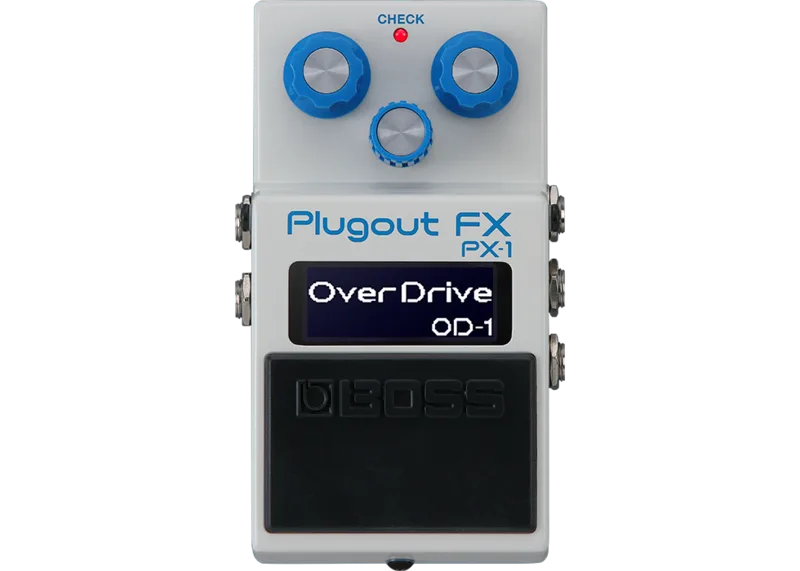
The original OD-1 also lives on digitally as effect 01 on the Boss PX-1 Plugout FX, Boss's compact multi-effects unit, which Guitar Pedal X lists alongside the pedal's 1977 debut date13. For players exploring modern multi-effects pedals, the OD-1 model is one of the vintage sounds carried forward there.
Videos
Boss Pedal Workbench
Wampler Pedals
TheToneShack
Questions
What chip is in the Boss OD-1?
It depends on the version. Early OD-1s, the ones with a long dash on the label and a clear switch, used a 14-pin RC3403 op-amp. Later versions replaced that chip with dual op-amps such as the JRC4558DD. The change happened during the pedal's eight-year production run, so both chips appear on original units.
Is the Boss OD-1 the same as a Tube Screamer?
No, but they are closely related. Analog Man describes the OD-1 as the first of the tube screamer type overdrive pedals, and TONEHOME notes that alongside the Ibanez Tube Screamer it set the standard for tube-like overdriven guitar sound from a small stompbox. They are separate circuits from different makers that arrived around the same era.
When was the Boss OD-1 discontinued?
The OD-1 came out in 1977 and was discontinued in 1985. Boss's own history article gives the more precise date of July 1985. Guitar World reports it was supplanted by the OD-2 Turbo Over Drive. It was briefly reissued later as part of the Box-40 commemorative set.
What is the difference between the Boss OD-1 and OD-1X?
The OD-1X Over Drive, released in 2014, is a digital pedal, unlike the analog original. It also has four controls, level, low, high and drive, where the original OD-1 has only two. MusicRadar describes the OD-1X as taking the legacy of the earliest compact OD-1 and running with it.
How can you tell a quad OD-1 from a dual OD-1?
Look inside. Early OD-1s with a long dash on the label and a clear switch carry a 14-pin quad op-amp, the RC3403. Later versions replaced it with dual op-amps such as the JRC4558DD. TONEHOME calls the RC3403 version the fantastic sounding one, so the chip change is a real point of difference for buyers of originals.
Sources (13)
- The PX-1 Plugout FX: Timeless BOSS Pedals Reborn, BOSS (articles.boss.info), 2025-06-06
- BOSS Effects Pedals for Keyboardists, BOSS (articles.boss.info), 2025-07-17
- Boss OD-, Analog Man (analogman.com), 2026
- BOSS - PX-1 | Plugout FX, BOSS (www.boss.info)
- Boss overdrive pedals: the evolution of its essential stompboxes, Guitar World, 2021-09-28
- TONEHOME, TONEHOME
- 40 Years of the BOSS SD-1 Super Overdrive, BOSS (articles.boss.info), 2021-03-17
- BOSS - PX-1 | Plugout FX, BOSS (boss.info)
- Green Giant: History of the Tube Screamer, Premier Guitar (www.premierguitar.com), 2011-10-18
- Boss SD-1 review, Guitar.com, 2025-04-29
- Boss OD-1X Overdrive review, MusicRadar, 2014-06-05
- Boss DS-1X Distortion and OD-1X Overdrive Pedals, Guitar World, 2014-05-21
- Guitar Pedal X, Guitar Pedal X, 2025-08-28