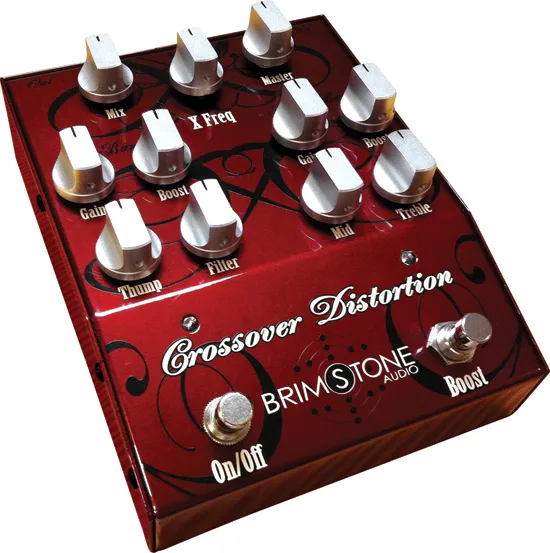


The Brimstone Audio Crossover Distortion XD-1 is a distortion pedal built around a different idea from most: it splits the guitar signal into high and low frequency bands and distorts each one separately. Vintage Guitar's reviewer called it "a great pedal for the discerning stomp-box geek with an ear for nuance"1. The pedal carried a list price of $299.952.
What multi-band distortion does
In a conventional distortion pedal, the whole signal is clipped at once, and heavy settings can crowd the low and high frequencies together. The XD-1 instead uses a crossover to separate the high and low frequencies and processes each band through its own distortion path. Vintage Guitar's reviewer put the reasoning plainly: "By having a multi-band setup and having the high and low frequencies separately, you're getting increased clarity"1.
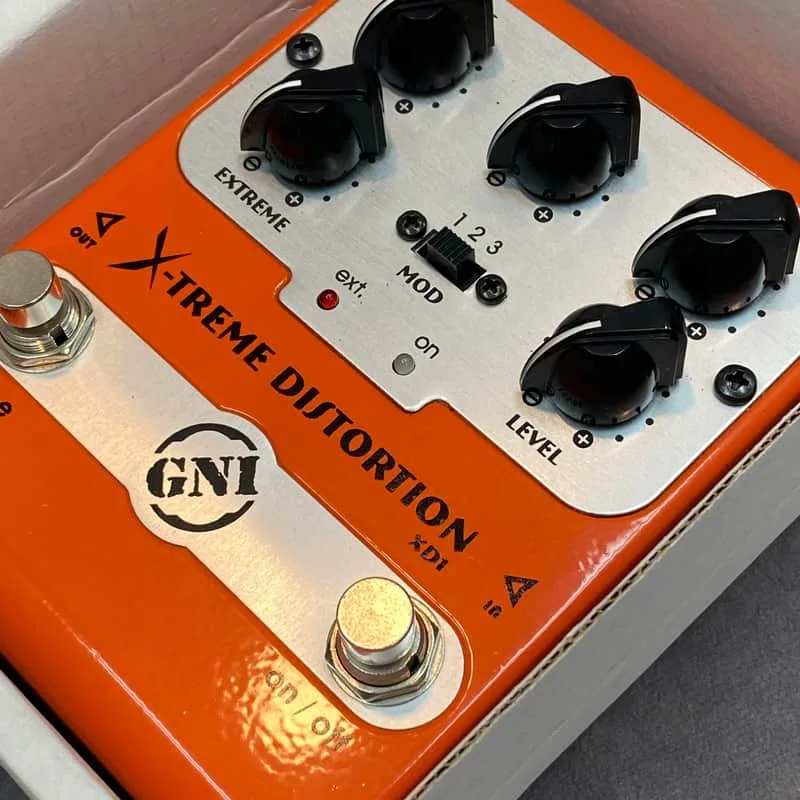
The same two-stage idea shows up in the pedal's listing on RockBoard's PedalPedia under the GNI XD1 Xtreme Distortion name, where two adjustable distortion stages can be switched on simultaneously, also raising the output level for solos3.
The controls: Low Band, High Band and Boost
The XD-1's front panel is built around blending and shaping the two bands:
| Control | What it does |
|---|---|
| Mix | Sets the balance between High and Low Band volume1 |
| Thump | Sub low-frequency enhancement on the Low Band2 |
| Boost switch | Engages the second stage for solo levels13 |
| On/Off switch | Bypasses the effect1 |
| Lo-Gain/Hi-Gain switch | On the rear panel, sets the input gain range1 |
Vintage Guitar's reviewer found each band had its own character. "The Low Band conjured up silky bottom end that could be tweaked with great detail," the review noted, while "with the Mix knob turned to the right, the High Band nails the top end with as much bark or bite required." Of the Boost switch, the reviewer wrote that it "yielded smooth, raspy, and resonant, to full-out metal"1.
Power, connections and pedalboard fit
The rear of the unit offers inputs and outputs as well as a Lo-Gain/Hi-Gain switch and a 9-volt adapter input1. Rear-mounted jacks are worth planning for: patch cables run around the sides of the pedal rather than straight down, which can matter on a crowded board.
Vintage Guitar's reviewer described the enclosure as "light but sturdy, and requires a bit more space on the pedal board," so leave extra room for it when laying out a board1.
What reviewers said
Vintage Guitar's December 2013 review is the main published verdict on the XD-1. Its summary line: "Brimstone Audio's Crossover Distortion XD-1 is a great pedal for the discerning stomp-box geek with an ear for nuance"1.
Videos
Prymaxe
MrExcane
John Huldt
Questions
What does the Brimstone Audio Crossover Distortion XD-1 cost?
Vintage Guitar listed the XD-1 at $299.95 in its December 2013 review, and the same price appears in the magazine's product index. Brimstone had announced the pedal in April 2013 at a $299 retail price.
What does multi-band distortion mean?
Instead of distorting the whole signal at once, the XD-1 splits it into high and low frequency bands and processes each separately. Vintage Guitar's reviewer explained the benefit this way: by having the high and low frequencies separately, you get increased clarity.
Does the Crossover Distortion XD-1 run on a 9-volt adapter?
Yes. The rear panel carries a 9-volt adapter input, alongside the inputs, outputs and a Lo-Gain/Hi-Gain switch.
Where are the inputs and outputs on the XD-1?
Both the inputs and the outputs are on the rear of the unit, together with a Lo-Gain/Hi-Gain switch and the 9-volt adapter input.
How much pedalboard space does the XD-1 take up?
Vintage Guitar's reviewer described the enclosure as light but sturdy, and noted that it requires a bit more space on the pedal board than a typical compact pedal.
Sources (3)
- Brimstone Audio Crossover Distortion XD-1, Vintage Guitar magazine, 2016-03-18
- features, Vintage Guitar magazine, 2026
- XD1 Xtreme Distortion by GNI Music, RockBoard PedalPedia, 2026