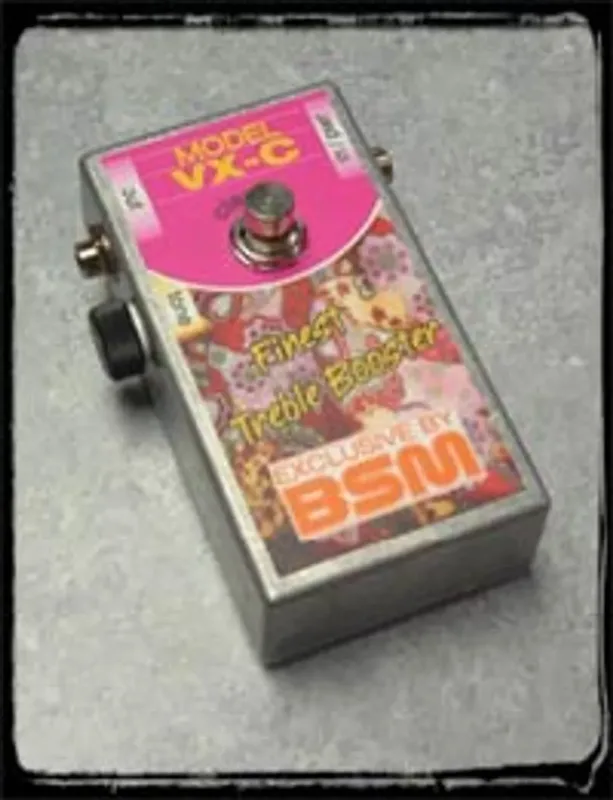
The BSM VX-C is a treble and bass booster pedal that recreates the British Vox Treble & Bass booster of the late 1960s. BSM calls the VX-C Classic model "the most authentical copy of the british Vox Treble & Bass booster from the late 60's", built around the original tone network and gain to reproduce the out-of-production unit1. Where many treble boosters only lift the high end, the VX-C boosts treble or brightness along with the bass frequencies, and one wide-ranging tone control sweeps the whole character of the boost2.
It is a small, simple pedal: one footswitch, one tone control mounted on the side of the enclosure, and a battery inside. Premier Guitar's reviewer, who owns an original Vox unit, found the BSM copy nearly identical to it2.
A Vox-style treble booster
The VX-C belongs to the family of boost pedals that came out of the British practice of driving an amp harder with a small booster box. BSM describes it as a recreation based on the second version of the Vox Bass & Treble Booster, the one used by many bands of the era4. The original Vox unit used a silicon transistor and came in a couple of different configurations, which is why BSM offers the circuit in more than one variant7.
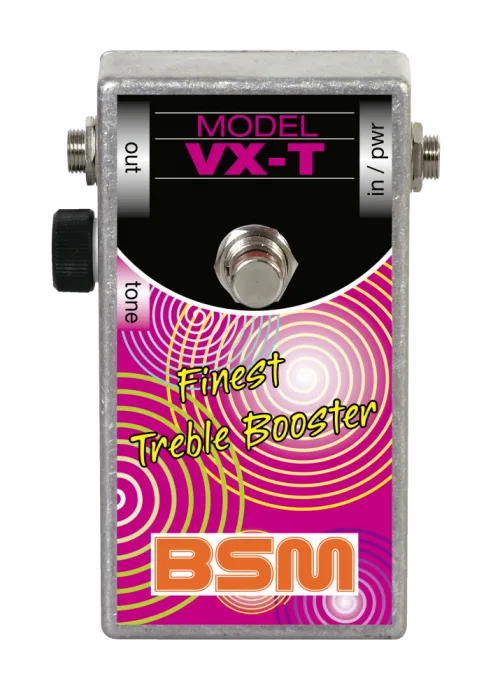
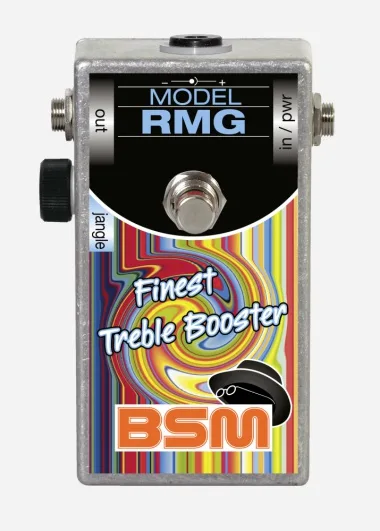
The VX-C is one of several BSM pedals built around this lineage. Its "hot brother" is the BSM VX-T Treble/Mid Boost, and the family also includes the BSM RMG5. BSM positions the VX-C as the low-gain, full-range member of the group: compared to the VX-T, it offers less gain and a more old-style tone control, while the VX-T is more focused on the mid frequencies15.
What that means for a player: the VX-C does not have a huge dB boost. Premier Guitar's reviewer found it had "enough to help push an amp into overdrive, a bit, but not massively"2. It is a shaping boost more than a slam-the-front-end boost.
The side-mounted tone control
The single control is a tone pot mounted on the side of the pedal rather than on top. BSM says it "allows an extraordinary amount of versatility from a wooly bass tone up to a sparkling high-end vintage sound"1, and Premier Guitar's reviewer described it as a smart design choice that lets you attenuate and define your own sound136.
Two things are worth knowing about what that control can do:
- At one end of its range it gives a wooly, bass-heavy tone; at the other, a sparkling vintage high end1.
- Set to a fixed middle position, it can produce the sound of a wah-wah pedal parked halfway, what MusicRadar called "the sound of a half-cocked wah-wah pedal"58.
That parked-wah setting is the classic use of this style of booster: a fixed midrange peak that adds bite and definition without the sweep. BSM's own Bernd C. Meiser wrote of the tone pot, "After you tried the tone pot of this pedal, you will ask yourself how you could live without it until now"9.
It is not, however, an EQ pedal. Premier Guitar's reviewer was direct about that: if "you're looking for an EQ-type pedal", this is not it2. One knob shaping a boosted signal is a different tool from a multi-band equalizer.
The circuit it comes from
The VX-C is a copy of the Vox Treble & Bass booster made in the mid to late 1960s4. BSM states that it "offers the original tone network and gain from the original, to make it the perfect copy of this out-of-production st"yle unit5. The original Vox booster was a simple silicon-transistor circuit, and General Guitar Gadgets, which documents the original as a DIY project, notes it came in a couple of different configurations7.
When the pedal was introduced, Premier Guitar reported that BSM considered the VX-C Classic the most authentic copy of the British Vox Treble & Bass booster from the late sixties6. The strongest endorsement came from Premier Guitar's 2026 review, whose reviewer happened to own an original:
The Premier Guitar reviewer compared the BSM VX-C with an original Vox pedal and found the two nearly identical2. BSM describes the VX-C as a recreation based on the second version of the British V*X Bass & Treble Booster, made in the mid to late 60s4.
Power, bypass and warranty
The VX-C is a battery-only pedal, and that is the main practical thing to know before putting one on a board853.
The VX-C runs on a single 9 volt battery only, with no external power supply input58. Current draw is approximately 50 µA, so the battery lasts a long time3. The negative pole of the battery is ground13.
With the pedal bypassed, BSM states the VX-C Classic is 100% true bypass53, so it will not load or color your signal when switched off.
The warranty, as reported by MusicRadar at the pedal's introduction, is one year for all mechanical parts, including the switch, pots and jacks, and three years for the electronics8.
What reviewers said
Premier Guitar reviewed the VX-C in September 2026 and found it works on both clean and dirty amp settings, giving several practical functions2. On a clean amp, the reviewer suggested it "would be wonderful with a Rickenbacker 12-string, a la The Byrds and Tom Petty"2. On the drive side, MusicRadar noted at launch that this style of booster gives "the legendary sound of UFO's '70s guitarist Michael Schenker or David Bowie's late sideman Mick Ronson"8.
The reviewer's overall verdict was favorable for the right buyer: the VX-C is worth it if "you're looking for more definition and bite to your guitar tone, or you've always wanted a Vox TB Booster"2. The same review repeated the caveat that it is not an EQ-type pedal2.
Price
The current list price is $269.99 MSRP, as given in Premier Guitar's 2026 review2 and previously in the magazine's 2023 roundup10. When BSM introduced the pedal in late 2007, the MSRP was 180 Euros, approximately $260 at the time6, and MusicRadar listed it at €180.00 in January 20088.
Questions
Is the BSM VX-C true bypass?
Yes. BSM states the VX-C Classic is 100% true bypass, so with the pedal switched off your signal passes through without buffering or loading, which matters if you run long cables or other vintage-style pedals on the same board.
Can the BSM VX-C run on a power supply?
No. The VX-C is powered only by a single 9 volt battery, with no external power supply input. Current draw is around 50 microamps, so a battery lasts a very long time. Note that the negative pole of the battery is ground.
Does the BSM VX-C work with a clean amp?
Yes. Premier Guitar's reviewer found it works on both clean and dirty amp settings, and on a clean amp it suits a Rickenbacker 12-string in the style of The Byrds and Tom Petty. It does not have a huge dB boost, but it can help push an amp into overdrive a bit.
How much does the BSM VX-C cost?
The list price is $269.99 MSRP, as stated in Premier Guitar's 2026 review. When the pedal was announced in 2007, BSM quoted an MSRP of 180 Euros, approximately $260 at the time.
Is the BSM VX-C an EQ pedal?
No. Premier Guitar's reviewer says to look elsewhere if you want an EQ-type pedal. The VX-C is a booster with one wide-ranging tone control that shapes the boosted signal, not a multi-band equalizer.
What warranty does the BSM VX-C have?
The warranty period is one year for all mechanical parts, including the switch, pots and jacks, and three years for the electronics, as reported by MusicRadar when the pedal was introduced.
Sources (10)
- VX-C Clean Treble/Bass Booster, treblebooster.net, 2025
- BSM VX-C Treble Booster Pedal Review, Premier Guitar, 2008-10-15
- geraeteblatt_2019_vx-c_klein.pdf, BSM (treblebooster.net), 2019
- Low-Gain Booster, treblebooster.net, 2025
- VX-C Clean Treble/Bass Booster, treblebooster.net, 2025
- BSM's New Boosters, Premier Guitar, 2007-12-26
- Vox™ Treble Booster™ Clone: DIY Kit & Schematic, General Guitar Gadgets, 2014-12-07
- BSM recreate classic Treble And Bass booster, MusicRadar, 2008-01-03
- Roger McGuinn, treblebooster.net, 2025
- Stomp on This! 28 Stompboxes Reviewed, Premier Guitar, 2008-10-15