| Type | Treble booster, single-transistor gain stage4 |
| Maker | Vox (original); replicas by General Guitar Gadgets, Griffin Effects, BSM and others256 |
| Status | Original out of production since the late 60s era7 |
| Transistor | Silicon, 2N2924 or other NPN bipolar junction transistor2 |
| Input capacitor | 500pF, 0.01µF or 0.022µF, to taste, film or ceramic2 |
| Power | 9V battery or 9V supply2 |
| Controls | None on the original; optional 100k linear volume control on replicas2 |
| I/O | Stereo 1/4" input jack, mono 1/4" output jack (on the GGG replica)2 |
The Vox Treble Booster is a British boost circuit built around a single transistor and a few components. It uses a silicon transistor and comes in a couple different configurations. It generates a fair amount of distortion on its own, especially with increased input cap values, and even unmodified it generates a bit of a dirty tone. Players used it in front of a cranked amp to get singing, harmonically rich sustain at volumes the amp alone could not cleanly deliver12.
The original unit was a spare piece of hardware by modern standards. It had no volume control, no tone control and no footswitch in its earliest form, and it was either installed inside guitars or built into a small unit that plugged directly into the instrument2. Vox made it in a couple of different configurations, including a Treble & Bass Booster sibling, and it was used by many British bands in the late 60s3. It was out of production by the end of that era, but the circuit has lived on continuously through replica builders and DIY kits.
Where the Vox Treble Booster came from
The Vox Treble Booster belongs to the first wave of British boost devices, the same family as the Dallas Arbiter Rangemaster, the Hornby-Skewes treble booster and the Orange and Apollo tone boosters. All of them shared the same job: sit between a guitar with dark, low-output pickups and an amp that only distorted when pushed very hard, and reshape the signal so the amp broke up earlier and more controllably.
The Vox unit was used by many British bands in the late 60s, and the Treble & Bass version of the circuit was out of production by the end of that era3. BSM, the German maker whose product pages carry much of the surviving history of these units, describes the Vox Treble & Bass Booster as a British unit made in the mid to late 60s, and its own VX-C model as the most authentic copy of it38.
The Hornby-Skewes treble booster, a close cousin used by Ritchie Blackmore, shows how players adapted these units to real stage conditions. BSM's history of Blackmore's Mk2 sound explains that the Hornby-Skewes was simply equipped with an additional volume control at the output of the circuit, so the amp's "Bright" volume could remain set quite high while the new control handled the actual level9. That is the same modification most Vox Treble Booster replicas carry today.
How the circuit works: one transistor and an input capacitor
The circuit is about as small as a guitar effect can be. One NPN bipolar junction transistor, typically a 2N2924, provides the gain; a small capacitor at the input sets the voicing2. The input capacitor is the heart of the design: it forms a high-pass filter with the transistor's input impedance, so only signal above a chosen frequency gets amplified. Everything below that rolls off.
General Guitar Gadgets, whose replica project is the most complete published build of the circuit, lists the input capacitor C1 as 500pF, 0.01µF or 0.022µF, chosen to taste, in film or ceramic2. What that means in practice:
| C1 value | Effect on the sound |
|---|---|
| 500pF | Thinnest, brightest voicing; strongest bass cut |
| 0.01µF | Middle ground; classic treble boost voicing |
| 0.022µF | Fuller; passes more low mids, more distortion on its own2 |
The transistor choice matters less than the capacitor, but it still colors the result. General Guitar Gadgets notes that germanium transistors have a bit more gritty sound while silicon transistors offer a more stable, reliable sound, and the Vox circuit is a silicon design2. The company also publishes working voltage readings for a 2N2924 on a 9V supply: 5.2V at the collector, 1.6V at the base and 0.1V at the emitter, which gives builders a quick bias check2.
One thing the circuit does that surprises first-time builders: it distorts on its own. General Guitar Gadgets found that the Vox Treble Booster generates a fair amount of distortion by itself, especially with increased input capacitor values, and that even unmodified it produces a bit of a dirty tone with what the company calls excellent tonal qualities2. It is not a clean hifi boost; it is a colored, mid-forward push that was always meant to meet a distorting amp halfway.
Vox's own modern reissue, the VTB-1, keeps the same architecture: a single-transistor gain stage for what Vox describes as traditional clarity and touch response, built around a hand-selected Silver Can BC109 transistor chosen for consistent performance and low noise4.
Versions: Treble Booster and Treble & Bass Booster
The circuit came in a couple of different configurations2. The plain Treble Booster is the stripped version: one transistor, one input cap, no controls. The Treble & Bass Booster, made in the mid to late 60s, added a bass side to the voicing, and BSM identifies a "second issue" of this Vox unit from the late 60s as the version its own VX-T copies almost identically610.
BSM's product line maps the two branches clearly:
| BSM model | Based on | Character |
|---|---|---|
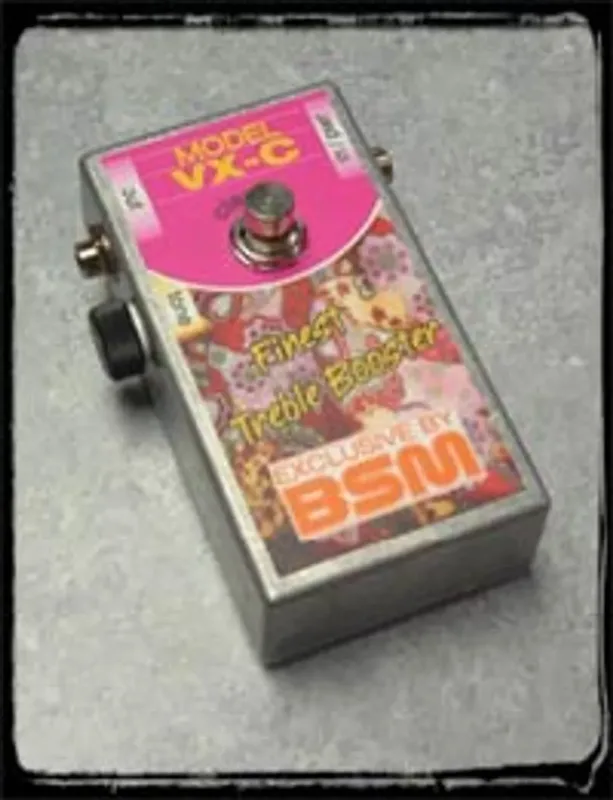
| VX-C | British Vox Treble & Bass Booster, mid/late 60s | Described as the most authentic copy of the original38 |
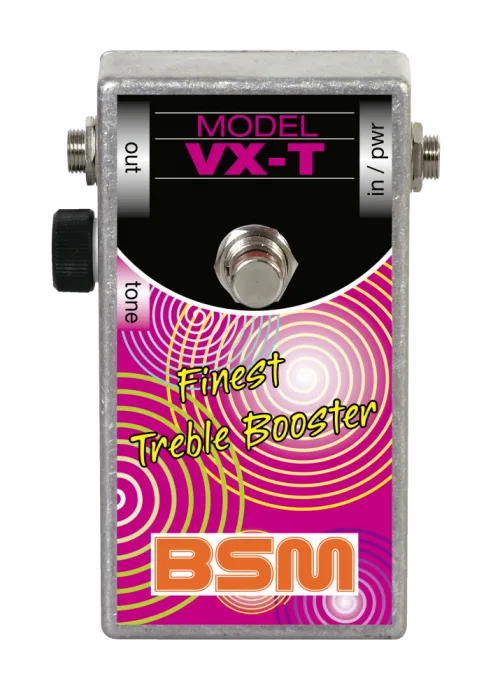
| VX-T | Second issue of the Vox Treble & Bass Booster, late 60s | Almost identical copy, with increased gain and a slightly modified tone610 |
The VX-T is a treble-midrange booster, and BSM describes it as the perfect treble-midrange booster for players who want the Vox sound with more push6. Both BSM units are 100% true bypass and are intended to be inserted between the guitar and the amplifier, not into an FX loop611.
Common modifications: volume, gain and tone
Because the original had no volume control, nearly every replica adds one. General Guitar Gadgets notes that a schematic including a volume control has circulated online for a long time, and the company includes that modification in its kit as R14, a 100k linear taper volume control2. The version without the volume control instead uses an R11 resistor of 390k2.
Other common modifications from the published projects:
- Input capacitor switch: General Guitar Gadgets' pictured build has an input cap switch modification that gives two different boost sounds, letting you flip between, say, a 500pF and a 0.022µF voicing from the top of the pedal2.
- Pull down resistors: the original-style circuit is very susceptible to bypass switch pop, so GGG added a pull down resistor on the input and output of all its versions, which stopped the pop2.
- Transistor sockets: GGG supplies sockets with its kits, so transistors can be swapped without desoldering2.
Pedals based on the Vox Treble Booster
The Vox circuit's DNA shows up across the modern boost market, sometimes directly and sometimes one step removed.
Vox VTB-1. Vox itself revived the design with the VTB-1 Treble Booster, which the company describes as a re-engineered, road-ready booster that delivers the expressive character of the original vintage British treble booster, with a single-transistor gain stage, a hand-selected Silver Can BC109 transistor, and a Boost control that pushes the amp into harmonically rich overdrive when turned clockwise4. It runs on 9V center-pin-negative power or a 9V battery and ships with an owner's manual4.
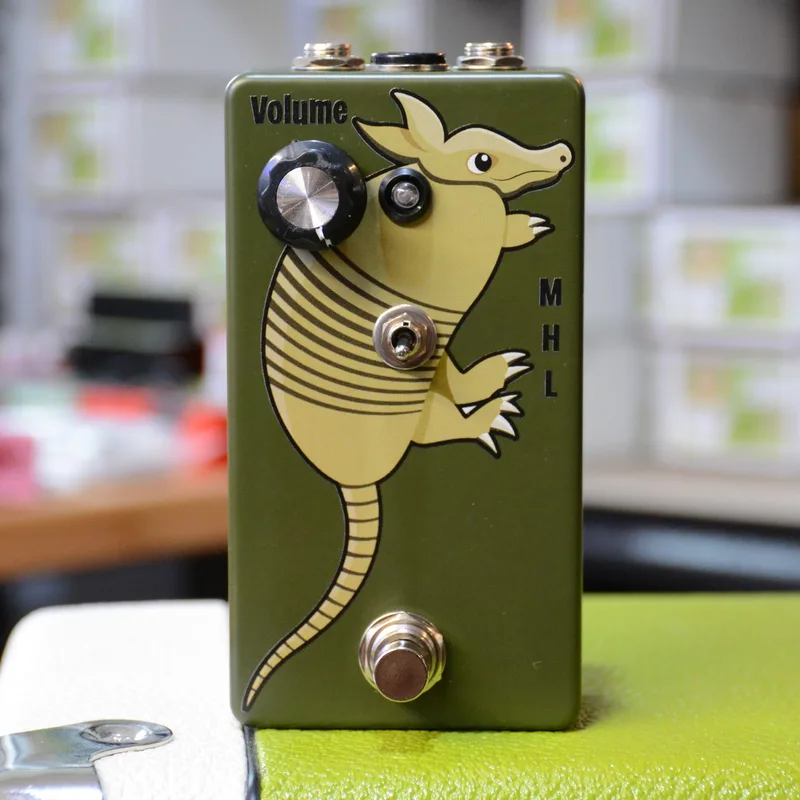
GUP Tech TATouh! Texas Treble Boost. A modern take with one volume knob, one NPN transistor and three boost voicings (Low, Mid and High), in a true-bypass design12.
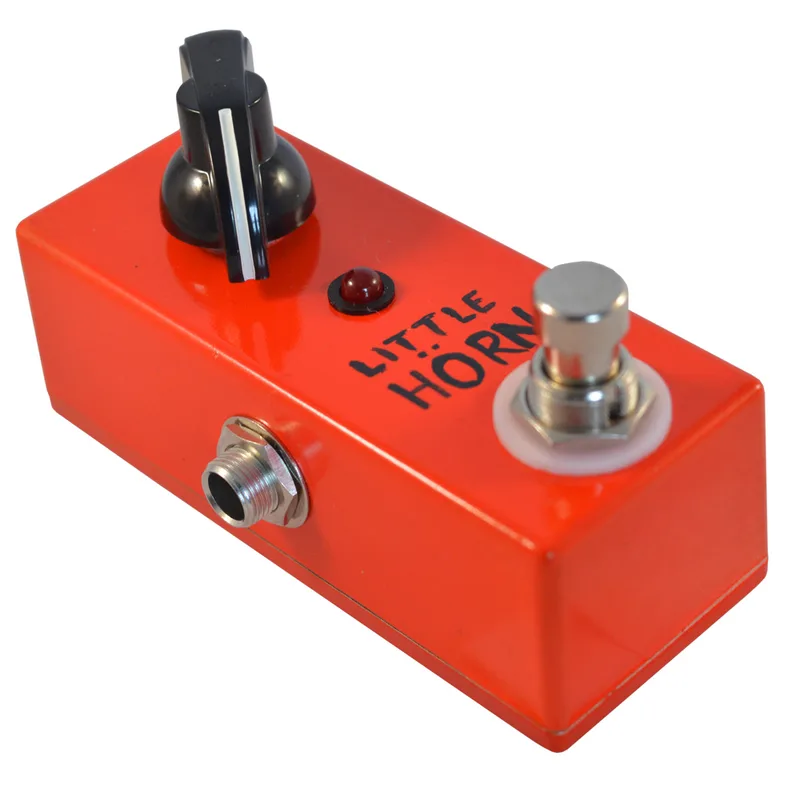
Vein-Tap Little Horn. A boost pedal wired with true bypass circuitry, with a Tone control that can be bypassed via a Tone Bypass switch for what the maker calls the old-fashioned full frequency boost13.
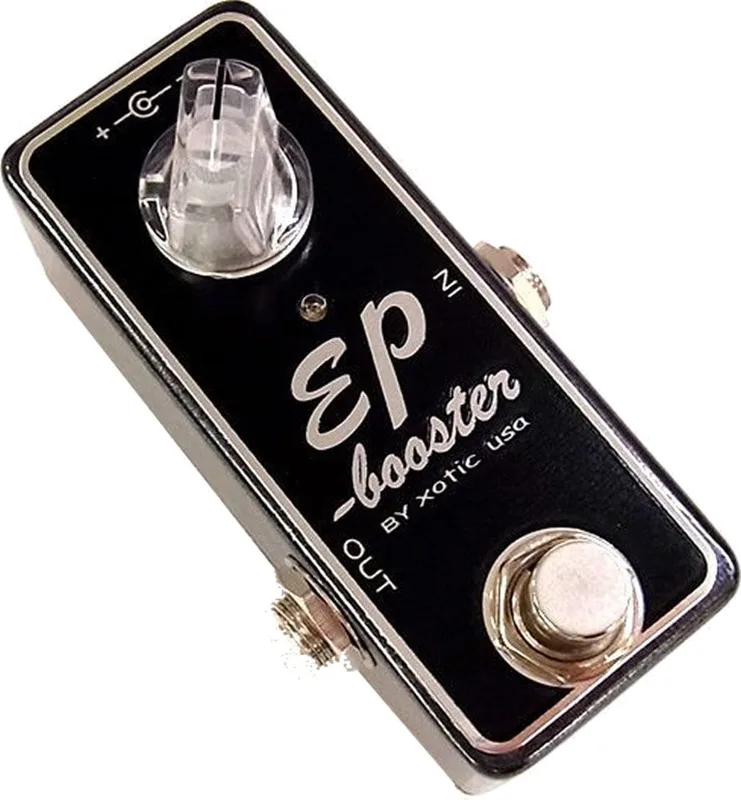
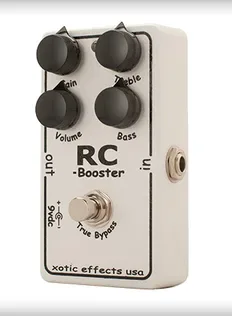
Xotic EP Booster and RC Booster. Xotic's EP Booster uses true bypass switching14, and the RC Booster line (including the V2 and the Classic) carries active Treble, Bass, Gain and Volume controls for tone shaping141516. These are not Vox copies, but they occupy the same slot on a pedalboard: a small pre-drive boost that shapes what the amp receives.
Roger Mayer Concorde+. Roger Mayer's Concorde+ Treble Booster uses both silicon and germanium transistors in a low-noise class A silicon drive circuit, a more elaborate take on the same idea17.
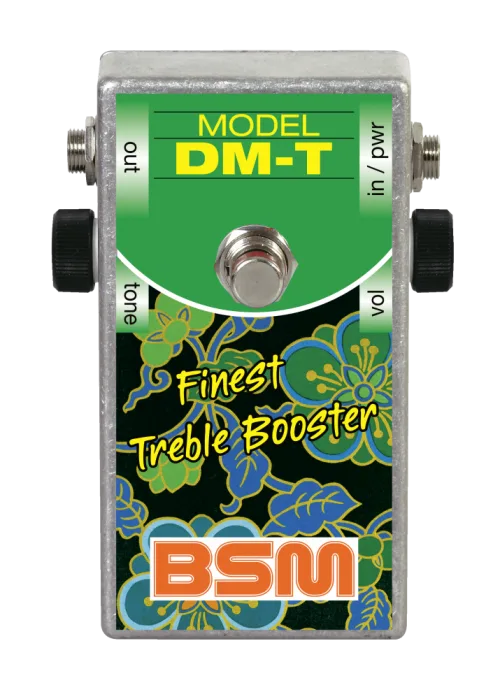
BSM DM-T Fat Treble Boost. A hybrid that uses the circuit of the Apollo booster for its treble and mid tone control and a modified Vox booster circuit for the bass tone control18.
DIY kits and replica builds
The Vox Treble Booster is one of the most-built DIY boost projects, largely because the circuit is so small and the parts are cheap219.
General Guitar Gadgets Vox TB kit. A direct replica of the Vox Treble Booster, built on GGG's shared GEB Booster PCB220. That same board also supports the Apollo Tone Booster, the Fryer/May Treble Booster, the Orange Tone Booster and the Dallas Arbiter Rangemaster, so one PCB covers most of the classic British boost family20. The kit uses a heavy-duty 3PDT footswitch, a stereo 1/4" input jack (J1), a mono 1/4" output jack (J2), a DC jack (J3) and a 9V battery, with transistor sockets supplied2.
Griffin Effects Vintage Treble Boost PCB. A DIY circuit board explicitly based on the Vox Treble Booster, which Griffin describes as a circuit that increases the treble frequency of your guitar signal5. Griffin also offers an EQ/Volume PCB project that the company compares to the Vox Treble Booster, adding the volume control the original never had21.
General Guitar Gadgets Fryer/Brian May Treble Booster. A related project on the same GEB PCB, described by GGG as a very popular treble booster, and like the Vox kit it carries the pull down resistor fix on input and output to stop the bypass pop2220.
For a builder assembling one of these, the practical checklist from the published projects is short:
- Choose the input capacitor value, 500pF, 0.01µF or 0.022µF, to set the voicing2.
- Fit the transistor in a socket, observing the CBE pin pattern the GGG layout uses2.
- Decide whether to include the optional 100k volume control, or the 390k R11 resistor if leaving it out2.
- Add pull down resistors on the input and output to prevent bypass pop2.
- Check the transistor voltages against the published readings: 5.2V collector, 1.6V base, 0.1V emitter on a 9V supply2.
What replaced it
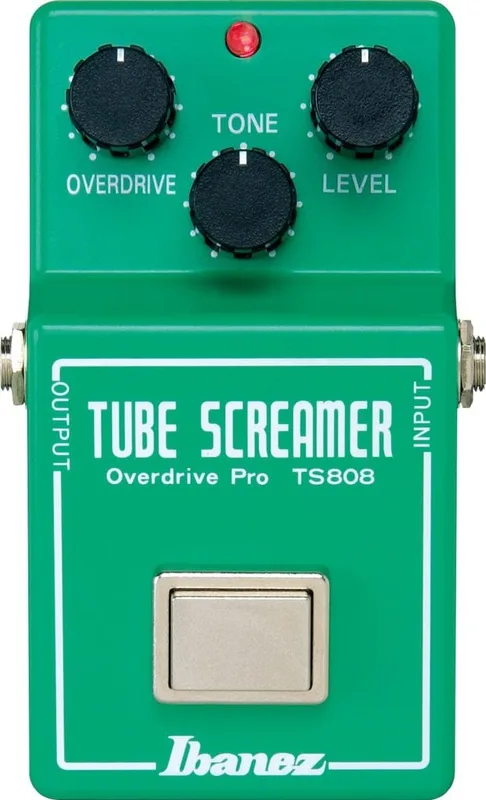
The treble booster era ended not because players stopped wanting the sound, but because a new circuit delivered it in a more convenient package. BSM's documentation is consistent across several of its manuals and product pages: by the end of the seventies, the treble booster was replaced by a new circuit from Japan, the so-called Tube Screamer and other similar overdrive circuits, which were based on the old treble boosters with a very similar frequency response23242526.
The Tube Screamer kept the mid-forward, bass-cut voice that made treble boosters work with dark amps, but added level, tone and drive controls in a floor pedal with a footswitch. The lineage is direct enough that BSM describes the Japanese overdrives as based acoustically on the old treble boosters26. Players who want the earlier, rawer version of that sound, with the amp doing more of the distortion work, are the audience the Vox Treble Booster replicas serve today.
Pedals on this page
Questions
Did the original Vox Treble Booster have a volume knob?
No. The original unit had no volume control at all. It was either installed inside the guitar itself or built into a small unit that plugged straight into the instrument, and it simply ran at full boost. Replica builders later added volume controls, and General Guitar Gadgets includes an optional 100k linear volume pot in its kit.
What transistor does the Vox Treble Booster use?
The circuit uses a silicon transistor, typically a 2N2924 or another NPN bipolar junction transistor. General Guitar Gadgets supplies transistor sockets with its kits so you can swap transistors without soldering. Silicon gives a more stable, reliable sound than germanium, which is grittier by comparison.
What input capacitor value should I use in a Vox treble booster?
General Guitar Gadgets lists the input capacitor, C1, as 500pF, 0.01µF or 0.022µF, chosen to taste, in film or ceramic. The smaller the value, the thinner and brighter the boost. Larger values pass more low end and the circuit generates more distortion on its own, so the cap choice sets both the voicing and the dirt.
How do I stop the bypass pop on a treble booster build?
These single-transistor circuits are very susceptible to a pop when the bypass switch is engaged. General Guitar Gadgets solved it by adding a pull down resistor on the input and the output of its versions, which stopped the pop. Any replica build can use the same fix on both ends of the circuit.
What replaced treble boosters on British pedalboards?
By the end of the seventies, treble boosters were replaced by a new circuit from Japan, the so-called Tube Screamer and other similar overdrive circuits. These were based on the old treble boosters with a very similar frequency response, but packaged as floor pedals with tone and level controls.
Sources (26)
- Chasing the Sound in Your Head with Cris Vincent - Premier Guitar, Premier Guitar, 2025-03-05
- Vox™ Treble Booster™ Clone: DIY Kit & Schematic, General Guitar Gadgets, 2014-12-07
- VX-C Clean Treble/Bass Booster, treblebooster.net, 2025
- The VOX VTB-1 Treble Booster Pedal, VOX (voxamps.com), 2026-03-17
- Vintage Treble Boost PCB, Griffin Effects
- VX-T Treble/Mid Boost, treblebooster.net, 2025
- geraeteblatt_2019_vx-c_klein.pdf, BSM (treblebooster.net), 2019
- VX-C Clean Treble/Bass Booster, treblebooster.net, 2025
- Mk2 Sound, treblebooster.net (BSM - Finest Treble Booster), 2025
- untitled, BSM, 2025
- VX-T Treble/Mid Boost, BSM (treblebooster.net), 2025
- TATouh! Texas Treble Boost, GUP Tech
- The Little Horn Guitar Boost Pedal from Vein-Tap.com, Vein-Tap.com, 2026-09-01
- EP Booster, Xotic California (xotic.us)
- RC Booster V2, Xotic, 2025-10-01
- RC Booster Classic, Xotic
- Guitar Effects Pedals by Roger Mayer, Roger Mayer (roger-mayer.co.uk)
- DM-T Fat Treble Boost, BSM (treblebooster.net), 2025
- Orange/Apollo™ Tone Booster™ Clone: DIY Kit & Schematic, generalguitargadgets.com, 2014-12-30
- Rangemaster™ Clone: Treble Booster Kit, PCB & Schematic, generalguitargadgets.com, 2014-05-12
- EQ and Volume PCB circuit boards projects by Griffin Effects, Griffin Effects
- Brian May Treble Booster Clone: DIY Kit, PCB & Schematic, generalguitargadgets.com, 2014-05-12
- RMG Clean Boost, treblebooster.net, 2025
- Neutral_neu, treblebooster.net, 2025
- Neutral_neu, BSM, 2025
- HS-C Treble Booster, treblebooster.net (BSM), 2025