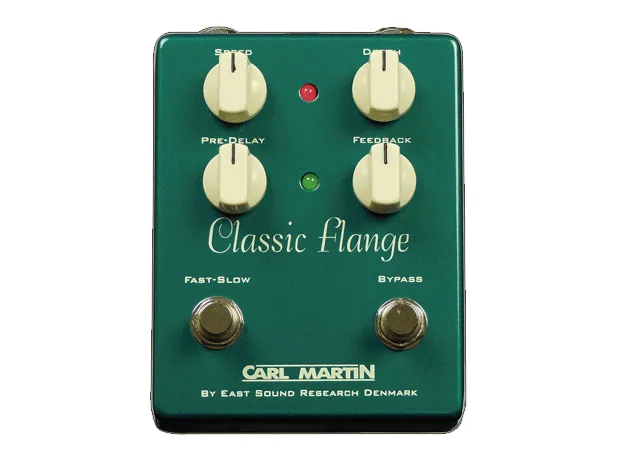


The Carl Martin Classic Flange is a vintage-style flanger pedal from Danish maker Carl Martin, part of the company's Vintage Series. Its distinguishing feature is a dual speed mode system: a footswitchable Fast/Slow toggle lets you jump between two different speed ranges instantly, with both modes sharing the same Speed control1. That means you can set one sweep rate and switch between a slow sweep and a fast one mid-song without bending down to turn a knob.
Controls
The Classic Flange has four knobs, each covering a familiar flanger parameter1:
| Control | What it does |
|---|---|
| Speed | Sets the sweep rate, shared by both Fast and Slow modes, with flashing red LED indication |
| Depth | Adjusts effect intensity from subtle to extreme |
| Feedback | Creates the characteristic hollow flanging sound and can be pushed into controlled oscillation |
| Pre-Delay | Sets the short delay time that determines which frequencies the sweeping filter emphasizes |
Carl Martin describes the Speed knob's range as going from glacially slow sweeps that stretch across entire chord progressions to frantic Leslie-simulation rates1. Pre-Delay is the tonal flavor control: it determines which frequencies are accentuated, taking the sound from very swirly chorus-like textures to rising and sinking curves1.
Sound range
Carl Martin describes the Classic Flange as capable of everything from gentle chorus-like shimmer at low Feedback settings to hollow, ghostly psychedelic tones, and controlled self-oscillation for acid-rock jet-plane effects at maximum Depth and Feedback1. In other words, the Depth and Feedback knobs together set how far the effect goes, from a light shimmer to full runaway oscillation.
Bypass and power
The pedal uses high-quality buffered bypass, which Carl Martin says is there to maintain signal integrity1. That is worth knowing if you are building a board around true-bypass switching: the Classic Flange will leave a buffer in the path when it is off.
Power comes from a 9V battery or a recommended regulated power supply1. The maker recommends the regulated supply option.
Enclosure
The Classic Flange is housed in Carl Martin's robust retro diecast enclosure with signature chicken-head knobs and vintage graphics, part of the Vintage Series1.
Where it sits among flangers
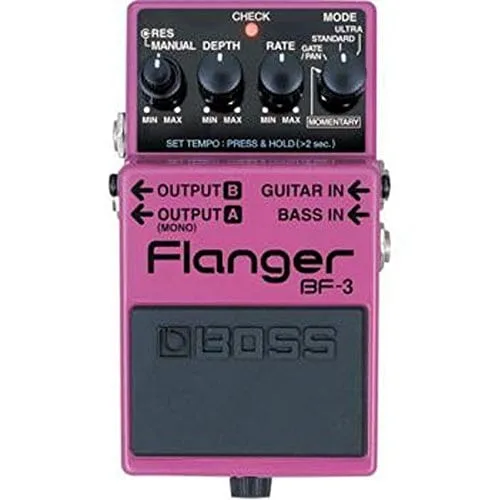
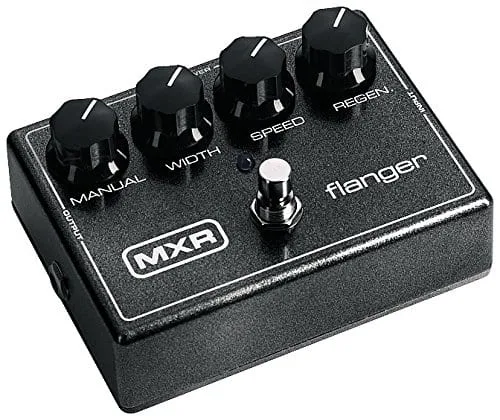
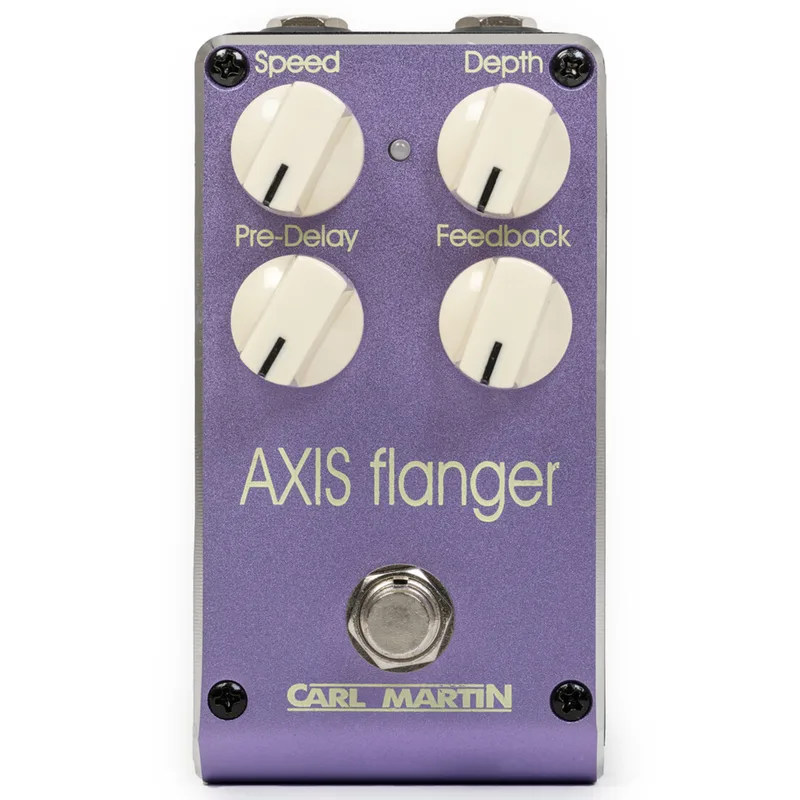
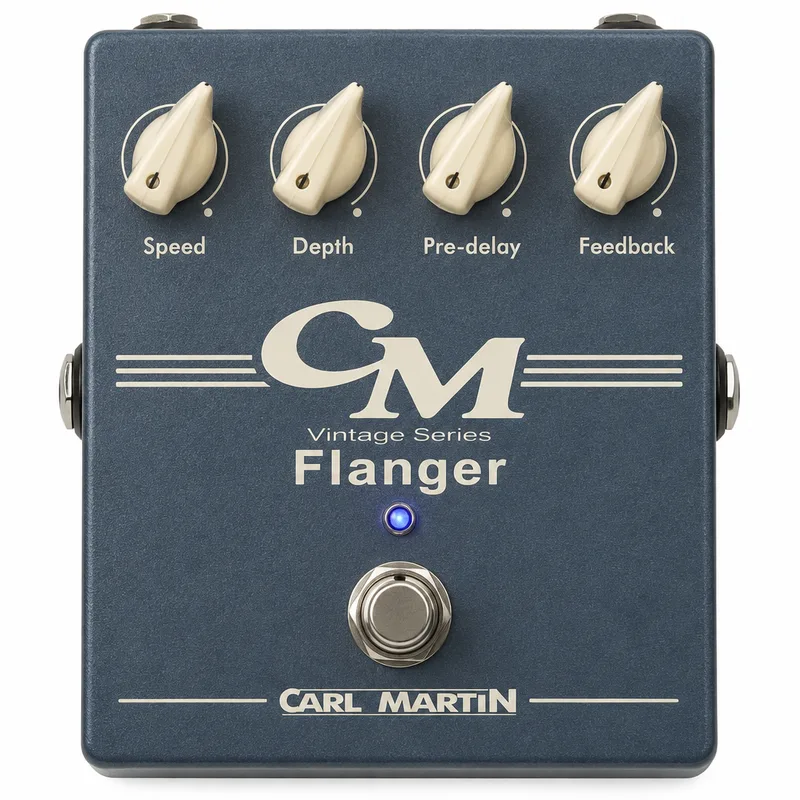
Most compact flangers, such as the Boss BF-3 Flanger or the MXR Flanger, offer a single speed knob and no way to switch rates by foot. The Classic Flange's two-range footswitch setup is aimed at players who want to move between a slow sweep and a fast one during a performance. Carl Martin also makes the Carl Martin Axis Flanger, a compact reissue of the company's classic flanger with simplified controls, and the earlier Carl Martin Vintage Series Flanger. For more on the effect type itself, see Flanger Pedals1.
Videos
superguitarrero
Music Force Official
Iga Massardi
Questions
Is the Carl Martin Classic Flange true bypass?
No. Carl Martin describes the Classic Flange as having high-quality buffered bypass, which the maker says is there to maintain signal integrity. With buffered bypass, a small buffer circuit stays in the signal path when the pedal is off, rather than the signal passing straight through as it would with true bypass.
Does the Carl Martin Classic Flange run on a battery?
Yes. According to Carl Martin, the Classic Flange powers via a 9V battery or a recommended regulated power supply. If you plan to run it on a pedalboard supply, use a regulated 9V supply as the maker recommends.
How do the Fast and Slow modes work on the Classic Flange?
The Classic Flange has a footswitchable Fast/Slow toggle that lets you jump between two different speed ranges instantly. Both modes share the same Speed control, so you set one sweep rate and the footswitch moves you between the two ranges without touching the knob.
Can the Carl Martin Classic Flange self-oscillate?
Yes. Carl Martin says the Feedback knob creates the characteristic hollow flanging sound and can be pushed into controlled oscillation. At maximum Depth and Feedback settings, the maker describes controlled self-oscillation for acid-rock jet-plane effects.
What does the Pre-Delay knob do on a flanger?
Pre-Delay sets the short delay time inside the flanger, which determines which frequencies the sweeping filter emphasizes. Carl Martin describes it as setting the tonal flavor, taking the sound from very swirly chorus-like textures to rising and sinking curves.
Sources (1)
- Classic Flange, Carl Martin, 2026