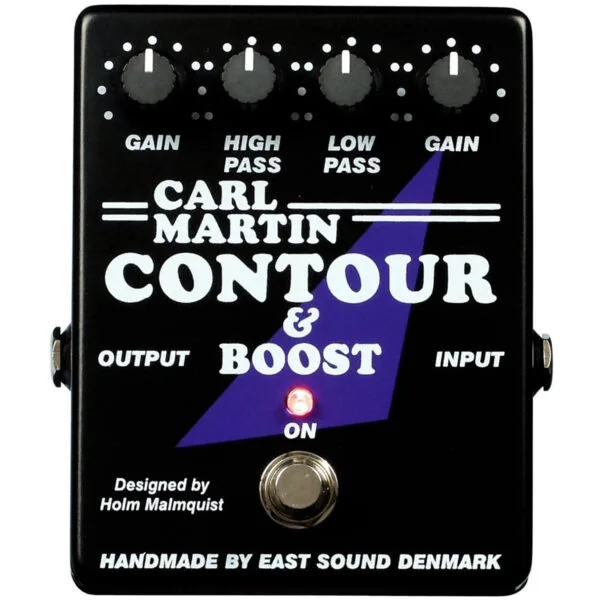


The Carl Martin Contour & Boost is a professional phase-linear EQ and boost pedal built around two sweepable filters, made to bring studio-quality tone shaping to a pedalboard1. Instead of fixed graphic EQ bands, it splits the spectrum at a fixed 440Hz crossover and gives you one filter below that point and one above it, each with its own frequency and gain controls1.
The two filters and what they do
The High Pass filter is a low cut that sweeps from 65Hz to 440Hz, and the Low Pass filter is a high cut that sweeps from 440Hz to 8kHz1. Each filter has its own sweepable frequency control and a gain control with 12dB of gain, so you can lift a chosen low frequency and a chosen high frequency independently2.
| Filter | Type | Frequency range | Gain |
|---|---|---|---|
| High Pass | Low cut | 65Hz to 440Hz | Up to +12dB |
| Low Pass | High cut | 440Hz to 8kHz | Up to +12dB |
Vintage Guitar's December 2001 review described the arrangement plainly:
"Each filter has a sweepable frequency control 65 hz. to 440 hz/440 hz to 8 khz), and a gain control with 12 dB of gain."
In practice, that means a player can tighten flubby low end with the High Pass filter, add presence with the Low Pass filter, or use either filter as a sweepable boost at a frequency the amp's own EQ cannot reach12.
Phase-linear circuitry versus a graphic EQ
Carl Martin describes the pedal as using phase-linear circuitry with high-quality components1. A graphic EQ pedal typically uses a row of fixed bands, and its filters can introduce phase shifts that alter the tone even when the level is flat. The Contour & Boost's two sweepable filters are designed to avoid that.
"the Contour & Boost's filters are smooth and very musical"
The review set that verdict against graphic EQ pedals, which it described as having inherent phasing problems and a generally sterile sound2.
Power and build
The pedal measures 120 x 95 x 56mm in a compact diecast housing and carries an internal ±12V regulated power supply1. On units built after January 2016, the pedal is powered by an external 9V DC supply with internal DC/DC conversion circuitry1.
Units built after January 2016 take an external 9V DC supply rather than relying on the internal power arrangement of earlier builds1.
The maker's specifications for the pedal:
| Specification | Value |
|---|---|
| Signal-to-noise ratio | 80dB |
| Distortion | 0.01% THD at 0dB |
| Dimensions | 120 x 95 x 56mm |
| Power | Internal ±12V regulated supply; external 9V DC on post-January 2016 units |
Those noise and distortion figures matter for a pedal intended to sit always-on in front of an amp1.
Who uses it and what reviewers said
Carl Martin's artist page lists session guitarist Tim Pierce among the players who use the Contour & Boost3. Vintage Guitar reviewed the pedal in its December 2001 issue, listing its dual sweepable filters, its 12dB gain controls and a price of $189 at the time2. The review's verdict on the sound: the filters are "smooth and very musical"2.
Videos
Selane Productions
Incrucator
GuitarCenterFr
Questions
What do the High Pass and Low Pass filters do on the Carl Martin Contour & Boost?
The High Pass filter is a low cut that sweeps from 65Hz to 440Hz, useful for trimming bass or tightening the low end. The Low Pass filter is a high cut that sweeps from 440Hz to 8kHz, useful for rolling off fizz or darkening a bright amp. The two filters meet at a fixed 440Hz crossover, and each filter provides up to +12dB of boost at its set frequency.
How much boost does the Contour & Boost give?
Each of the two filters provides up to +12dB of boost. Because the filters sweep across different parts of the spectrum, you can apply up to +12dB in the lows and up to +12dB in the highs at the same time, shaping two separate regions of your tone.
Where is the Carl Martin Contour & Boost made?
Carl Martin builds the Contour & Boost by hand in Denmark. The pedal carries an internal regulated power supply, and on units built after January 2016 it is powered from an external 9V DC supply through internal DC/DC conversion circuitry.
Which guitarists use the Carl Martin Contour & Boost?
Carl Martin's own artist page lists session guitarist Tim Pierce among the players who use the Contour & Boost, alongside other Carl Martin pedals.
How is a phase-linear EQ different from a graphic EQ pedal?
A graphic EQ uses a row of fixed frequency bands, and its filters can introduce phase shifts that color the tone. The Contour & Boost uses phase-linear circuitry with two continuously sweepable filters instead. Vintage Guitar's 2001 review found its filters smooth and very musical, unlike graphic EQ pedals the reviewer described as having inherent phasing problems and a generally sterile sound.
Sources (3)
- Contour & Boost, Carl Martin (carlmartin.com), 2026
- Carl Martin Contour & Boost, Vintage Guitar magazine, 2004-10-28
- Artists - Carl Martin, Carl Martin (carlmartin.com), 2026