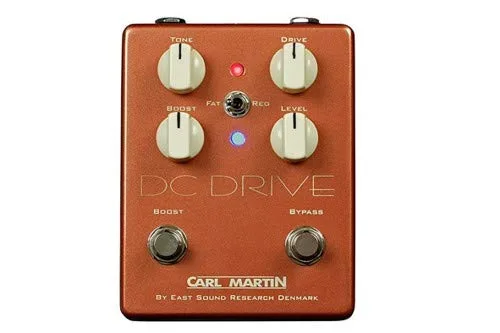


The Carl Martin DC Drive is an overdrive pedal with an independent clean boost built in, made by Carl Martin. The original version is a double-footswitch pedal: one switch for the drive, one for the boost, with a Regular/Fat toggle that shifts the voicing from vintage overdrive to thicker, more modern gain1. Because the boost circuit runs independently of the drive section, the pedal gives you four complete sounds from one box: your clean amp signal, clean with boost, overdriven signal, and overdriven with boost2.
The original DC Drive is discontinued1. Carl Martin's current product page still describes the design, and the 2018 version, a smaller single-footswitch pedal in the Vintage Series, carries the drive sound forward in a more compact enclosure3.
What it does: overdrive with an independent clean boost
Carl Martin describes the DC Drive as an ultra-versatile drive pedal in a robust retro housing, with independent clean boost functionality and a Regular/Fat switch covering everything from vintage overdrive to modern high-gain tones2. The boost is a feature borrowed from Carl Martin's standalone Clean Boost pedal, and it sits after the drive section24. That placement is what makes the four-sound setup work: the drive can be off while the boost pushes your clean amp, or the boost can stack on top of the overdrive for solos2.
On the spec sheet, Carl Martin lists a 54dB signal-to-noise ratio and up to +68dB maximum gain for the circuit2. The housing is a die-cast vintage-style enclosure with chicken-head knobs and classic Carl Martin graphics, part of the retro look Carl Martin has used across its Vintage line24.
The controls
The drive side of the pedal is straightforward: three knobs and a voicing switch.
| Control | What it does |
|---|---|
| Level | Sets the volume of the signal3 |
| Tone | Sets the tone; on the 2018 version it focuses on top-end presence31 |
| Drive | Sets the amount of overdrive3 |
| Regular/Fat switch | Selects between the two voicings5 |
The Regular/Fat switch is the part Delicious Audio called "not so typical" for an overdrive box5. In Regular mode, the drive is crisp and clear, suitable for anything that calls for old-school drive4. Switch to Fat and the drive gets thicker with a lot more gain, much more modern4. MusicRadar's reviewer Trevor Curwen put the difference in practical terms:
"Regular is quite lean, rolling off some of your bottom-end, but Fat puts that back in and adds in lower mids for more girth and a smidge more gain - it's fuller and smoother."
Curwen found quite a range of drive available, from clean boost through all shades in-between to a driven-amp saturation that brings out harmonics, and noted it cleans up very well with the volume knob1. His verdict on the 2018 pedal: "A workmanlike drive pedal with two voices, which would lend itself to many styles"1. He also found it "makes a great dirt channel for a clean amp but can also push driven sounds further"1.
Power and connections
The original DC Drive runs on a standard 9V battery or a regulated power supply, and Carl Martin recommends a regulated supply like its ProPower for reliable performance night after night2. When the pedal was introduced as the Vintage DC Drive, the company made the same recommendation, suggesting a supply like the Carl Martin Big John4. The 2018 version can be powered by a regulated supply like the Carl Martin ProPower V23.
If you power a board of Carl Martin pedals, the maker's DC Factory power supply offers four isolated 9V sections, each delivering up to 500 mA and feeding two outputs, plus a dedicated 12V section delivering 500 mA to two additional outputs, with 100 to 240V worldwide mains compatibility6.
The original DC Drive's true bypass switching means the pedal is out of the signal path when the drive is disengaged, with a red LED showing drive status and a green LED showing boost status2.
The 2018 version: smaller, single footswitch
In 2018 Carl Martin gave its Vintage Series a face lift, and the DC Drive was reissued as a smaller and updated version of the classic overdrive3. The new pedal is an anodized design aimed at a smaller pedalboard footprint, with the same tones as the original35.
The significant functional change is on the floor: the 2018 pedal is a single-footswitch version that loses the boost, keeping the overdrive with level, tone and drive knobs and the Regular/Fat toggle1. Besides the size, Delicious Audio identified the new Regular/Fat switch as the main upgrade, adding more gain in Fat mode for a modern sound3. So a player choosing between the two versions is really choosing between the original's four-sound, two-footswitch setup and the 2018 pedal's simpler, more compact two-voice drive21.
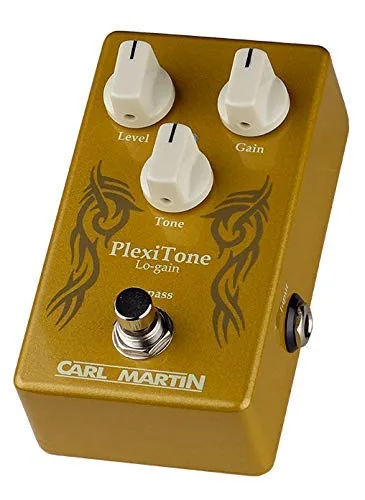
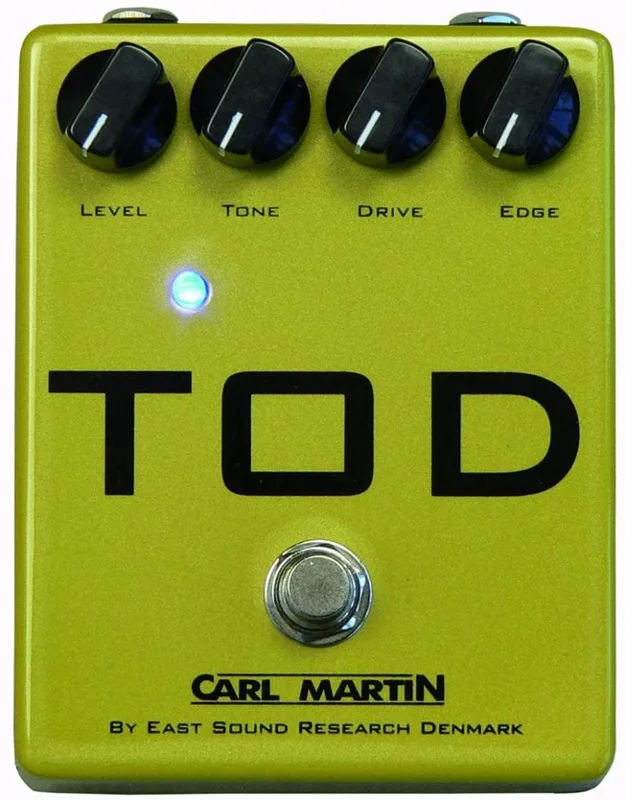
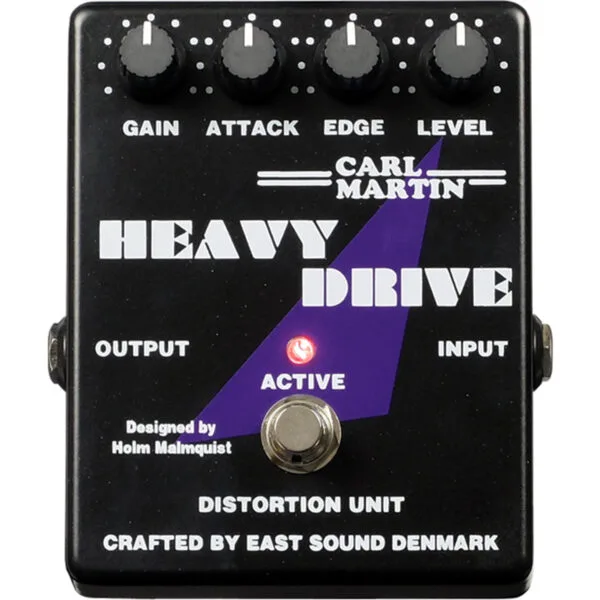
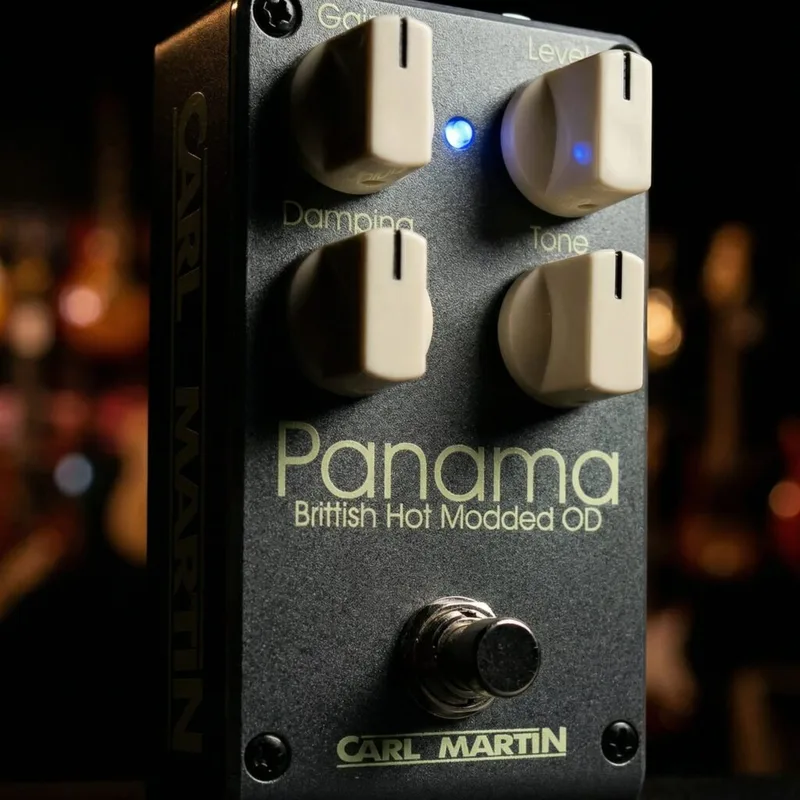
For context on where the DC Drive sits in the maker's range, Carl Martin's drive lineup has included the Plexitone Lo-Gain, the high-gain TOD, the Heavy Drive, and the Panama OD, alongside the DC Drive's overdrive-plus-boost format2. Players comparing boost-equipped drives may also want to look at boost pedals as a category, since the DC Drive's clean boost circuit originated as a standalone pedal2.
Videos
Brett Kingman
N Stuff Music
Brett Kingman
Questions
Is the Carl Martin DC Drive true bypass?
Yes. The original DC Drive uses true bypass switching with a red LED indication for the drive function, so your tone is preserved when the drive is disengaged. The separate boost footswitch has its own green LED so you can see at a glance which functions are active on a dark stage.
What is the difference between Regular and Fat mode?
Regular mode gives a crisp, clear, old-school overdrive suited to vintage tones, and MusicRadar's reviewer noted it is quite lean, rolling off some bottom-end. Fat mode is thicker, with enhanced low-end and more gain for a more modern sound. The reviewer described Fat as fuller and smoother, adding lower mids for more girth.
How much boost does the DC Drive clean boost give?
The built-in Carl Martin Clean Boost offers 0dB to +15dB, and it operates independently from the drive section. That means you can boost your clean signal or your overdriven sound without the boost coloring the tone, which Carl Martin positions as ideal for switching between rhythm and solo volumes.
Is the smaller DC Drive different from the original?
Yes. The 2018 DC Drive is a smaller, updated version with an anodized case designed for a smaller pedalboard footprint. The main upgrade is a new Regular/Fat switch that adds more gain in Fat mode for a modern sound. Delicious Audio reported it still offers all the same great tones of the original overdrive pedal.
Does the Carl Martin DC Drive take a 9V battery?
Yes. The original DC Drive can be powered by a standard 9V battery or a regulated power supply, and Carl Martin recommends a regulated supply such as the ProPower for reliable performance night after night. The 2018 version can be powered by a regulated supply like the Carl Martin ProPower V2.
Does the 2018 DC Drive still have the boost footswitch?
No. The original DC Drive was a double-footswitch pedal with a boost alongside its overdrive, but the 2018 version is a single-footswitch pedal that loses the boost. It still offers the overdrive, delivered via level, tone and drive knobs and a Regular/Fat toggle switch that gives two distinct voices.
Sources (6)
- Carl Martin DC Drive 2018 review, MusicRadar, 2018-10-27
- DC Drive, Carl Martin, 2026
- Carl Martin 2018 DC Drive, Delicious Audio, 2018-08-16
- Carl Martin Announces New Pedals, Premier Guitar, 2008-12-22
- Carl Martin DC Drive Pedal, Delicious Audio, 2020-01-08
- DC Factory, Carl Martin, 2026