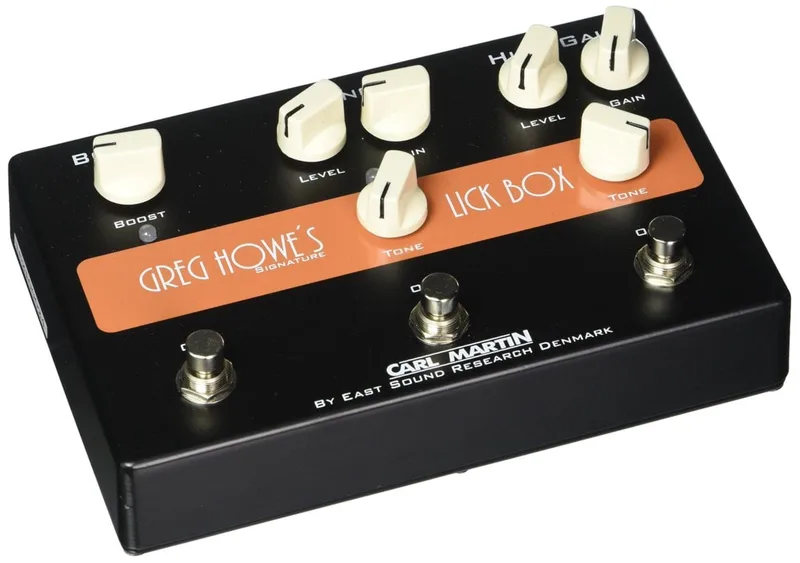


The Greg Howe's Lick Box is a three-channel distortion pedal from Carl Martin, the Danish effects maker, designed in collaboration with jazz-fusion guitarist Greg Howe. It packs three independent sections into one box: a High Gain channel, a Crunch channel, and a clean Boost of up to 12 dB, each with its own controls and footswitch, so a player can go from rhythm crunch to a boosted lead voice without touching the knobs1.
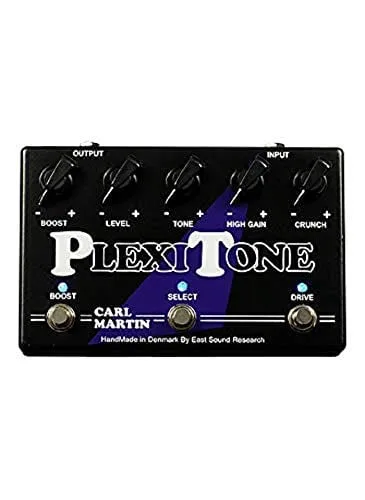
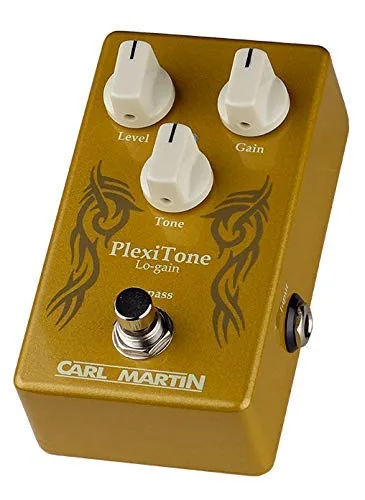
Carl Martin describes it as a solid-state analog pedal with no tube inside, built in the company's usual cast metal casing12. Greg Howe, who has a signature pedal relationship with Carl Martin and also uses the PlexiTone, is listed by the maker as using the Lick Box live13.
Three channels: High Gain, Crunch and Boost
The Lick Box is built around three independent sections, each with dedicated controls1:
- High Gain: Carl Martin describes this channel as having extended low end and clear highs, with its own Drive, Level and Tone knobs15.
- Crunch: A crunch channel focused on the midrange with very little compression, again with Drive, Level and Tone knobs15.
- Boost: A clean boost of up to 12 dB with a single Level knob, placed after the two drive channels in the signal chain, so it can push whichever drive sound is engaged, or run alone15.
Because the Boost sits after the two drive channels, stacking works the way many players expect: Crunch alone for rhythm, High Gain for a heavier voice, either channel with the Boost on top for leads, or the Boost by itself as a clean volume lift5.
Premier Guitar's 2023 review confirmed the channel layout:
"The channels are simple with boost, crunch, and high-gain functions that can be activated independently or in combination."4
That independence is the point of the design: nothing is hardwired in series, so each section earns its own footswitch41.
The controls and footswitches
Each channel has its own footswitch and control set1:
| Control | What it does |
|---|---|
| High Gain Drive, Level, Tone | Sets gain, output level and brightness of the high-gain voice15 |
| Crunch Gain | Controls the amount of crunch overdrive1 |
| Crunch Level | Sets the output level of the Crunch channel1 |
| Crunch Tone | Shapes the mid-focused crunch character1 |
| Boost Level | Sets the level of the clean 12 dB Boost5 |
| Boost Footswitch | Turns the Boost section on or off1 |
| High Gain Footswitch | Engages or bypasses the High Gain channel1 |
| Crunch Footswitch | Engages or bypasses the Crunch channel1 |
| Output | Sends the signal to the next device or amp1 |
Each drive channel gets a single tone knob rather than a multi-band EQ. Premier Guitar's reviewer found the range of both tone knobs to be quite balanced despite each channel having only that single control4.
Power: 9V DC, around 100 to 150 mA
The Lick Box requires a 9V DC power supply with a standard center-negative jack and draws around 100 to 150 mA15. Guitar World's launch coverage put the draw at 150 mA and credited Carl Martin's DC/DC converter circuitry, which lets the pedal run on a 9V supply while maintaining the plus and minus 12V circuitry inside2.
The Lick Box cannot run on batteries. Carl Martin says the internal DC-DC converter to plus and minus 12V rules out a real battery, so it is designed for power supply use only15.
At 100 to 150 mA, the pedal is also a poor candidate for a small daisy chain shared with several other pedals; an isolated output or a supply with headroom is the safer choice512.
Designed with Greg Howe
The Lick Box began when Greg Howe, whom Premier Guitar calls a jazz-fusion great, asked Carl Martin to develop a pedal recreating his signature sound42. Guitar World reported the result in December 2016 as the Greg Howe Signature Lick Box, a three-channel pedal with High Gain, Crunch and a 12 dB Boost, priced at MSRP $380 and street $2662.
Carl Martin positions the pedal as signature versatility that stays flexible for any rig, not a one-sound signature box1. The maker lists Howe on its artists page as using the Lick Box, and says he is using it live with great results13.
What reviewers said
Premier Guitar's 2023 quick-hit review found the channel architecture simple and practical, with the three functions activatable independently or in combination4. On the Boost, the reviewer's verdict:
"The one-knob boost channel proved to be robust and transparent, and it didn't add much noticeable coloration to my base tone."4
The same review listed a street price of $2664, matching the launch street price Guitar World reported in 20162.
Videos
Carl Martin
Carl Martin
Simon Gotthelf Music
Questions
Can the Lick Box run on batteries?
No. Carl Martin says it cannot run on batteries because of its power needs: an internal DC-DC converter raises the 9V input to plus and minus 12V for the circuitry, so it is designed for power supply use only, drawing around 100 to 150 mA.
Can you use the Crunch and High Gain channels at the same time?
Yes. Premier Guitar's review notes the boost, crunch and high-gain channels can be activated independently or in combination, so you can stack Crunch and High Gain together, or run either with the clean Boost after them.
Does the Greg Howe Lick Box have a tube inside?
No. Carl Martin describes it as a solid-state analog pedal with no tube inside. All three channels, High Gain, Crunch and Boost, are analog solid-state circuits in a cast metal casing.
How much does the Carl Martin Lick Box cost?
Guitar World reported an MSRP of $380 and a street price of $266 at the pedal's launch in December 2016. Premier Guitar's 2023 review also listed a street price of $266.
Sources (5)
- Greg Howe's Lick Box, Carl Martin (carlmartin.com), 2026
- Carl Martin Effects Launches Greg Howe's Lick Box Pedal, Guitar World, 2016-12-13
- Artists - Carl Martin, Carl Martin (carlmartin.com), 2026
- Quick Hit: Carl Martin Greg Howe’s Lick Box Review, Premier Guitar, 2017-06-04
- Support - Carl Martin, Carl Martin (carlmartin.com), 2026