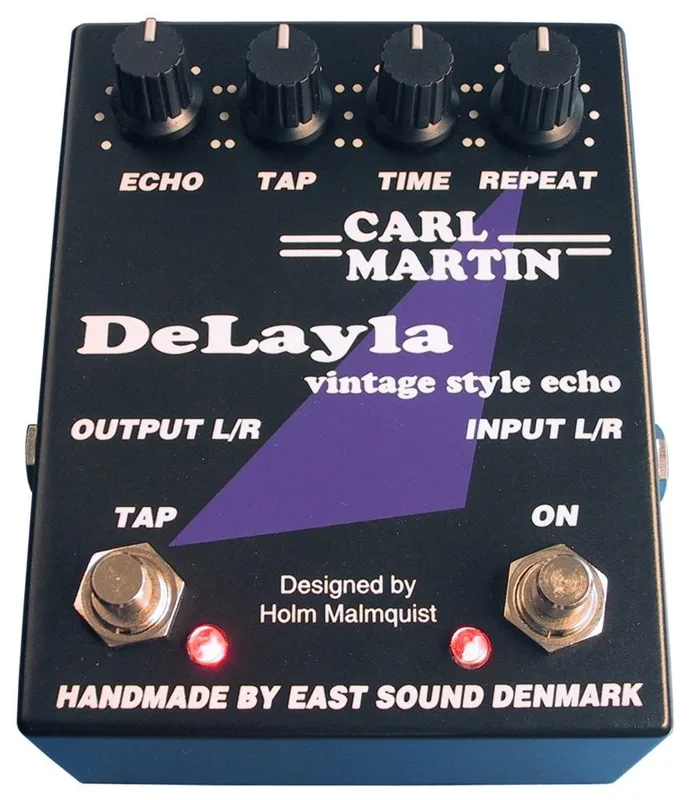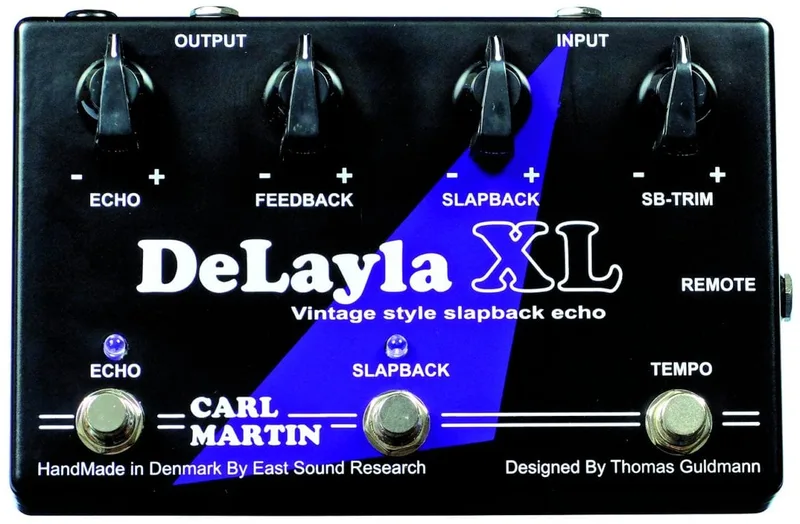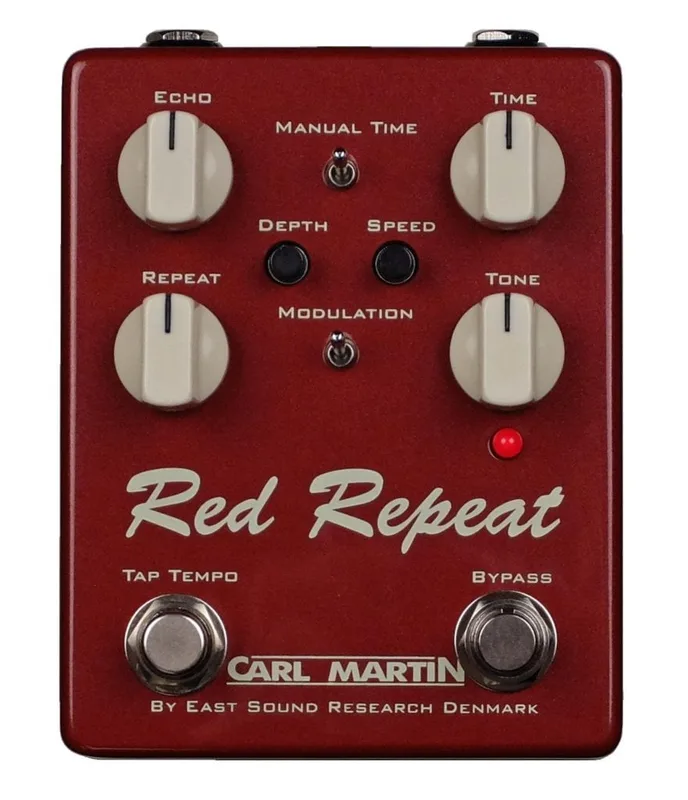


The Carl Martin EchoTone is a delay pedal from Danish maker Carl Martin. Carl Martin says it delivers warm, musical repeats with classic character, and that test players called it "the best echo they have ever heard"1. It sits alongside Carl Martin's other delay pedals, the Delayla, the Delayla XL and the Red Repeat.
What sets the EchoTone apart from a basic echo box is its flexibility: two foot-switchable timing modes, an insert loop that lets other pedals color the repeats, and a switchable trails function that governs whether repeats continue after you bypass the pedal1.
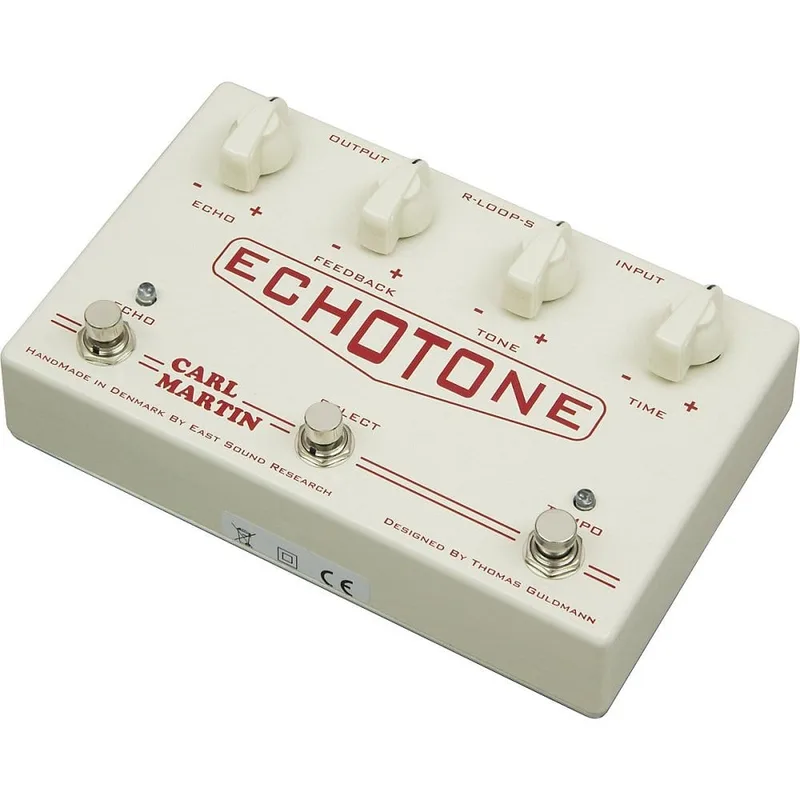
The controls and footswitches
The EchoTone is built around two timing modes that you switch between with your feet. Carl Martin describes the pedal as foot-switchable between Manual and Tap tempo modes, which the maker says allows instant switching from slapback echo on rhythm parts to tempo-synced repeats1. In MusicRadar's review, Dave Burrluck explains the split: the Time control is dedicated to the manually set delay time of the Echo footswitch, covering 20 to 1200 milliseconds, while the tap tempo side handles the tempo-synced settings21.
The shared controls work across both modes:
| Control | What it does |
|---|---|
| Echo | Wet/dry mix, affects both echo modes2 |
| Feedback | Number of repeats, affects both echo modes2 |
| Tone | Shapes the repeats, affects both echo modes2 |
| Time | Manually set delay time, 20 to 1200 milliseconds, for the Echo footswitch21 |
The pedal also carries a switchable trails function, which determines whether the repeats ring out or cut off when you disengage the effect1.
The insert loop
The EchoTone's most distinctive feature is its built-in insert loop, which lets you place external pedals inside the echo path so they affect the repeats rather than your whole signal. Carl Martin suggests flavoring the repeats with external chorus, flange, distortion or modulation pedals1. In practice, this means a repeat can get progressively more distorted or more modulated as it recurs, something a conventional delay with only an output-level effects loop cannot do.
Design and origin
The EchoTone was designed by Thomas Guldman, and MusicRadar's review notes that the color scheme is not the only difference from earlier versions of the pedal2. It is the only Carl Martin pedal to come in its retro off-white finish, housed in the company's low-profile enclosure2. Like all Carl Martin effects, it is built in Denmark1.
MusicRadar first reported the pedal as a new foot pedal in April 2008, with pricing not yet available at the time of the announcement3.
What reviewers said
MusicRadar's review, by Dave Burrluck, was positive on the pedal's core qualities, listing its organic sound, dual delay settings and FX loop as reasons to buy2.
"Organic sound. Dual delay settings. FX loop."
Power
Unlike pedals that run on an external adapter or battery, the EchoTone has a built-in 12V (+/-) regulated power supply1. That internal regulation means the pedal is self-contained and does not draw from an external daisy chain, which suits players whose pedalboard power supplies are already loaded.
Videos
Selane Productions
Alberto Barrero
Victor Hugo Targino
Questions
Is the Carl Martin Echotone analog?
Yes. Carl Martin describes the EchoTone as a vintage analog echo pedal, delivering up to 1200 milliseconds of warm, musical repeats with classic character. It is not a digital delay.
Does the Carl Martin Echotone need an external power supply?
No. The EchoTone has a built-in 12V (+/-) regulated power supply, so it runs on its own internal power rather than needing an external adapter or a spot on a daisy chain.
What is the maximum delay time of the Echotone?
The EchoTone offers up to 1200 milliseconds of delay. The Time control for the manually set delay covers a range of 20 to 1200 milliseconds on the Echo footswitch.
Where is the Carl Martin Echotone made?
The EchoTone is built in Denmark. Carl Martin notes that, like all of its Danish-built effects, the pedal comes in the company's low-profile housing, in this case finished in an off-white color.
What is the insert loop on the Echotone for?
The built-in insert loop lets you run external pedals into the echo repeats themselves. Carl Martin suggests using chorus, flanger, distortion or modulation pedals to flavor the repeats rather than the whole signal.
Sources (3)
- EchoTone, Carl Martin, 2026
- Carl Martin EchoTone review, MusicRadar, 2008-08-27
- Carl Martin puts out the Echotone pedal, MusicRadar, 2008-04-07