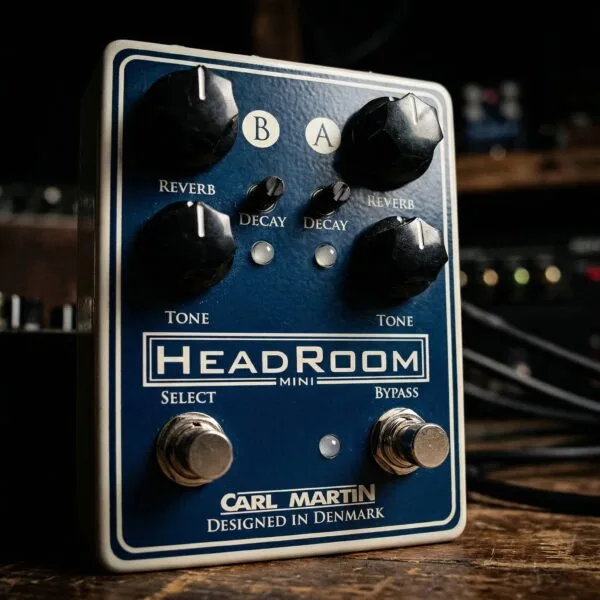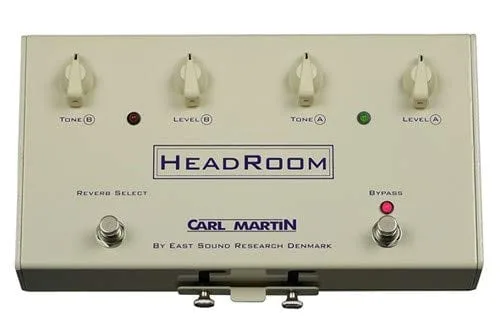



The Carl Martin HeadRoom is a spring reverb pedal from Danish maker Carl Martin, first released in 20111. What sets it apart from most reverb pedals is what is inside: a genuine spring reverb tank in a stompbox format, with actual springs, rather than a digital circuit imitating one23. Carl Martin describes the result as "a natural, organic reverb response that reacts dynamically to your playing instead of behaving like a static effect added on top"2.
Instead of menus or presets, the HeadRoom gives you two identical, independent reverb channels that you can set and switch between on stage, like having two reverb presets under your feet23. It is a mono pedal, one input and one output, in a rugged metal enclosure with classic chicken-head knobs23.
A real spring tank in a pedal
Spring reverb was originally an amp feature: a set of metal springs mounted in a tank, driven by a transducer, whose wobble and bounce produce the familiar surf-and-twang reverb tail. The HeadRoom puts that whole mechanism inside a pedal. Carl Martin's own support material is blunt about it: "The HeadRoom is a real analog spring reverb pedal, effectively a genuine spring reverb tank in a stompbox format"3.
That makes it a different animal from the digital reverbs most players are used to. There are no algorithms, no menus and no presets; the springs themselves do the work, and the pedal behaves like the reverb in a vintage amp rather than a programmed effect2. Guitar Pedal X has noted that Carl Martin is "well known for their real Spring Tank Reverb HeadRoom Pedal" and that the original is "a fairly sizeable proposition" compared with ordinary compact pedals, which is the trade-off for housing a real tank6.
The pedal has been through a couple of revisions over its life. Older versions had an AC mains plug and an internal power transformer; newer versions are DC23.
The controls: two channels, each with Tone and Level
The HeadRoom's control scheme is deliberately simple. There are two identical channels, A and B, each with its own Tone and Level knobs, and two footswitches: one is Bypass (effect on/off), and the other is Channel Select, which toggles between A and B237.
| Control | What it does |
|---|---|
| Level A | Sets reverb level for channel A2 |
| Tone A | Adjusts reverb tone for channel A7 |
| Level B | Sets reverb level for channel B2 |
| Tone B | Adjusts reverb tone for channel B2 |
| Bypass footswitch | Engages or bypasses the effect3 |
| Channel Select footswitch | Toggles between channels A and B3 |
Carl Martin's support article explains how the two knobs shape the sound: "Level sets the mix/depth of the reverb (from very subtle to very wet), and Tone adjusts the brightness/darkness of the reverb tail"3. The two channels work like two settable reverb sounds you can jump between mid-song: a soft, small-room reverb on channel A and a much more dramatic, dark large-room sound on channel B, for example37.
On the back of the pedal you will find the input and output jacks for your guitar, plus remote footswitch jacks for channel and bypass, so the switching can be done from a distance if the pedal lives in a rack or off the pedalboard35.
Power: 9V DC, about 200mA
The HeadRoom runs internally at around ±12V, and it has an internal power transformer to get there2. How you feed it depends on the version:
- A standard 9V DC center negative supply at ~200 mA powers the current versions23.
- Depending on version, it can also run on a 9V battery or a 12V AC adapter23.
- Older versions had an AC mains plug; newer ones are DC23.
The ~200 mA draw is well above what a typical small analog pedal pulls, so plan your power supply accordingly. Check which revision you have before buying an adapter, since the AC mains and DC versions differ.
What reviewers said
Pete Thorn demoed the pedal on his YouTube channel back in 2011, walking through the two-preset switching, the remote jacks and the spring reverb sound, and noting the true bypass switching5. Pedal of the Day has described the original HeadRoom as "a popular release"1.
"Really loving the sounds coming out of this pedal"
That same review was of the newer HeadRoom Mini, which leads to the obvious comparison6.
The HeadRoom and the HeadRoom Mini
| HeadRoom (2011) | HeadRoom Mini (2025) | |
|---|---|---|
| Reverb engine | Real analog spring tank23 | Digital emulation of the spring reverb8 |
| I/O | Mono, one in, one out3 | Stereo inputs and outputs, mono or stereo operation8 |
| Bypass | True bypass5 | Buffered bypass with spillover trails8 |
| Channels | Two, each with Tone and Level793 | Two, each with Reverb, Tone and Decay793 |
| Size | Full-size tank pedal38 | Compact, pedalboard-friendly8 |
Guitar Pedal X called the Mini "an interesting move" by Carl Martin, while suggesting that customers for this sort of device might still prefer a genuine spring tank pedal overall6. The Mini's controls also differ slightly: each of its channels carries a Reverb amount control plus Tone and Decay, where the original keeps its two-knob-per-channel layout937.
Who uses it
Carl Martin's artist pages list a number of players using the HeadRoom, including Carl Verheyen, Paul Nelson, Fred Turner, Kid Anderson, John Jorgenson and Derek Gripper210. The HeadRoom Mini has its own users, among them James Massi and Amir John Haddad10.
Videos
Pete Thorn
Carl Martin
Robert Baker
Questions
Does the Carl Martin HeadRoom have real springs?
Yes. The HeadRoom is a real analog spring reverb pedal, effectively a genuine spring reverb tank in a stompbox format, with actual springs inside rather than a digital emulation. Carl Martin describes it as a fully analog spring reverb with two identical, independent channels.
Can the Carl Martin HeadRoom run on a battery?
It depends on the version. The pedal can be powered by a standard 9V DC center negative supply at roughly 200 mA, and some versions can also run on a 9V battery or a 12V AC adapter. Older versions had an AC mains plug, while newer ones are DC.
Is the Carl Martin HeadRoom stereo?
No. The HeadRoom is a mono pedal with one input and one output. It also has remote footswitch jacks for channel and bypass if you want to switch it from a distance. The later HeadRoom Mini is the stereo option, supporting both mono and stereo operation.
Is the Carl Martin HeadRoom true bypass?
Yes. Pete Thorn's demo of the pedal notes that it has true bypass switching. The later HeadRoom Mini differs here, using a buffered bypass with spillover trails instead, so the reverb tail continues when you switch the effect off.
What is the difference between the HeadRoom and the HeadRoom Mini?
The original HeadRoom, released in 2011, is a fairly sizeable pedal with a real spring tank, mono input and output, and true bypass. The HeadRoom Mini, released in 2025, is a digital emulation of that spring reverb in a much smaller pedal, with stereo inputs and outputs and a buffered bypass with spillover.
Sources (10)
- Carl Martin HeadRoom Mini Dual Channel Digital Spring Reverb, Pedal of the Day (www.pedal-of-the-day.com), 2025-03-25
- HeadRoom, carlmartin.com, 2026
- Support - Carl Martin, Carl Martin (carlmartin.com), 2026
- THE MOTHER OF ALL PLEXI PEDALS! Carl Martin PLEXIRANGER, YouTube (Pete Thorn channel), 2020-11-20
- Carl Martin Headroom Reverb, demo by Pete Thorn, youtube.com, 2011-11-17
- Guitar Pedal X, Guitar Pedal X, 2025-04-02
- Headroom by Carl Martin, RockBoard PedalPedia, 2026
- HeadRoom Mini, Carl Martin, 2026
- Carl Martin Headroom Mini Stereo Reverb, Delicious Audio, 2025-08-19
- Artists - Carl Martin, Carl Martin (carlmartin.com), 2026
 Pete Thorn