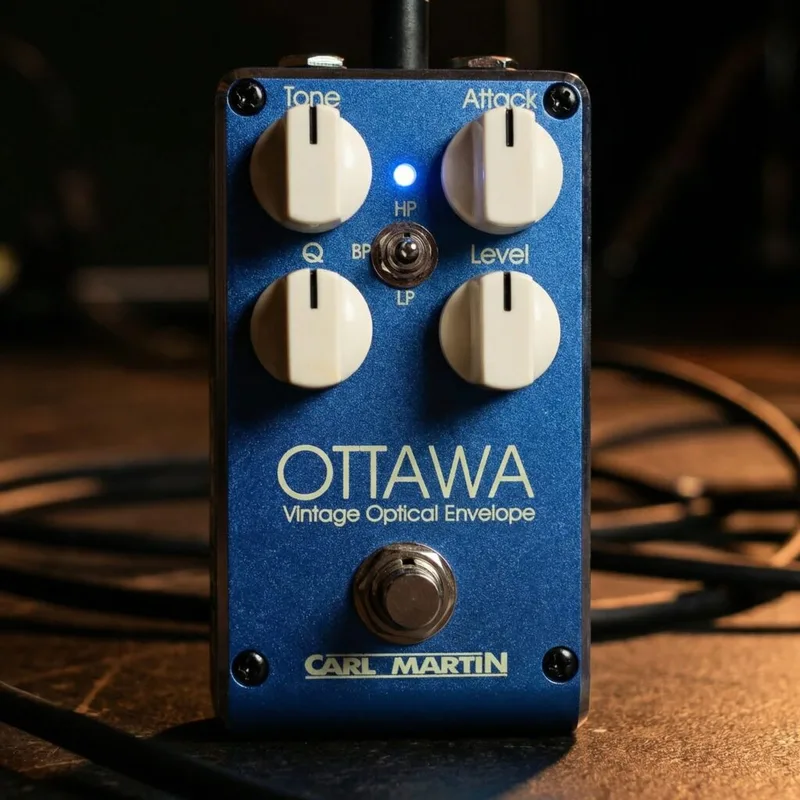


The Carl Martin Ottawa is a compact, fully analog envelope filter pedal, an auto-wah that sweeps a wah-like filter in response to how hard you pick instead of a treadle under your foot1. At the center of the circuit is an optical envelope filter with three selectable modes, High Pass, Band Pass and Low Pass, and Carl Martin designed it to be usable with both guitar and bass12. It is a redesign of the Danish maker's earlier optical envelope filter, arriving in the lineup Carl Martin refreshed in 2018 with anodized enclosures and top-mounted jacks13.
What it does to your sound
An envelope filter reads the level of your signal, your picking dynamics, and uses it to sweep a filter up and down. Carl Martin describes the Ottawa as giving "classic wah-like movement without a treadle," with the sweep following your attack rather than your foot1. The optical part means the circuit uses a light-dependent element to do the sweeping, and Premier Guitar's review of Carl Martin's earlier optical envelope filter noted that "you can manipulate the wave envelope with an analog optical circuit," the principle the Ottawa carries on4.
Compared with a standard wah pedal, the hands-free approach has a practical advantage. Reviewing Carl Martin's optical envelope design at MusicRadar, the reviewer made the case that "an optical filter can react more quickly (and accurately) to your playing technique than rocking your foot back and forth"5. The trade-off is control: there is no treadle to place the filter exactly where you want it, so the Attack and Q knobs do that shaping instead.
The three filter modes set the character of the sweep:
- High Pass: the filter emphasizes the high end as it opens, the familiar quacky auto-wah voice.
- Band Pass: a focused peak that moves through the midrange.
- Low Pass: the filter works downward from the top of the spectrum, retaining low frequencies, which Carl Martin says "specifically allows it to function great as a bass envelope filter"1.
Guitar World's news coverage of the pedal placed its tonal range "from '60s psych sounds to '70s disco tones"6.
The controls
The Ottawa has four knobs and a three-way switch, plus a bypass footswitch16. Carl Martin's own support article explains what each control does2:
| Control | What it does |
|---|---|
| Attack | Adjusts how sensitive the filter is to your playing dynamics2 |
| Q (Bandwidth) | Sets how sharp or broad the wah filter is; shapes the resonance and width of the sweep12 |
| Tone | Essentially a high-cut on the output2 |
| Level | Sets the output level2 |
| Range (Select) switch | Three-way toggle for High-pass, Band-pass and Low-pass filter modes2 |
| Bypass footswitch | Engages or bypasses the effect1 |
One thing to know before dialing it in: Guitar World noted that the Tone, Attack and Q knobs "are said to be closely linked, and so some off-the-cuff changes may be required to maintain an optimum tone"6. In practice that means a change to the Q or Attack may call for a small Tone or Level adjustment to rebalance the sound.
Power and setup
The Ottawa runs on a 9V DC center-negative power input and draws around 14 mA, which Carl Martin calls "super low" and easy on a pedalboard supply1.
The Ottawa does not run on a battery. Carl Martin omitted the battery clip, so it needs an external 9V DC supply, center negative1.
The input jack accepts the guitar (or bass) signal and the output jack sends it on to the next device or amp, both top-mounted to save pedalboard space13. With the effect off, the pedal is true bypass1.
Where it came from
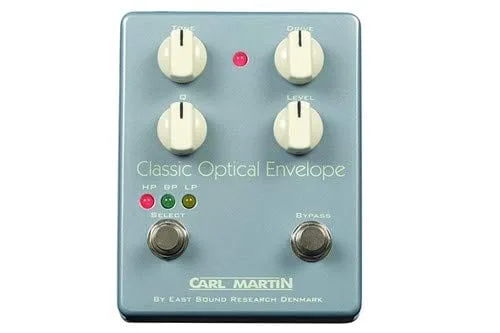
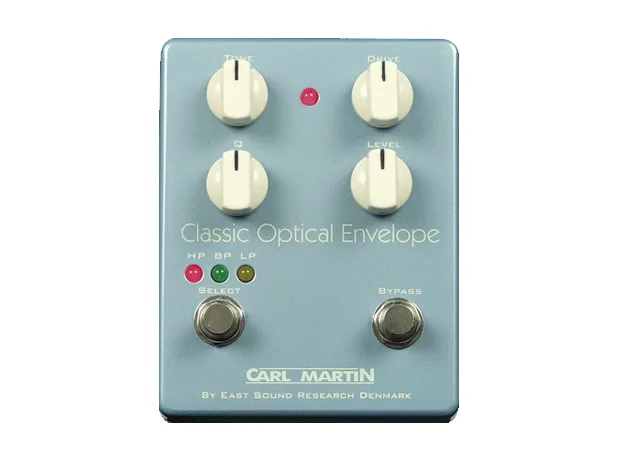
The Ottawa is a redesign of Carl Martin's earlier optical envelope filter, which the company announced in 2011 alongside the Blue Ranger overdrive17. That earlier pedal, the Classic Optical Envelope, was described by No Treble at its release as a "Classic Auto-Wah with Opto-Technology" for bass or guitar, running on a 9V battery or regulated supply, and built, in Carl Martin's words, using "the same high-quality optical technology as Carl Martin's renowned Opto-Compressor"87.
The Ottawa arrived as part of the lineup refresh Carl Martin carried out in 2018, which brought the anodized enclosures and top-mounted jacks the Ottawa wears3. When the pedal reached the press in September 2021, Guitar World called it "a beefed-up version of the brand's pre-existing Optical Envelope Filter," and Delicious Audio described it simply as "a redesign of the company's previous auto-wah"69. Gearnews reported its three presets for High, Band and Low Pass filters on a three-way mini-toggle10.
The main practical differences from the Classic Optical Envelope are the compact enclosure, the Low Pass mode that makes bass use straightforward, and the power arrangement: the Classic could run on a battery, the Ottawa cannot187.
What reviewers said
Guitar World's review of the Ottawa listed its origin as China and its dimensions as 60 x 115 x 50 mm, and summed up the pedal's sound in two words: "Superb sounds"3. The same review credited the refreshed enclosure style, noting that "slick-looking anodized enclosures were the order of the day, with pedalboard placement made easier via top-mounted input and output jacks"3.
"+ Superb sounds."
On Carl Martin's artist page, Phil Soussan is listed as a user of the Ottawa11.
Videos
Pete Thorn
Carl Martin
Simon Gotthelf Music
Questions
Does the Carl Martin Ottawa work on bass?
Yes. Carl Martin designed the Ottawa to be usable with both guitar and bass, and the Low Pass filter mode specifically retains low frequencies, which lets the pedal function as a bass envelope filter12.
Can the Carl Martin Ottawa run on a battery?
No. The Ottawa does not run on a battery and takes external power only, through a 9V DC center-negative input1.
Is the Carl Martin Ottawa true bypass?
Yes. Carl Martin states that the Ottawa is true bypass when off1.
Where is the Carl Martin Ottawa made?
The Ottawa is made in China, as listed in Guitar World's review3.
What is the difference between the Ottawa and the Classic Optical Envelope?
The Ottawa is a compact redesign of Carl Martin's earlier optical envelope filter, with a Low Pass mode for bass use and no battery option, where the 2011 Classic Optical Envelope used the Opto-Compressor's optical technology and could run on a 9V battery187.
What is the difference between the Ottawa and the Carl Martin Classic Optical Envelope?
The Ottawa is a redesign of Carl Martin's earlier optical envelope filter, built into a compact enclosure with a Low Pass mode that makes it work well as a bass envelope filter. The Classic Optical Envelope, from 2011, used the same optical technology as Carl Martin's Opto-Compressor and could run on a 9V battery, which the Ottawa cannot.
Sources (11)
- Ottawa - Carl Martin, Carl Martin, 2026
- Support - Carl Martin, Carl Martin (carlmartin.com), 2026
- Carl Martin Ottawa Vintage Optical Envelope review, Guitar World, 2022-04-13
- Carl Martin Optical Envelope Filter Pedal Review, Premier Guitar, 2012-05-02
- Carl Martin Classic Optical Envelope review, MusicRadar, 2012-05-31
- Carl Martin debuts streamlined Ottawa Vintage Optical Envelope filter pedal, Guitar World, 2021-09-22
- Carl Martin Releases Classic Optical Envelope Pedal, No Treble, 2011-03-17
- Classic Optical Envelope, Carl Martin, 2026
- Carl Martin Ottawa Optical Envelope Filter, Delicious Audio, 2021-09-21
- Carl Martin Ottawa envelope filter: Time to get your groove on!, www.gearnews.com, 2021-09-21
- Artists - Carl Martin, Carl Martin (carlmartin.com), 2026