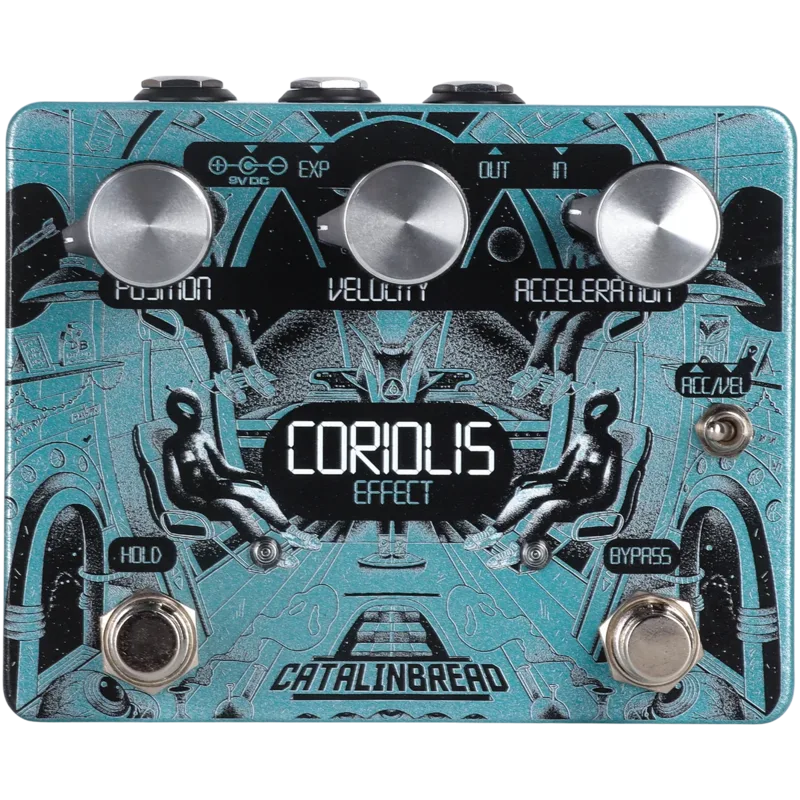


The Catalinbread Coriolis Effect is a multi-effect pedal that packs a sustainer, wah, filter, pitch shifter and harmonizer into one box1. Announced by Portland, Oregon's Catalinbread at NAMM 2019 and targeted for release on March 28, 20191, it works differently from most filter pedals or octave and pitch pedals: instead of an LFO sweeping a filter, it samples your signal and lets you drag that sample down in pitch and brightness with two knobs2. The current version is a limited edition, with only 25 units available3.
The idea behind the pedal comes from physics. Catalinbread named it after the classical mechanics phenomenon, and the maker describes turning the two main knobs down as dragging your playing into the heart of a black hole, red-shifting your tone into a lower pitch and filtering out the high frequencies4.
What it does to your sound
The Coriolis Effect splits your signal into dry and wet paths. The wet path is sampled, and the two main knobs act on that sample. Premier Guitar's reviewer noted how unusual the approach is: the pedal produces pitch-shift and filter effects without any LFO modulation at all2.
- Velocity adjusts the pitch of the wet signal. Clockwise there is no pitch shifting; at 12 o'clock the sample sits near an octave down; counter-clockwise it lowers the frequencies all the way to zero Hertz, which silences the wet signal3.
- Acceleration is a 2-pole low-pass filter on the wet signal. Clockwise nothing is filtered (all pass); counter-clockwise the signal is filtered down to nothing (no pass)3.
- Position controls the dry/wet mix, full wet clockwise and full dry counter-clockwise3.
MusicRadar described the result in plain terms: the Velocity and Acceleration controls shift your tone into a lower pitch and filter out high frequencies respectively6. With both knobs turned down, the wet signal drops in pitch and darkens until it disappears, while the dry signal stays put underneath, which is where the harmonizer-like interval effects come from as the two paths separate.
The Hold button
The Hold button is the sustainer side of the pedal. Pressing it stops any new sampling and loops the current sample3. How you press it changes what you get:
- Initialize during a chord and the chord sustains for upwards of two minutes1.
- Initialize while playing melody lines and you get a fast-delay or stutter sound1.
MusicRadar described the same function as looping the current signal with up to two minutes of sustain5, so the pedal can hold a chord for a solo or chop a melody line into stutters depending on when you hit the button.
Expression pedal control
The EXP jack takes an expression pedal connected with a 1/4" TRS cable3. An internal toggle sets whether the expression pedal controls Velocity or Acceleration3, so you can sweep the pitch or the filter with your foot, wah-style. There is also an internal expression pedal polarity switch1, which lets the pedal work with expression pedals of either wiring, and MusicRadar noted the input lets you manipulate parameters on the fly5. If you are shopping for a controller, see expression pedals.
Bypass and power
Inside the pedal there is a bypass mode switch that selects between true bypass and buffered bypass1. That choice matters if you run long cables or a large board: buffered bypass keeps a buffer in the signal path with the pedal off, while true bypass removes the circuit entirely.
Power comes from a 9V center-negative DC supply3. Catalinbread warns that plugging in anything other than 9V center-negative DC risks voiding the warranty3, so a standard modern pedalboard supply with the correct polarity cable is the safe route.
The current run is a limited edition with only 25 units available3. The original 2019 release was a standard production pedal, so secondhand units from that run also exist.
Where it came from and what it costs
Catalinbread announced the Coriolis Effect at the NAMM 2019 show in January 20191, with pre-orders opening through retailers and a target release date of March 28, 20191. MusicRadar reported it as available for $229 on April 1, 20196; the announcement price was $229.99 MSRP5, and the two figures differ only in how each outlet rounded the price. Like Catalinbread's other pedals, it is handmade in the US5, hand-built in Portland, Oregon1.
What reviewers said
Premier Guitar reviewed the pedal in August 2021 and highlighted its "Unique pitch-shift/filter effects" and the fact that "It doesn't even employ LFO modulation"2, pointing to the sampling approach as what sets it apart from conventional filter and pitch pedals. At launch, the press coverage focused on the range of functions in one box: MusicRadar called it a pitch and filter multi-fx that moves between effects, pulling in elements of a wah, pitch-shifter, harmonizer, sustainer and low-pass filter5.
Videos
Premier Guitar
Catalinbread Effects
AndyDemos
Questions
Does the Catalinbread Coriolis Effect work with an expression pedal?
Yes. The EXP jack takes an expression pedal connected with a 1/4 inch TRS cable, and an internal toggle sets whether the expression pedal controls the Velocity or Acceleration parameter. There is also an internal expression pedal polarity switch so the pedal can match different expression pedal brands.
What power supply does the Catalinbread Coriolis Effect use?
It accepts 9V from a center-negative DC power supply. Catalinbread warns that plugging in anything other than 9V center-negative DC risks voiding the warranty, so check your supply's polarity before connecting it.
Is the Catalinbread Coriolis Effect true bypass?
It can be. An internal bypass mode switch lets you choose between true bypass and buffered bypass, so you can set it to suit the rest of your pedalboard, for example keeping a buffer in the chain when the pedal is off.
What does the Hold button do on the Coriolis Effect?
Pressing Hold stops any new sampling and loops the current sample. Initialize it during a chord and the chord sustains for upwards of two minutes; initialize it while playing melody lines and you get a fast-delay or stutter sound.
Where is the Catalinbread Coriolis Effect made?
It is handmade in the US. Catalinbread is based in Portland, Oregon, and the Coriolis Effect is hand-built there, like the rest of the company's pedals.
How much does the Catalinbread Coriolis Effect cost?
At launch in 2019 the pedal was priced at $229.99 MSRP, and MusicRadar reported it available for $229 in April 2019. The current run is a limited edition with only 25 units available, so pricing today depends on the maker's store.
Sources (6)
- Catalinbread Effects Announces the Coriolis Effect, Premier Guitar, 2019-02-04
- Catalinbread Coriolis Effect Review, Premier Guitar, 2019-06-04
- Coriolis Effect (Limited Edition), Catalinbread Effects
- Catalinbread Unveils the Coriolis Effect Pedal, Guitar World, 2019-01-31
- NAMM 2019: Catalinbread's Coriolis Effect rotates between pitch and filter for new tonal possibilities, MusicRadar, 2019-01-26
- Catalinbread's Coriolis Effect combines a sustainer, wah, filter, pitch-shifter and harmonizer, MusicRadar, 2019-04-01