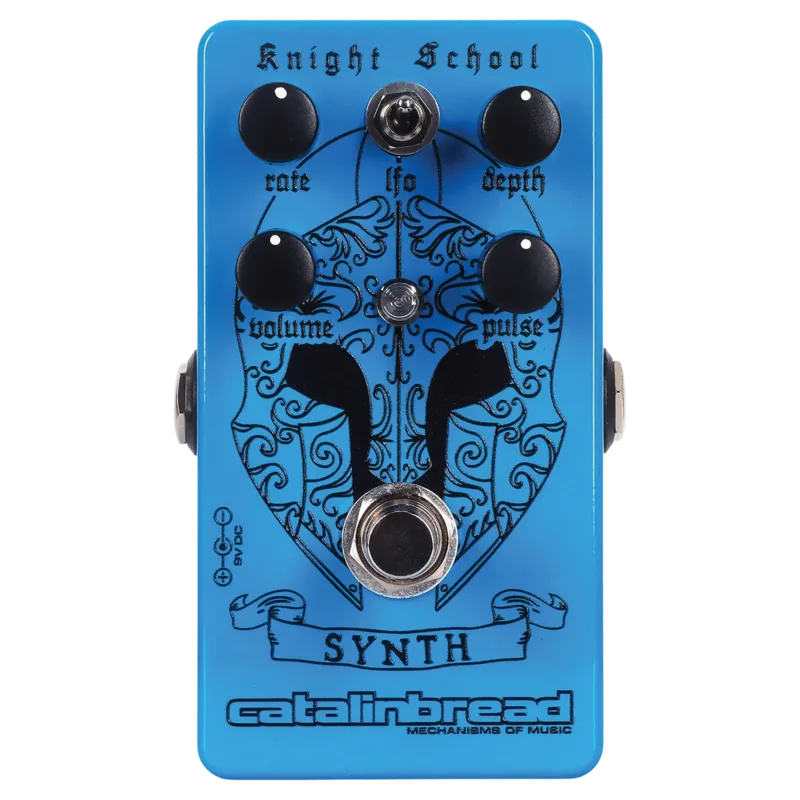
The Catalinbread Knight School Synth is a DIY kit synth pedal: you buy it as a bag of parts and a labeled circuit board, solder it together yourself, and end up with a pedal that converts your guitar signal into a square wave whose pulse width you can shape by hand or sweep automatically with an onboard LFO1. It sits in Catalinbread's Knight School line, a family of build-it-yourself pedal kits that also includes overdrive, fuzz, filter, bit crush, distortion, delay and tremolo circuits123.
The synth voice at the heart of it comes from pulse-width modulation. The LFO varies the pulse width at a speed and intensity set with the knobs directly adjacent to the LFO toggle, which is how the pedal moves from a steady synthetic voice to a sweeping, raygun-like motion4.
What the Knight School Synth does
The pedal's core effect is a pulse-width modulated version of your input signal. Pulse width is what determines whether a square wave sounds thin and nasal or fat and hollow, and having it under a knob, and under a moving LFO that varies the pulse width at a speed and intensity set with the knobs adjacent to the LFO toggle, is what gives the Knight School Synth its synth character. Compared with polyphonic pitch-tracking synth pedals, which analyze your notes and rebuild them as synth voices, this is a simpler, more direct approach: the wave itself is reshaped rather than resynthesized4.
The LFO is the motion source. With the LFO toggle off, the two knobs beside it do nothing; with it on, the LFO automatically varies the pulse width at a speed and intensity you set1. Turned down, the LFO softly shifts the pulse width; all the way up, the most dramatic effect is heard4.
The controls
Catalinbread describes the control set in its own words on the product page4:
| Control | What it does |
|---|---|
| VOLUME | Sets the output level4 |
| RATE | Changes the speed at which the LFO automatically varies the pulse width, from slow to raygun-fast4 |
| DEPTH | Changes the intensity of the LFO; down is a soft shift of pulse width, up is the most dramatic effect4 |
| LFO TOGGLE | Turns the LFO on and off; the two knobs to the left and right of this switch do nothing unless it is turned on1 |
The layout tells you how to use it: the toggle gates the modulation, and the adjacent RATE and DEPTH knobs shape it. With the LFO off, the pedal behaves as a static pulse-width synth voice; with it on, the same voice starts moving14.
Power: 9V, center-negative
The Knight School Synth accepts a center-negative DC power supply capable of supplying 9 volts and at least .5mA of current, with higher current being fine4. That is the same power arrangement Catalinbread specifies across the Knight School line, from the Fuzz to the Filter, Bit Crush, Overdrive, Distortion, Delay and Trem235.
Plugging in the wrong supply will void the warranty4. The pedal wants 9V DC, center-negative. A center-positive plug, an AC supply or a higher voltage is the wrong supply, so check the plug before you power a fresh build.
Kit build and mods
The Knight School Synth is sold as a kit, and the build is aimed at people learning to solder. The circuit board has everything labeled as to what part goes where, so component placement is spelled out rather than left to a separate diagram1. That matches the philosophy Catalinbread has applied to the whole Knight School range: Guitar World reported on the line's Overdrive kit in 2023, noting you need a soldering iron to piece the pedal together, and Gearnews observed of the Fuzz kit that the DIY build option is around $50 cheaper than the built version and the circuit does not contain a huge amount of components, making it a way to teach yourself the basics of pedal building67.
Because you build it, you can also change it, and Catalinbread points to two specific component swaps on the product page1.
LFO speed range. The 4u7 electrolytic capacitor governs the range of the LFO rate control. Bigger values shift the range down, so the RATE knob reaches slower speeds; smaller values do the opposite, pushing the whole range faster1. If the stock range feels too slow or too fast for the parts you play, that one capacitor is the part to change.
Low end. In this circuit, the 100n capacitor is the output capacitor, and enlarging it slightly enhances the low end of the circuit1. For bass players, or guitarists who want a thicker synthetic body, that is the bass mod.
"In this circuit, the 100n capacitor is that device and enlarging it slightly enhances the low end of the circuit."
Both mods are single-component changes on a board where every position is labeled, which makes them reasonable first projects for a builder who has finished the kit and wants to go further1.
Where it sits in the Knight School line
The Knight School Synth is one circuit in a broader Catalinbread series of DIY kits. The line includes an Overdrive based on the stock TSF circuit, a Fuzz with silicon 1N4148 clipping diodes, a state-variable low-pass Filter whose RESONANCE knob introduces feedback to make it more "synth-like", a Bit Crush descended from Catalinbread's Heliotrope, plus Distortion, Delay and Trem offerings2. The Filter in particular overlaps in spirit with the Synth: both lean into synth-style sounds, the Filter through a resonant low-pass sweep and the Synth through pulse-width modulation and its LFO.
Where the rest of the line covers conventional gain and time-based effects, the Synth is the line's odd one out, the kit to pick if the sound you want to build toward is a square-wave synth voice rather than an overdrive or a delay89.
Questions
Is the Knight School Synth sold as a kit?
Yes. Catalinbread sells the Knight School Synth as a DIY kit that you solder together yourself. The supplied circuit board has every component labeled as to what part goes where, so the build is approachable for someone learning pedal building. It is part of Catalinbread's wider Knight School line of DIY kit pedals.
Does the Knight School Synth run on a battery?
Plan on a 9V DC power supply with a center-negative plug, the same standard arrangement as the rest of the Knight School line.
What happens if I use the wrong power supply?
Catalinbread states plainly that plugging in the wrong supply will void the warranty. The pedal wants a 9V DC center-negative supply. Anything else, such as a center-positive or higher-voltage plug, risks damage and takes the warranty with it, so it pays to check the plug before powering up.
How do I change the LFO speed range?
The RATE knob sets the speed at which the LFO varies the pulse width, from slow to raygun-fast. To shift the whole range, Catalinbread identifies the 4u7 electrolytic capacitor as the part that governs the range of the rate control: a bigger value shifts the range down, and a smaller value shifts it up.
How do I add more low end to the Knight School Synth?
Catalinbread's bass mod points to the 100n capacitor, which is the output capacitor in this circuit. Enlarging it slightly enhances the low end of the circuit. Because the board is labeled, finding and swapping that one part is a straightforward first mod for a builder.
Sources (9)
- Knight School Synth DIY Kit, Catalinbread Effects
- Knight School Fuzz (DIY Kit), Catalinbread Effects
- Knight School Filter DIY Kit, Catalinbread Effects
- Knight School Synth (Built Pedal), Catalinbread Effects
- Knight School Bit Crush (Built Pedal), Catalinbread Effects
- Catalinbread sees the JHS Pedals Notaklön and raises the Knight School Overdrive, Guitar World, 2023-11-28
- Catalinbread Knight School Fuzz DIY pedal kit, www.gearnews.com, 2023-09-21
- [Knight School Delay DIY Kit
- [Knight School Overdrive DIY Kit