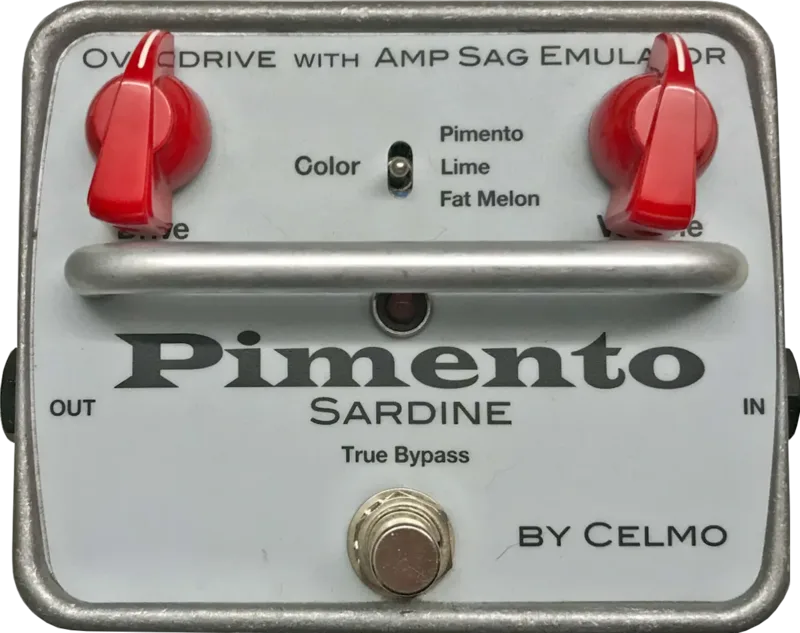



The Celmo Labs Pimento Sardine is a hand-crafted overdrive pedal made in France by Celmo Labs, a company the press describes as relatively small, with just a few effects pedals under its belt1. Its distinguishing feature is an analog sag-emulation circuit called E.A.S.E. (Enhanced Analog Sag Emulator), which RockBoard's PedalPedia says imparts a vintage flavor with strong note-to-note clarity and an expressive response rather than heavy distortion1. True to its name, the pedal sits in a brushed-metal style box resembling a sardine can1.
A sag-emulating overdrive in a sardine-can box
Most overdrives shape tone with clipping and EQ. The Pimento Sardine's hook is different: it emulates the sag of a tube amplifier's power supply, the compression and softening that happens when an amp is pushed hard. RockBoard's PedalPedia describes the result as a vintage flavor with strong note-to-note clarity and an expressive response rather than heavy distortion1. Players looking for a conventional comparison point can see how it sits among other Overdrive Pedals, or against more distortion-focused designs in Distortion Pedals and Fuzz Pedals.
Premier Guitar's reviewer described the housing as a medium-sized, brushed-metal box with two red chicken-head knobs and a three-position switch2. On the circuit inside, the reviewer wrote that "the Pimento uses an enhanced analog sag emulation technology (predictably called EASE)"2.
The controls: Drive, Volume and the Color switch
The pedal keeps things simple: two knobs and one switch1.
| Control | What it does |
|---|---|
| Drive | Sets the amount of drive2 |
| Volume | Sets the output level2 |
| Color switch: Fat Melon | Carves away some of the highs and boosts lows2 |
| Color switch: Lime | Accentuates the upper frequencies2 |
| Color switch: Pimento | Adds midrange focus2 |
RockBoard's PedalPedia describes the three-position Color switch as altering the pedal's tonal character, with settings named Fat Melon, Lime and Pimento1. In practice, that gives players three fixed voicings, from darker and fuller to brighter to mid-forward, without a tone knob to fiddle with.
Power and bypass
The Pimento Sardine runs on 9V DC, center negative, and draws 5 mA1. That low draw means it sits easily on any standard pedalboard power supply. The pedal includes true-bypass switching, so its circuit drops out of the signal path when off1.
What the press said
Premier Guitar reviewed the pedal in June 2023, listing a street price of $1852. The reviewer's verdict on the E.A.S.E. circuit:
"The EASE technology seems to deliver true amplifier grit, and it imparts a distinctly vintage flavor. There's buttery sm"
The reviewer summed up the pedal as "Good for boosting or set-it-and-forget-it crunch"2. In other words, the reviewer found it at home either as a boost in front of another drive or amp, or as a single crunch stage set once and left alone, rather than a pedal players reshape constantly.
Videos
La Chaîne Guitare
Michel Geiss
Midi Music Toulouse
Questions
Is the Celmo Pimento Sardine true bypass?
Yes. The maker's listing states the pedal includes true-bypass switching, and Premier Guitar's reviewer likewise described the true-bypass footswitch. That means the pedal's circuit is removed from the signal path when it is off, so it should sit cleanly on a board without loading down your guitar's signal.
What does E.A.S.E. stand for on the Pimento Sardine?
E.A.S.E. stands for Enhanced Analog Sag Emulator, according to the maker's listing. It is an analog circuit that emulates the sag of an amplifier, and the maker says it imparts a vintage flavor with strong note-to-note clarity and an expressive response rather than heavy distortion.
Where is the Celmo Pimento Sardine made?
France. The maker's listing describes it as a hand-crafted overdrive pedal made in France by Celmo Labs, and Premier Guitar's review likewise calls it hand-crafted in France. Celmo is described by the reviewer as a relatively small company with just a few effects pedals.
What do the Fat Melon, Lime and Pimento settings do?
They are the three positions of the Color switch, which alters the pedal's tonal character. Premier Guitar's reviewer found that Fat Melon carves away some of the highs and boosts lows, Lime accentuates the upper frequencies, and Pimento adds midrange focus.
Sources (2)
- Pimento Sardine by Celmo labs, RockBoard PedalPedia, 2026
- Celmo Pimento Sardine Overdrive Review, Premier Guitar, 2013-09-08