| Most common requirement | 9V DC, center negative ("BOSS style")2 |
| Other common voltages | 12V, 18V and 24V DC; a few pedals, like the Line 6 DL4, need 9V AC2 |
| Typical analog pedal draw | less than 100 mA2 |
| Typical digital pedal draw | 200 mA to 1000 mA2 |
| Golden rule | supply voltage must match pedal voltage, or the pedal may be damaged1 |
Powering a pedalboard means feeding every pedal on the board the voltage, current and polarity it was designed for, from one organized power system instead of a pile of wall warts. Get it right and the board is quiet and reliable. Get it wrong and you get hum, buzz, pedals that cut out, or in the worst case damaged circuits. EarthQuaker Devices puts the core rule plainly: "You want to always ensure the voltage from your power supply unit (PSU) matches the voltage of the pedal. Not doing so may damage the pedal."1
The decisions that matter are three. First, what each pedal needs: most want 9V DC with a center negative plug, but 12V, 18V, 24V and even 9V AC pedals exist. Second, how much total current your board draws, since digital pedals in particular are hungry. Third, whether you share power across a daisy chain or give each pedal an isolated output. This page walks through each of those, the hardware involved, and the noise problems that show up when something is mismatched. For the bigger picture of laying out a board, see How to Build a Pedalboard.
What each pedal needs: voltage, current and polarity
Three numbers describe a pedal's power requirement, and all three appear in the pedal's manual or product page.
Voltage is the electrical pressure the pedal expects. Most pedals take 9V DC, but JHS Pedals notes that "a few other common power requirements" include 12V, 18V and 24V DC, and some pedals, like the Line 6 DL4, require 9V AC power2. AC and DC are not interchangeable: a pedal built for DC will not run correctly on an AC adapter and vice versa. Some pedals accept a wide range. The 29 Pedals FLWR "will accept 7.5 to 35 volts of AC or DC in either polarity with absolutely no change in tone or power to the circuit"3, and the Master Effects DC3 uses a standard boss-style 9 to 18V power supply4. But range tolerance is a feature of specific designs, not a general rule.
Current, measured in milliamps (mA), is how much the pedal actually consumes. A supply must deliver at least this much; more is fine, less is not. A pedal will not "use up" extra current, it simply draws what it needs. The Master Effects Super Four Hundred, for example, uses a standard boss-style 9V power supply (2.1mm, center pin negative) and requires a minimum of 150mA5.
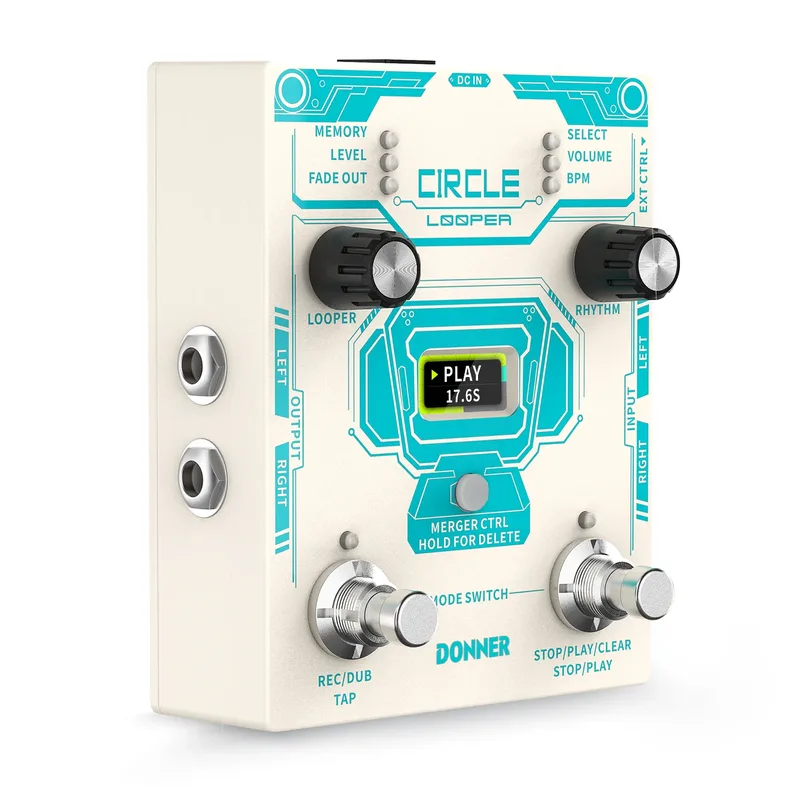
Polarity describes which part of the barrel plug is positive and which is negative. The industry standard, set by BOSS-style pedals, is 9V DC with a center negative 2.1mm plug. Donner states the same requirement from the other direction for its Circle Looper: "a voltage of DC9V, an internal negative and external positive polarity, and a current of 500mA or more"67. Plugging a center positive supply into a center negative pedal can damage it, which is why polarity reversing adapter cables exist.
| Requirement | Typical value | Where to find it |
|---|---|---|
| Voltage | 9V DC most common; 12V, 18V, 24V DC and 9V AC also exist2 | Pedal manual or product page |
| Current draw | Under 100 mA for most standard pedals; 200 to 1000 mA for digital2 | Pedal manual or product page |
| Polarity | Center negative, 2.1mm barrel (BOSS style)2 | Pedal manual or product page |
The parts: supplies, cables, adapters and mounting
A pedalboard power system has a few building blocks.
- Power supply: the unit that converts wall AC into pedal-friendly DC. Options range from a single 9V adapter to multi-output brick supplies.
- Daisy chain cable: one plug that fans out to several barrel connectors, letting one supply feed several pedals8.
- Adapter cables: Tech 21 notes that as pedalboards grew, "high power switching power supplies with daisy chains, adapter cables to reverse polarity or change the voltage" appeared89. These let one supply serve pedals with different plug sizes, polarities or voltages.
- Current doubler: for pedals with higher power requirements, the Voodoo Lab PPAP Current Doubler Adapter "accepts any cable with a 2.1mm plug" and combines two Pedal Power outputs into one10.
- Mounting hardware: supplies are fixed to the board with brackets or dual lock. Aclam's Power Supply Support is a dedicated mounting accessory for pedalboards11, and Vertex makes an AC power module that "makes it easy to connect two independent power supplies on your pedalboard, eliminating the need" for multiple external AC cords12.
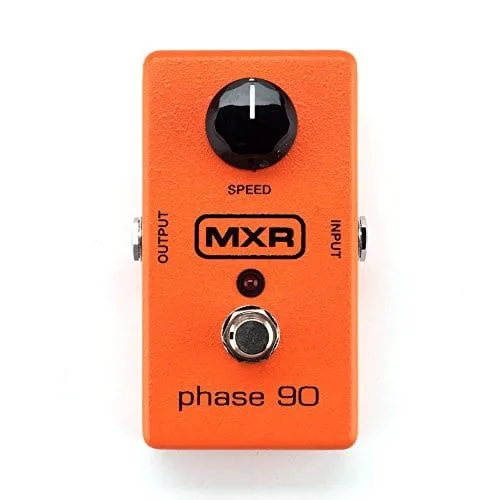
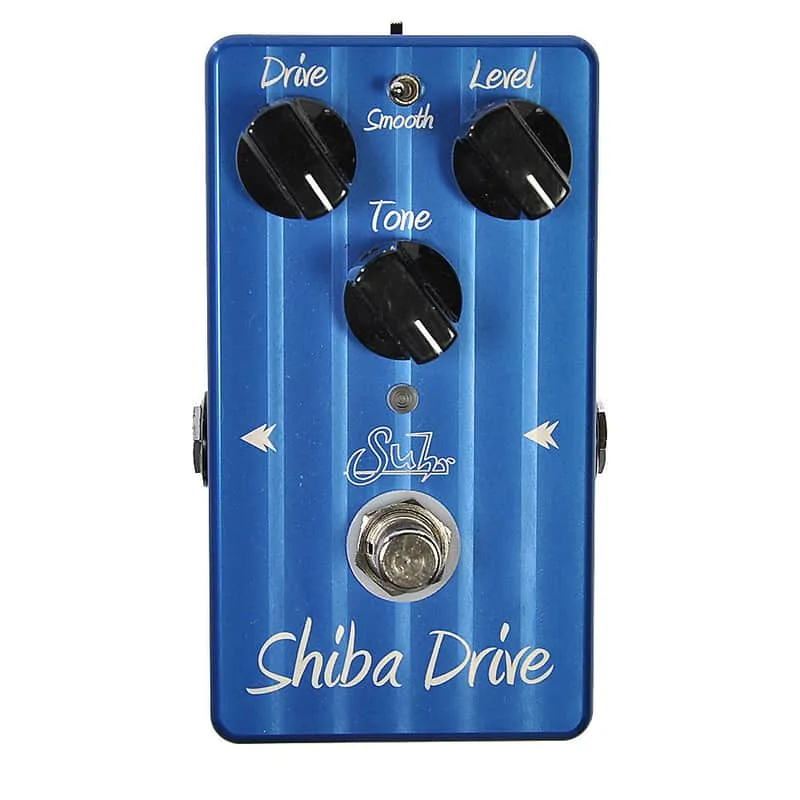
Many pedals also run on a 9V battery. Dunlop's MXR range, including the Phase 90, can be powered by "a 9-volt battery, a Dunlop ECB003 9-volt adapter, or the DC Brick, Iso-Brick, and Mini Iso-Brick"13. Some pedals power up the moment a cable is plugged into the input jack, as Suhr notes for the Shiba Drive: "Connecting a cable to the input jack will power up the pedal"14, so a pedal left patched in will drain its battery even when unused.
Installing the supply
West Coast Pedalboard lays out the installation sequence15:
- Mount the supply using a mounting kit, either brackets or dual lock.
- Connect the power cable before permanent mounting.
- Run cables loosely at first.
- Test the whole rig.
- Secure cables with a cable clamp kit.
One adapter or many: daisy chain versus isolated power
These are the two main architectures, and the choice drives both cost and noise.
Daisy chain power
A daisy chain connects several pedals to one supply through a single cable. Tech 21 calls it an "economical way to power multiple pedals from a single supply," and notes that switching versions can run on 100-250VAC worldwide89. Often the chain starts from a spare output on a pedal you already own: "Often, the chain's main source is the extra female jack on the good ol' tuner pedal"16.
The limitation is electrical. As Voodoo Lab's Darrin Fox explains, "Daisy chains force every pedal in your rig to share a single electrical path. That means they share the same ground and" the same noise floor17. There is also a hard compatibility limit: "Any pedal needing to see a positive ground CANNOT be daisy chained with standard 'boss-type' neg-tip adapters (which 99% of effects use)"16. Vintage-style positive ground fuzz circuits fall in this group.
Isolated multi-output supplies
An isolated supply gives each output its own separate power source. Voodoo Lab describes the benefit directly: "True isolation effectively gives every pedal on your board its own dedicated power source"17. On the product side, the Pedal Power 2 PLUS "isolates every output," which "eliminates tone-robbing interaction between other effects" by breaking unwanted ground paths9. Tech 21 lists the familiar examples: "Pedal Power, Dunlop DC Brick, Cioks and others"89, and Voodoo Lab's current lineup includes the Pedal Power 3, 3 Plus, X4 and X817.
Isolation costs more than a daisy chain, but it is the standard answer for larger boards, mixed analog and digital pedals, and any rig where hum is a problem.
Isolated outputs do not make a pedal louder or better sounding. They prevent noise and ground interaction between pedals. If your board is small, all-analog and quiet on a daisy chain, isolation may solve a problem you do not have.
Digital pedals and current
Digital pedals are the main reason current planning matters. Tech 21 warns that "Digital pedals, however, consume much more power (80mA and above) and you may find out at the worst possible moment" that a supply or battery cannot keep up189. On batteries the situation is worse: a digital pedal can drain one "in about an hour"18. JHS Pedals gives the planning numbers: "most standard pedals require less than 100 mA. Digital pedals often require a much higher current to operate correctly," generally 200 mA to 1000 mA2.
Supplies exist for exactly this case. The Voodoo Lab Pedal Power Digital is "a linear (analog) power supply for high-current DSP-based pedal effects and accessories"19. Notably, it is not a digital switching supply despite the name: Voodoo Lab says it "keeps pedals free from high-frequency noise that occurs with digital 'switching' power supplies"19. The Pedal Power 2 PLUS likewise "uses an audiophile quality linear supply for consistently stable, clean, pure power"9. Linear supplies are heavier and cost more to build than switching supplies, which is part of what you pay for in an isolated brick.
To size a supply, add up the current draw of every pedal (from each manual) and compare the total, and each individual output, against the supply's ratings. A pedal like the Blackstar ID:X Floor, which "uses a standard 9V 500mA pedalboard friendly power supply"20, needs an output rated for that full 500 mA, not a typical 100 mA output.
Common power problems and their causes
Hum and buzz. General Guitar Gadgets identifies the core issue: "The main problem is hum and buzz noise added to the audio signal in some pedals or situations," and advises that "the power supply should be well filtered and regulated," noting that most wall warts are not21. A cheap unregulated adapter is the most common source of power noise on a small board.
Ground loops and stacking drives. Shared grounds on a daisy chain let noise circulate between pedals, and "stacking drive pedals with a daisy chain can boost the hum"8. Isolated outputs break those paths9.
Underpowered pedals. A pedal asked to run on less current than it needs may work until it does not: digital pedals in particular can fail mid-gig18. Symptoms include LEDs dimming, screens glitching or the pedal resetting. The fix is an output with enough rating, or a current doubler combining two outputs22.
Wrong voltage or polarity. Mismatched voltage can damage the pedal outright1. Reversed polarity can do the same; check the barrel symbol printed near the jack before plugging in an unfamiliar adapter.
Positive ground pedals. Vintage-style fuzz circuits that need a positive ground cannot share a standard daisy chain with negative tip pedals at all16. These need their own isolated output or a battery.
Batteries remain an option, and a quiet one. Tech 21 calls them "by far the easiest, and quietest, way to power your pedals"189. The tradeoffs are cost over time, environmental waste, and the drain from pedals that power up when a cable is plugged in14.
A note on unusual power designs
Not every pedal fits the standard model. Creation Audio Labs' FUNKULATOR includes "a built-in power boosting circuit that takes standard 9V pedal power and steps it up to 36V or even 72V for headroom"23, meaning it accepts ordinary 9V while running its internal circuit at much higher voltage. Pedals like this are why reading the manual before buying a supply matters: the label on the jack does not always tell the whole story of what the circuit does with the power it receives.
For how power fits into the wider picture of connecting a board, see Pedal Signal Chain Order and True Bypass and Buffers.
Pedals on this page
Questions
Can I use one power adapter for all my pedals?
Yes, if the total current draw of every pedal stays within what the adapter can deliver and the pedals all want the same voltage and polarity. A daisy chain does exactly this, and it is the economical option. The tradeoff is that all the pedals share one ground and one noise floor, which can introduce hum, and JHS Pedals warns daisy chaining can even damage some pedals over time.
What does isolated power mean for guitar pedals?
An isolated supply gives every pedal its own dedicated power source, with each output separated from the others. Voodoo Lab describes this as breaking unwanted ground paths and eliminating tone-robbing interaction between effects. Examples include the Voodoo Lab Pedal Power series, the Dunlop DC Brick and Cioks supplies. It costs more than a daisy chain but keeps noise from jumping between pedals.
How do I know how much current my pedals need?
Check each pedal's manual or product page for its current draw in milliamps, then add them up and compare with what your supply's outputs can deliver. As a rule of thumb from JHS Pedals, most standard pedals require less than 100 mA while digital pedals generally require 200 mA to 1000 mA. Always give a pedal at least what it asks for, and more headroom is fine.
Why do my pedals hum when I use a daisy chain?
A daisy chain forces every pedal to share a single electrical path, the same ground and the same noise floor, so ground loops and power noise travel through the whole board. Stacking drive pedals on a daisy chain can boost the hum further. Poorly filtered wall warts add their own buzz. Isolated outputs break those shared ground paths and usually quiet things down.
Can I power a 9V pedal with an 18V supply?
Only if the pedal is built for it. EarthQuaker Devices warns that the voltage from the supply must match the voltage of the pedal, and that not doing so may damage the pedal. Some pedals accept a range, like the Master Effects DC3, which takes a 9 to 18V supply, and the 29 Pedals FLWR, which accepts 7.5 to 35 volts AC or DC. Check the manual first.
Do digital pedals need more power than analog pedals?
Yes, generally. Tech 21 notes that digital pedals consume much more power, 80mA and above, and can drain a battery in about an hour, while analog pedals sip power by comparison. JHS Pedals puts typical digital pedals at 200 mA to 1000 mA. Supplies built for high-current DSP pedals, like the Voodoo Lab Pedal Power Digital, are designed around this need.
Sources (23)
- A Beginners Guide To Pedalboards Pt. 2 : Those Boards Don’t Work, Unless You Have Power!, EarthQuaker Devices, 2022-05-23
- HOW TO POWER PEDALS, JHS Pedals
- 29 Pedals FLWR, 29 Pedals (Believable Audio)
- DC3 | Marshall JCM800 preamp | Master Effects, Master Effects
- Super Four Hundred, Master Effects
- Circle Looper Guitar Pedal with Drum Machine Time Display Donner, donnerdeal.com
- Voes | Midi Controllers, Voes, 2026
- Power Struggle #3: Pedalboards, Tech 21 NYC, 2021-03-08
- Pedal Power® 2 PLUS, Voodoo Lab
- Voodoo Lab PPAP {|} Current Doubler for Pedal Power Supplies, westcoastpedalboard.com
- Power_supply_support_universal.pdf, Aclam Guitars, 2024
- Vertex AC Power Module for MKII Pedalboards, Vertex Effects (vertexeffects.com)
- MXR® PHASE 90, Dunlop (jimdunlop.com)
- Suhr-Shiba-Drive-Pedal-Manual-070924.pdf, Suhr (JS Technologies, Inc.), 2024-07-09
- What pedalboard power supply do I need? 9 Ways To DIY, westcoastpedalboard.com, 2019-08-13
- Power Supplies, Wren and Cuff Effects
- The Complete Guide to Powering Your Pedalboard, Voodoo Lab, 2026-06-24
- Power Struggle #1: Batteries, Tech 21 NYC, 2021-03-08
- Pedal Power Digital, Voodoo Lab, 2026-10-14
- ID:X Floor, Blackstar Amplification (blackstaramps.com), 2026-10-05
- How to Add a 9V Power Jack to a Guitar Pedal, generalguitargadgets.com, 2014-05-22
- Current Doubler Adapter, Voodoo Lab
- Creation Audio Labs, Creation Audio Labs