

The Chase Bliss Audio Condor is an analog EQ, preamp and filter pedal with a 100% analog signal path under digital control, giving it presets, MIDI and ramping movement that a purely analog pedal cannot manage1. Released on April 16, 2018 at $3491, it was announced at NAMM 2018 as Chase Bliss Audio's new EQ pedal2, and it covers a lot of ground for one box: EQ, overdrive, boost, tremolo and filter tones2.
The original Condor is now discontinued3, but the design returned in 2024 as the Condor HiFi, an updated version with new components and a redesigned faceplate45.
The original Condor is discontinued3. The Condor HiFi launched in 2024 at $399, and owners of the original could upgrade for $49 by sending their units to Chase Bliss7. Guitar World reported 2,000 HiFi pedals would be made, with the first 1,000 built and ready to ship8.
What the Condor does
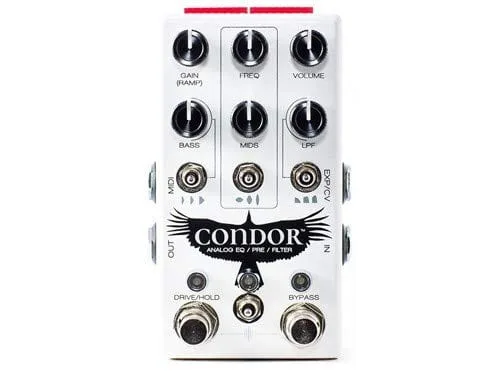
The Condor is a tone-shaping pedal first and foremost. Its EQ section is built around a parametric mids control that boosts or cuts from 150Hz to 5kHz with three Q settings, a bass boost/cut control with three intensity settings, and a low-pass filter with three settings: normal, slight resonant, and very resonant1. On top of the EQ sits a preamp that is switchable between clean and overdrive modes1, so the pedal can serve as a clean boost, an EQ station, or a drive voice.
MusicRadar described the range at launch: "Offering clean and overdrive tones, the Condor - as its name suggests - packs a host of EQ controls for honing tones"9.
The controls
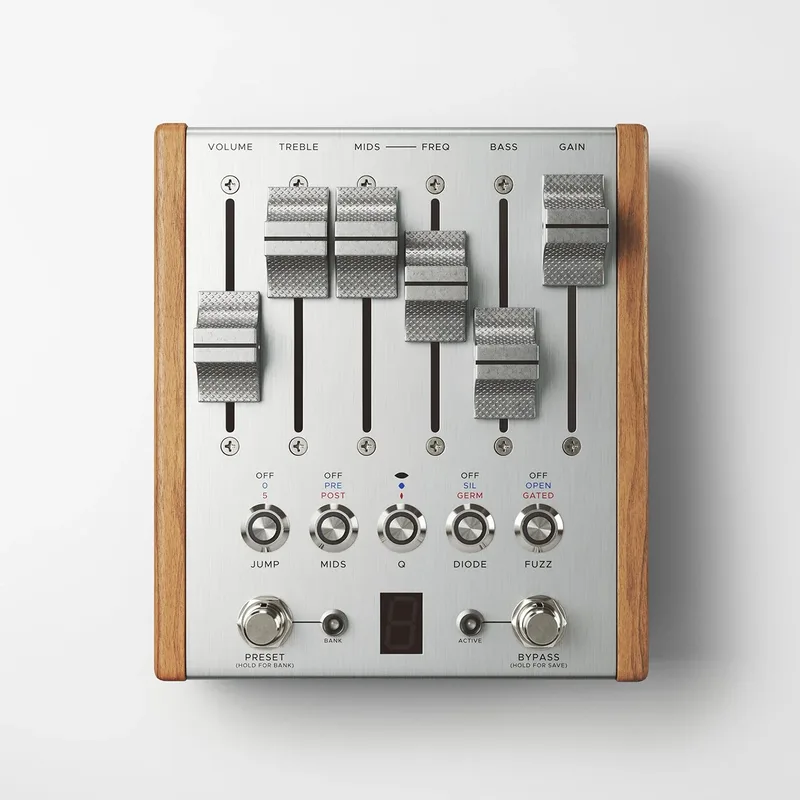
The HiFi edition carries six dials: gain, frequency, volume, bass, mids, and LPF8. The Freq knob selects which mid frequency the Mids control acts on, and the Mids control can apply 18dB of boost or cut at that frequency6. There are two footswitches, one for drive/hold and one for bypass8.
| Control | What it does |
|---|---|
| Gain | Sets drive level, from clean boost to crunch7 |
| Freq | Selects the mid frequency for the Mids control6 |
| Mids | Parametric boost/cut, up to 18dB, 150Hz to 5kHz61 |
| Bass | Pre-gain bass boost/cut with three intensity settings16 |
| LPF | Low-pass filter, three resonance settings1 |
| Volume | Sets output level8 |
How the controls interact matters as much as what they do. The bass control sits before the gain stage, so pushing it hard drives the pedal harder, while the mids and LPF sit after the gain stage4. Chase Bliss suggests going heavy with the pre-gain bass control to really push the pedal, or using the post-gain mids and LPF to give your sound "resonant punch"6.
Pedal of the Day's reviewer put the mids at the center of the pedal's appeal:
"Condor's parametric mids are the key. Freely sweep the frequency spectrum and find the sweet spot to push, scoop or slice to make everything sit just right."
Drive, boost and tremolo
The HiFi's drive section dials in a clean boost, grit, or saturated crunch, with a gain section that works alongside the EQ to change the drive character7. Pedal of the Day described the drive circuit as interacting with the EQ blocks, "for everything from a sparkly boost to full-on soaring crunch"4.
Tremolo is not a dedicated mode, but the original Condor's ramping and hold functionality produces LFO filter tremolo effects1, and Chase Bliss's support material suggests using the Volume control to create tremolo effects10. Players looking for a dedicated unit can compare tremolo pedals, but the Condor can get tremolo-style movement out of its own controls.
MIDI, expression and CV
The digital control layer is what separates the Condor from a straightforward analog EQ. It offers MIDI, CV and expression pedal control, presets, and internal modulation of any or all of its knobs4. An internal memory banks presets8. For players building a rig around control, this puts the Condor in the same conversation as other MIDI pedals and works with an expression pedal for real-time sweeps.
Condor and Condor HiFi
The Condor HiFi, released in 2024, is a modern update of the original tone-shaping pedal65. According to Pedal of the Day, the HiFi was partly a fix for a distortion artifact in the original, though that design also had a "sweet spot" when the headroom was lowered far enough11.
The HiFi changes break down into three areas:
- Op-amps: Built around OPA1662 op-amps, which lower the overall noise level throughout the circuit and create a characteristically contrasting clipping sound to the original654
- Power: The power supply is swapped for the one from the Chase Bliss Preamp MKII, which internally boosts the voltage up to 30V and offers increased headroom54
- Design: A slightly arty, minimalist faceplate redesign5
Guitar World reported that the OPA1662 op-amps "pack a higher fidelity sound whilst minimizing noise and providing an entirely different clipping character"8, and gearnews described the result as cleaner and more dynamic, with more headroom and dynamic range than the original5.
Guitar Pedal X's Stefan Karlsson offered a practical verdict on who the upgrade serves:
"If you mainly use the EQ and Filter elements - then the newer lower noise, smoother breakup and higher headroom HiFi edition is actually a really decent upgrade."
Pedal of the Day's reviewer called the HiFi's sound "vivid character where you need it and absolute transparency where you don't"4, built around the OPA1662 op-amp for lower noise and a more high-fidelity response than the original4.
Where the Condor sits in the Chase Bliss lineup
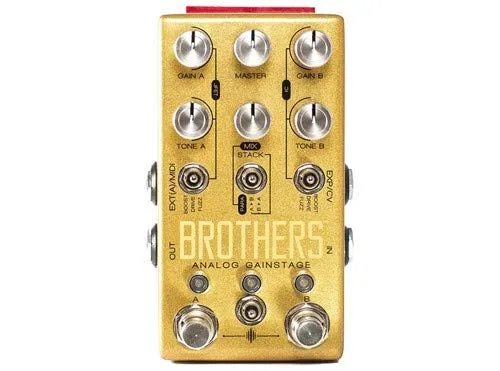
The Condor's combination of analog signal path with digital control, presets and MIDI follows the pattern Chase Bliss established with pedals like the Brothers1. Guitar World has grouped the Condor alongside the Thermae and Dark World as pedals that "helped affirm Chase Bliss' reputation as one of the most forward-thinking pedal outlets currently around"13. For players comparing categories, the Condor overlaps with EQ pedals, preamp pedals, filter pedals and boost pedals, doing a share of each job in one programmable box.
Videos
Knobs
chase bliss
chase bliss
News
Questions
Is the Chase Bliss Condor discontinued?
Yes. The original Condor, released in April 2018, is now discontinued. Chase Bliss brought the design back in 2024 as the Condor HiFi, an updated version with OPA1662 op-amps, a lower noise floor and more headroom. Owners of the original could send their units in for a $49 upgrade.
Is the Condor true bypass or buffered?
The original Condor lets you choose. A dip switch inside the pedal selects either true bypass or buffered bypass, so you can set it to suit the rest of your pedalboard. The HiFi edition carries the same selectable bypass approach.
Can the Condor do tremolo?
Yes, in a roundabout way. The original Condor has ramping and hold functionality for LFO filter tremolo effects, and Chase Bliss's own support material suggests using the Volume control to create tremolo effects. It is not a dedicated tremolo pedal, but tremolo-style movement is within reach.
Does the Condor have an overdrive mode?
Yes. The original Condor is switchable between clean and overdrive modes, and the HiFi edition has a drive section that goes from a clean boost through grit to saturated crunch. The gain section works with the EQ to change the drive character.
What op-amps does the Condor HiFi use?
The Condor HiFi is built around OPA1662 op-amps. According to press coverage, these lower the overall noise level throughout the circuit and produce a clipping character that contrasts with the original Condor's.
What is the difference between the Condor and the Condor HiFi?
The HiFi swaps in OPA1662 op-amps for lower noise and a different clipping character, and uses the power supply from the Chase Bliss Preamp MKII, which internally boosts voltage up to 30V for more headroom. It also gets a minimalist faceplate redesign. Otherwise the EQ, filter and drive concept carries over.
Sources (13)
- Chase Bliss Audio Condor Analog EQ, Delicious Audio, 2018-05-29
- Joel Korte's Demo Of The Chase Bliss Audio Condor EQ At NAMM 2018, Delicious Audio, 2018-01-30
- Review: Chase Bliss Audio Automatone CXM 1978, Guitar.com, 2021-01-27
- Chase Bliss Condor HiFi Analog Tone Bird, Pedal of the Day, 2024-03-03
- Meet the cleaner and more dynamic Chase Bliss Condor Hi-Fi, gearnews.com, 2024-02-22
- “Part EQ, part filter, and part overdrive, it's all there… a 100% analogue, all-in-one solution to crafting your core tone”: Chase Bliss's Condor HiFi takes flight, MusicRadar, 2024-02-23
- Bored of your 'board? Stomp this way for the must-have new guitar effects pedals of 2024, MusicRadar, 2024-03-28
- “An all-in-one solution to crafting your core tone”: The Chase Bliss Condor HiFi is the next generation of its “weird little EQ pedal” that it hopes you'll never want to turn off, Guitar World, 2024-02-26
- NAMM 2018: Chase Bliss Audio introduces Condor Analog EQ / Pre / Filter pedal, MusicRadar, 2018-01-16
- Pilot Wave™, StepAudio.net
- Chase Bliss Dirt Bird Limited Edition Overdrive Distortion, Pedal of the Day, 2025-06-14
- Guitar Pedal X, Guitar Pedal X, 2024-02-22
- “There's so much we are working on, I'd rather keep my eyes forward. We'll ultimately emerge stronger”: Why Chase Bliss has been forced to discontinue 5 of its finest pedals, Guitar World, 2024-09-19