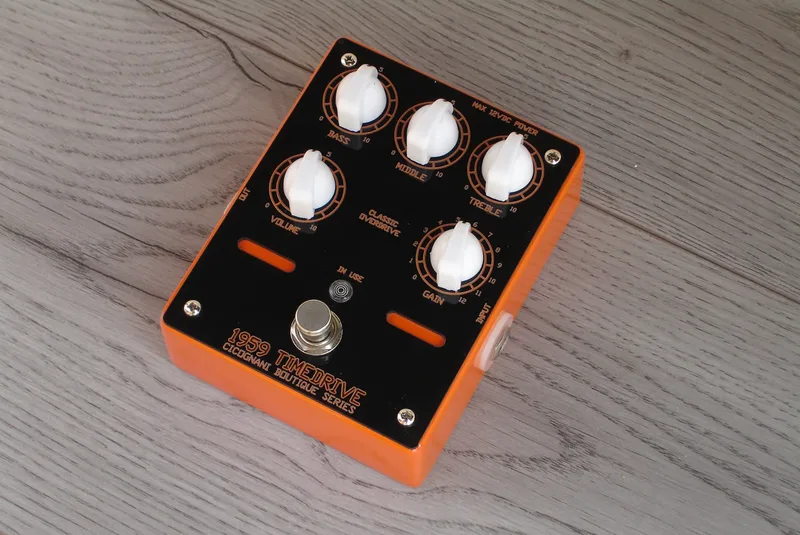


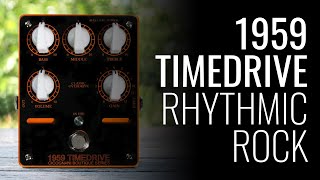
The Cicognani Engineering 1959 TIMEDRIVE is an overdrive pedal built around the sound of one amplifier: the 1959 Marshall Plexi. The maker describes it as taking its inspiration from "the legendary British OD tone of the 1959 Marshall Plexi," offering the dynamic response and warmth of tone typical of those classic British amplifiers, reproducing their saturation characteristics and signal dynamics at high volumes even at low playing levels1.
It is a low to mid-gain design with a second use: the maker says the TIMEDRIVE "ranges from low to mid-level gain and can be used as both a signal booster and an overdrive pedal"1. Players comparing overdrives in this territory can also see our Overdrive Pedals page, or the Boss SD-1 vs Ibanez TS9 Tube Screamer comparison for two common reference points.
The 1959 TIMEDRIVE has been discontinued. This pedal has been discontinued by Cicognani Engineering"1.
What it does to your sound
Cicognani Engineering describes the pedal as capturing the saturation characteristics and signal dynamics of classic British amplifiers at high volume, but at levels that work on a pedalboard or in a bedroom setup. In the maker's words, it offers "a dynamic response and warmth of tone typical of those classic amplifiers"1. The gain range is deliberately limited: this is not a high-gain distortion pedal, but a low to mid-gain circuit that can also push an amp as a booster1.
The features the maker highlights, in its own terms:
- Inspiration from "the legendary British OD tone of the 1959 Marshall Plexi"1
- Saturation characteristics and signal dynamics of classic British amplifiers at high volume, reproduced at low playing levels1
- Usable as both a signal booster and an overdrive pedal1
- 3-band active tone stack calibrated for the Plexi sound1
- Twin parallel input buffer for high or low impedance signals1
- 24 VDC internal voltage doubling for headroom and low noise1
- Mechanical true bypass switching1
Controls and circuit
The pedal's tone shaping comes from a 3-band active tone stack. The maker says it is "specially calibrated to capture the best sound details of the classic Plexi"1. An active tone stack, unlike a passive one, can cut and boost each band, which gives more range over bass, mids and treble than the simple tone control on many overdrives.
A second distinguishing feature is on the input side. The maker describes "a unique twin parallel input buffer that accepts high or low impedance signals with equal aplomb"1. In practice, that means the pedal is designed to take either a typical guitar signal or a lower-impedance source without the input loading changing the tone, and buffers of this kind sit in the wider family of Buffer Pedals.
Power and bypass
The TIMEDRIVE runs on 24 VDC internally, achieved by voltage doubling from its external supply. The maker says this "provides maximum headroom and dynamic response while providing low-noise performance," including at high gain settings1. Higher internal voltage gives the circuit more room before it clips, which the maker ties to the pedal's dynamic response.
Bypass is mechanical true bypass. The maker states that this "makes sure you bypassed signal remains clean and unaltered when the effect is OFF"1, so the pedal stays out of the signal path entirely when switched off.
| Specification | Detail |
|---|---|
| Effect type | Overdrive, also usable as a signal booster1 |
| Gain range | Low to mid-level gain1 |
| Tone section | 3-band active tone stack1 |
| Input stage | Twin parallel input buffer, high or low impedance1 |
| Internal voltage | 24 VDC, doubled from the external supply1 |
| Bypass | Mechanical true bypass1 |
| Status | Discontinued1 |
Related Cicognani pedals
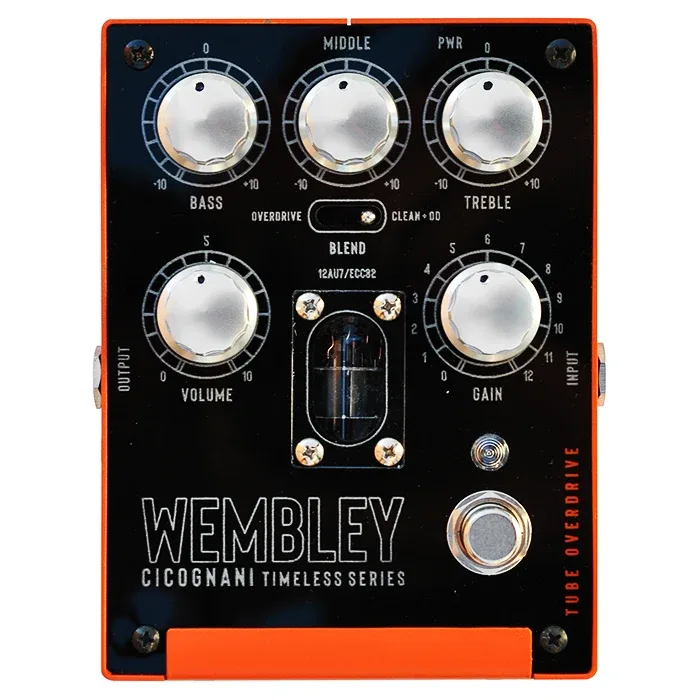
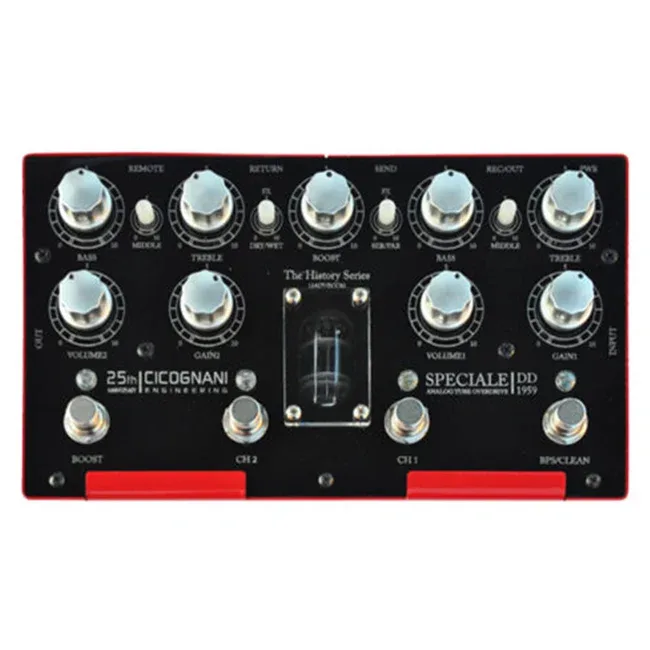
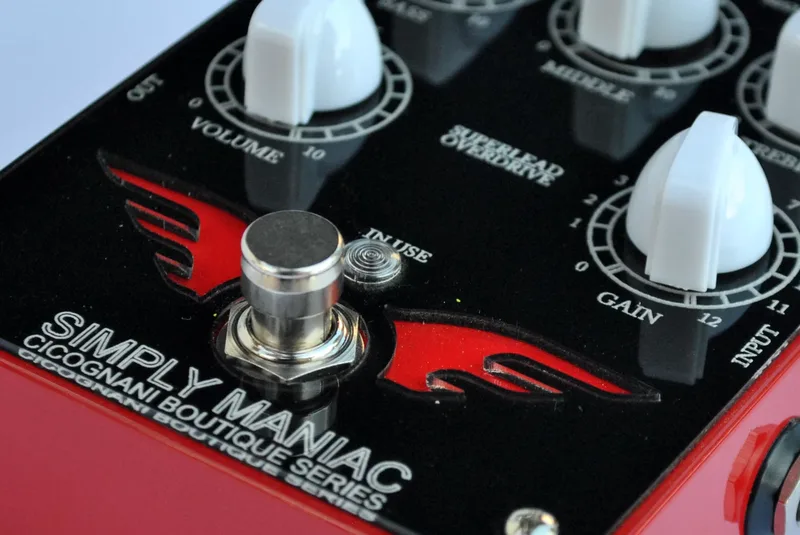
Cicognani Engineering built a small range of drive and boost pedals around British amp tones. Others covered on this site include the Cicognani WEMBLEY, the Cicognani SPECIALE DD1959, which shares the 1959 reference in its name, and the SIMPLY MANIAC. Players after heavier textures in the same family of sounds can also look at Distortion Pedals and Fuzz Pedals.
Videos
Cicognani engineering
Cicognani engineering
Cicognani engineering
Questions
Is the Cicognani 1959 TIMEDRIVE true bypass?
Yes. According to the maker, the pedal uses mechanical true bypass switching, which keeps the bypassed signal clean and unaltered when the effect is off. That means when the pedal is engaged it shapes your tone, and when it is off your guitar signal passes through the switching without the overdrive circuit in the path.
Can the Cicognani 1959 TIMEDRIVE be used as a booster?
Yes. The maker describes the TIMEDRIVE as ranging from low to mid-level gain, and says it can be used both as a signal booster and as an overdrive pedal. At its lower gain settings it pushes the front of an amp, while higher settings give it more overdrive character.
Is the Cicognani 1959 TIMEDRIVE discontinued?
Yes. It is no longer in current production, so players looking for one would need to find it secondhand or from remaining stock at dealers.
What voltage does the Cicognani 1959 TIMEDRIVE run on?
The pedal uses 24 VDC internal voltage doubling. The maker says this provides maximum headroom and dynamic response while keeping the pedal low noise, even at high gain settings. The internal voltage is doubled from the external supply, so a standard external power supply powers it.
What amp is the Cicognani 1959 TIMEDRIVE modeled on?
The maker says the pedal takes its inspiration from the legendary British overdrive tone of the 1959 Marshall Plexi. Its 3-band active tone stack is described as specially calibrated to capture the sound details of that classic amplifier.
Sources (1)
- 1959 TIMEDRIVE (British overdrive) *discontinued*, Godlyke Distributing, Inc.